Mounting Positions for Tractor Lights: Roof, Bumper, Fender, and A-Pillar
In this guide
A tractor light mounting position is the specific physical location on the tractor where a work light, headlight, beacon, or auxiliary lamp is fitted. UK farmers and contractors choose between 7 standard positions: cab roof front, cab roof rear, A-pillar, B-pillar, front grille or bumper, fender, and sunroof rear edge. Each position has a measurable trade-off between visibility coverage, vibration exposure, weather load, and ease of installation. This guide covers each position in turn, with mounting heights, bracket choices, sealing requirements, and the type of work each position suits best.
Why Mounting Position Matters
Mounting position determines what the light shows the operator and how long the lamp lasts. A 6,000 lumen LED work lamp fitted in the wrong position lights the wrong area and fails 3 to 5 times faster than the same lamp fitted correctly.
Coverage. A lamp on the cab roof front lights ahead of the tractor for 50 to 100 metres. The same lamp on the rear fender lights only 15 to 25 metres behind. Position changes the work area covered.
Vibration. Lamps on the front grille or bumper sit on the tractor’s stiffest mounting points and absorb 30% to 50% less vibration than lamps on a cab corner. Vibration shortens LED driver life and cracks lens seals.
Weather and dust. Fender lamps sit in the mud and stubble path, exposed to direct impact from clods, stones, and water spray. Cab-roof lamps see only weather and the occasional branch. Position changes the IP-rating requirement.
Drilling and sealing. Some positions (cab roof, sunroof) need sealed bolt holes through structural panels. Others (A-pillar, grille) use clamp-on or bolt-on brackets that need no drilling. Position changes the install effort.
For the broader install context, see How to Mount Work Lights and The Complete Guide to Tractor Lighting.
Cab Roof Front Mounting
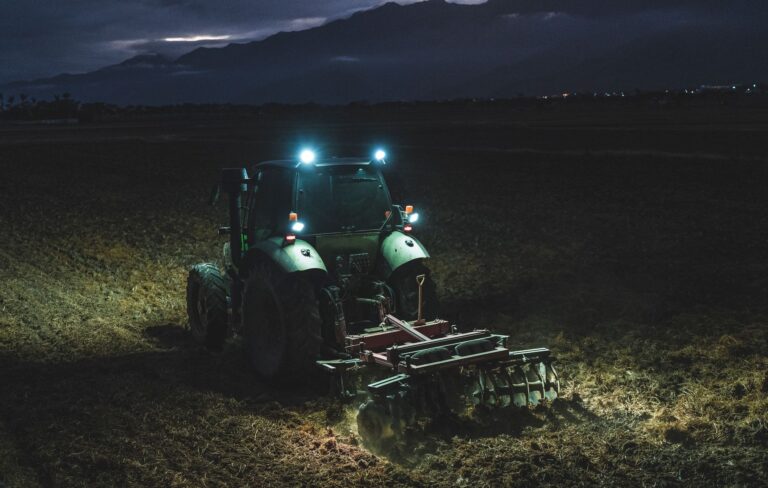
Cab roof front mounting puts work lights on the front edge of the cab roof, typically 2.4 to 3.0 metres above ground. The position gives the widest forward coverage of any mount on the tractor.
Height range. 2.4 to 3.0 metres above ground depending on tractor model. John Deere 6R, 2.7 metres. New Holland T7, 2.8 metres. Massey Ferguson 7700S, 2.6 metres. Fendt 700 Vario, 2.9 metres.
Coverage. Two lamps on the front cab roof cover a 30 to 60 metre forward reach with a 50 to 80 degree horizontal spread. The high vantage looks down on the work area, which gives clean visibility of obstacles, holes, and field margins.
Best for. Cultivating, drilling, road movement at dusk, paddock work where seeing the ground 20 to 40 metres ahead matters more than seeing close-in detail. The high mount minimises shadow under the implement at the front of the tractor.
Bracket type. Pre-drilled OEM bracket on most tractors built since 2010. Bolt holes are factory-supplied with M8 or M10 threaded inserts in the cab roof skin. On older tractors, an aftermarket bolt-on roof bar takes 4 to 6 work lights without drilling.
Drilling considerations. The cab roof skin is typically 1.5 to 2.5 mm steel with a foam interior layer for sound insulation. Drilling a new hole requires a sealing washer and silicone sealant on both sides to prevent water tracking down through the cab headlining. Always drill from outside in, using a step drill to avoid burr.
Drawbacks. Wiring run from the lamps to the relay is 3 to 5 metres, which needs careful loom routing through the cab door pillar. Vibration is moderate; cab roofs flex more than the chassis. The high mount creates back-scatter in fog or heavy dust.
For the cab roof beam choice, see Flood vs Spot Beam and Tractor Work Lights.
Cab Roof Rear Mounting
Cab roof rear mounting puts work lights on the rear edge of the cab roof to light the work area behind the tractor. The position is the standard for ploughing, baling, and any rear-mounted implement.
Height range. 2.4 to 3.0 metres above ground, mirroring the front cab roof position.
Coverage. Two lamps on the rear cab roof cover a 4 to 8 metre wide work area immediately behind the tractor with a 60 to 120 degree flood beam. The high mount looks down on the implement and the soil.
Best for. Ploughing, power-harrowing, drilling, baling, mowing. Any operation where the operator turns to look back at the implement during work.
Bracket type. Pre-drilled OEM bracket on most modern tractors. Aftermarket roof bar fits where no factory mounting exists. On vintage tractors, a bolt-on rear cab corner bracket (90-degree welded steel angle, 4 mm) clamps onto the cab roof rim.
Drilling considerations. Same as front cab roof, with an extra requirement: the rear roof skin often runs over the cab heater or air-conditioning ducts, so drill depth needs careful checking against the OEM workshop manual to avoid puncturing a duct.
Wiring. The rear-cab work-light circuit is pre-wired on most tractors built since 2008. Older tractors need a 4-mm² loom run from the cab interior up through a roof gland fitted with silicone sealant.
Drawbacks. Lights wash the operator’s mirrors if mounted too far inboard. Mount the lamps at least 200 mm out from the cab centreline to keep light off the mirror surfaces.
For the rear-light specific guide, see Tractor Plough Lights and Tractor Tail Lights.
A-Pillar and B-Pillar Mounting
A-pillar and B-pillar mounting puts work lights on the vertical cab posts. The A-pillar runs from the cab roof down to the front fender top; the B-pillar runs from the cab roof down to the rear fender top. Pillar mounts give a side-projecting flood pattern useful for fence-line work, paddock checks, and yard reversing.
Height range. 1.6 to 2.6 metres above ground, depending on whether the bracket clamps near the top or bottom of the pillar.
Coverage. Two lamps on the A-pillars cover the area directly to the side of the tractor (left and right) with a 60 to 90 degree flood spread. The mid-height mount sits at eye level for the operator and matches the natural head-turn line of sight.
Best for. Hedge-cutting (the lamp lights the cutting deck), yard work and reversing, livestock work where the operator needs to see the side of the tractor not the front, fence-line spraying.
Bracket type. Clamp-on pillar mount, typically a 30 to 50 mm internal-diameter rubber-lined steel clamp that bolts around the pillar without drilling. Two clamp halves bolt together with M8 fasteners at 20 to 25 Nm. No drilling required.
A-pillar vs B-pillar. A-pillar is the front pillar, between the windscreen and the door. B-pillar is the rear pillar, between the door and the rear cab window. A-pillar mounts give better forward-side coverage; B-pillar mounts give better rear-side coverage.
Drawbacks. Pillar mounts can interfere with the door swing or with grab-handles. Test the door movement and check the operator’s grab-handle reach before final tightening. The lamp position can dazzle the operator’s peripheral vision if angled inward; aim the lamp 5 to 15 degrees outward from straight ahead.
Cab post strength. Modern ROPS-rated cab pillars are 4 to 6 mm wall steel and easily carry a 2 kg work lamp on a clamp. Vintage tractors with thinner cab posts may need a clamp-on with a wider load-spreading plate.
For yard and reversing work, see Tractor Reversing Lights.
Front Grille and Bumper Mounting
Front grille and bumper mounting puts work lights on the front of the tractor below or alongside the headlights. The position gives long forward reach and minimum vibration thanks to the rigid front-end structure.
Height range. 0.6 to 1.2 metres above ground, well below the headlight centreline.
Coverage. Two lamps on the grille cover 80 to 200 metres of forward reach with a narrow combo or spot beam. The low mount throws light below the fog layer and gives less back-scatter than high-mount lamps in mist.
Best for. Front loader work (lights show the bucket and the working face), road movement at low ambient light, fog or mist conditions, front-mounted implement work.
Bracket type. Bolt-on weight-frame bracket using existing front-weight mounting bolts (M16 or M20 on most modern tractors). Bumper-mount brackets bolt to the front bumper or weight carrier. Some tractors have purpose-built front auxiliary mounting plates from the factory.
Drilling considerations. Most positions use existing threaded holes, no drilling needed. Where drilling is required, the front weight carrier is 6 to 10 mm thick steel and needs a sharp HSS bit at low speed.
Wiring. Wiring runs from the lamps along the front chassis rail, behind the front grille, and up to a relay near the battery. Loom run is 1 to 2 metres on most tractors. Use cable ties every 200 mm and avoid the radiator hoses, the turbo housing, and any moving steering link.
Drawbacks. Low mount catches mud, stones, and snow. Lens damage is more common than on high-mount lamps. IP67 rating with tempered glass lens is essential. Heavy front loader use can knock lamps off-aim or damage brackets; consider stone guards.
For the front loader application, see Tractor Headlights.
Front and Rear Fender Mounting
Fender mounting puts work lights on the rear of the front mudguards or the rear of the rear mudguards. The position is common on vintage tractors, on tractors without ROPS cabs, and on telehandlers where cab roof space is limited.
Height range. 1.5 to 2.0 metres above ground (rear fender), 1.0 to 1.4 metres (front fender).
Coverage. A rear fender lamp covers a 4 to 6 metre work area immediately behind the rear wheel. The flatter angle of incidence reveals soil texture and depth more clearly than the high cab-roof angle.
Best for. Vintage and open-cab tractors without a cab roof to mount on. Compact tractors and ride-on machines. Plough work where a flat angle on the soil shows ploughing depth changes. Telehandlers needing a rear flood for reversing.
Bracket type. Bolt-on fender bracket using existing fender bolts or a clamp-on bracket. Most aftermarket fender brackets are 4 mm steel with a 90-degree return that drops the lamp 100 to 200 mm below the fender top edge.
Drilling considerations. Fenders on modern tractors are 2 to 3 mm steel and accept M8 bolts directly. Vintage tractor fenders may be 1.5 mm; use a load-spreading plate underneath to avoid distorting the panel.
Wiring. Loom runs along the inside of the fender, protected from mud by the rim of the fender skin. Use a sealed Deutsch connector at the lamp end and avoid bulky connectors that catch on debris.
Drawbacks. Fender lamps see direct impact from clods, stones, and stubble. Lens replacement is more common than for cab-roof lamps; budget for a spare lens per lamp. Vibration on the fender is higher than on the cab; flexible bracket arms (with a rubber bushing) can extend lamp life by 30% to 50%.
For the broader work-lamp choice, see Tractor Work Lights and How Many Lumens for Work Lights.
Sunroof Rear Edge Mounting
Sunroof rear edge mounting puts work lights on the trailing edge of a glazed cab sunroof or roof hatch. The position gives the highest mount available on a tractor and the cleanest view down onto the rear implement.
Height range. 2.6 to 3.2 metres above ground, the highest mount on the tractor.
Coverage. A pair of lamps on the sunroof rear edge cover a 6 to 10 metre work area behind the tractor, with the steepest downward angle of any position. Headland turns and rear implement detail are visible without the operator turning their head.
Best for. Reversible plough work (sees both sides of the plough as it turns), large-square baler work (lights the baler and the swath), drilling and cultivating with implements over 4 metres wide.
Bracket type. Sunroof-specific bolt-on bracket using the existing sunroof mounting bolts. Some bracket designs clamp around the sunroof frame without drilling. The bracket holds 2 to 4 work lamps in a horizontal row.
Drilling considerations. Most sunroof rear edges have factory-drilled threaded inserts for OEM bracket fitment. Aftermarket fitment uses these existing holes. New holes through the sunroof frame are not advisable; the frame is structural and cracks can spread.
Wiring. Loom runs from the lamp pigtails through a sealed gland in the cab roof, down the rear cab pillar, and to a relay near the battery. Loom run is 4 to 6 metres.
Drawbacks. Sunroof frames are not always rated for heavy loads. Check the OEM specification before fitting more than 2 lamps. The high mount makes the lamps vulnerable to overhead branches; route checks before fitting.
For the rear-implement application, see Tractor Plough Lights and Best Tractor Lights for Night Harvesting.
Brackets, Bolts, and Sealing
Bracket choice and bolt specification matter as much as lamp choice. A loose bracket or a corroded bolt fails first, before the lamp itself.
Bracket material. 4 mm to 6 mm mild steel with a powder-coated or galvanised finish. Stainless steel costs 30% to 70% more but lasts 2 to 3 times longer in coastal or high-fertiliser environments. Aluminium brackets are lighter (50% lighter than steel) but bend under impact; not recommended for fender or low-mount positions.
Bolt grade and torque. M8 grade 8.8 bolt, torque 18 to 25 Nm with a Nyloc nut or a spring washer. M10 grade 8.8 bolt, torque 35 to 50 Nm. Always use a Nyloc, a spring washer, or a thread-locking compound (Loctite 243 or equivalent). Plain hex nuts vibrate loose within 50 to 200 hours of work.
Vibration management. Rubber-bushed bracket mounts (vibration-isolating) extend LED driver life by 30% to 50% on high-vibration positions (fenders, A-pillars on rough-running tractors). Cost difference is GBP 3 to GBP 8 per bracket.
Sealing drilled holes. Always seal new bolt holes with silicone sealant on both sides. Use a sealing washer (rubber-bonded steel) under the bolt head and the nut. Water tracking through an unsealed hole causes interior cab corrosion within 1 to 3 years.
Earth point. Each lamp needs a clean earth. Bolting the bracket to the chassis is not enough; paint and powder-coat insulate the bracket from the chassis. Run a dedicated 4 mm² earth wire from each lamp body back to the battery negative or to a clean unpainted chassis earth point.
Stone guards. On low-mount positions (grille, fender), a wire-mesh stone guard adds 5% to 10% lens area but reduces lens damage by 80% to 95%. Stone guards cost GBP 5 to GBP 20 per lamp.
For the wiring side, see How to Wire Work Lights and How to Wire Tractor Lights.
Matching Mounting Position to the Job
The right tractor light mounting position depends on the work the tractor does. The summary below maps common farm tasks to the position that gives best coverage with longest lamp life.
Ploughing. Cab roof rear (primary) plus sunroof rear edge (secondary on large ploughs).
Cultivating, drilling, power-harrowing. Cab roof front (forward visibility) plus cab roof rear (implement view).
Mowing and tedding. Cab roof rear plus B-pillar (side visibility for swath line).
Baling. Cab roof rear plus sunroof rear edge (large square balers benefit from the high mount).
Front loader work. Front grille or bumper (for the working face) plus cab roof front (for the bucket).
Hedge cutting. A-pillar (left or right depending on hedge side) plus cab roof front.
Yard work and reversing. B-pillar plus cab roof rear, with a dedicated reverse-trigger circuit.
Road movement (off-field). All work lights off; only road-legal headlights, indicators, and beacons in use.
Agri Lighting stocks LED, halogen, and xenon work lamps with mounting brackets suitable for every position covered in this guide. Brackets are available for John Deere, New Holland, Massey Ferguson, Case IH, Fendt, Claas, Valtra, Kubota, JCB, and most older UK tractor brands. Browse the universal work lamp range and the work lamp accessories range for brackets, guards, and wiring kits.
For the wider tractor lighting context, see The Complete Guide to Tractor Lighting, How to Mount Work Lights, and Tractor Work Lights.