Tractor Work Lights: How to Choose the Right Output and Beam Pattern
In this guide
- What Are Tractor Work Lights
- How Many Lumens Does a Tractor Work Light Need
- Beam Patterns for Tractor Work Lights
- Mounting Positions for Tractor Work Lights
- LED vs Halogen Tractor Work Lights
- EMC Compliance for Tractor Work Lights
- IP Ratings for Tractor Work Lights
- Recommended Tractor Work Light Setups by Task
- Summary
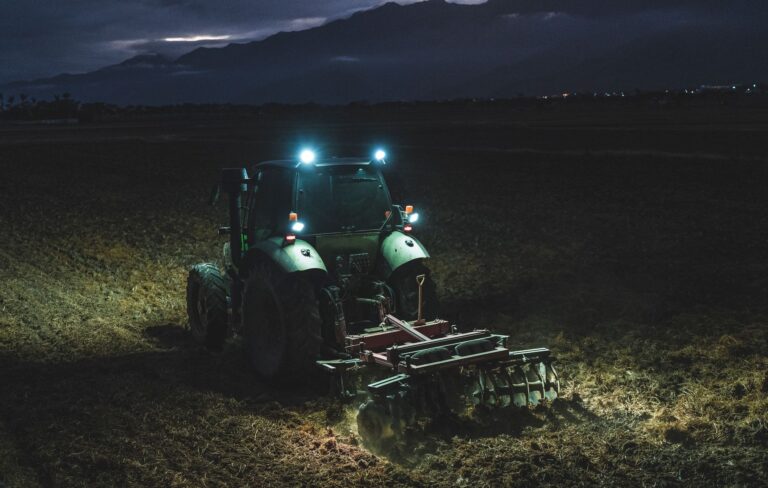
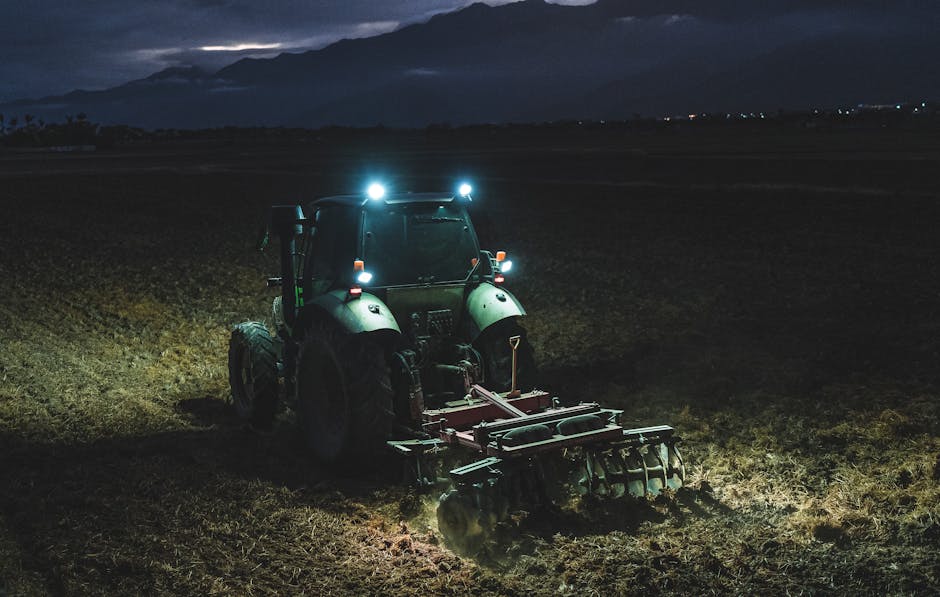
A tractor work light is an auxiliary lamp mounted on a tractor to illuminate the working area during field operations, loading, and low-light conditions. Unlike headlights, which project a regulated dipped or main beam for road use, tractor work lights cast broad or focused light across the ground, implements, and surroundings so the operator can see what the machine is doing. Most modern tractors run between 4 and 8 tractor work lights across multiple mounting points, with a combined output that can exceed 20,000 lumens. Choosing the right combination of output, beam pattern, and mounting position for each task is the difference between a well-lit working environment and wasted light that falls in the wrong place.
This guide covers how to select tractor work lights by lumen output, beam pattern, mounting position, and technology, with specific recommendations for ploughing, drilling, spraying, loading, and road transport. For a broader overview of all lighting systems on a tractor, see the full tractor lighting guide.
What Are Tractor Work Lights
A tractor work light is a separately switched lamp designed to illuminate the work area around the tractor rather than the road ahead. Headlights conform to strict road-lighting regulations and produce a shaped beam that lights the road surface without dazzling oncoming traffic. Tractor work lights have no such beam shaping requirement because they are intended for off-road use during fieldwork, yard operations, and implement monitoring.
Tractor work lights differ from headlights in 3 key ways. First, they mount in multiple positions around the cab (roof, fenders, bumper, A-pillars, rear) rather than in fixed forward-facing positions. Second, they switch independently, allowing the operator to activate only the lights needed for a given task. Third, tractor work lights are not road-legal as forward-facing lights on public highways. Any forward-facing tractor work light must be switched off before entering a public road, and rear-facing work lights must not dazzle following traffic.
The range of available tractor work lights spans from compact 1,500-lumen units suited to yard work up to 6,000-lumen units built for night harvesting. Getting the right light in the right position depends on understanding three variables: output (lumens), beam pattern, and mounting position.
How Many Lumens Does a Tractor Work Light Need
The lumen output a tractor work light requires depends on the task. Lumens measure the total amount of visible light a lamp produces. A higher lumen count means more light, but more is not always better. A 6,000-lumen tractor work light mounted on the fender for close-range row-crop monitoring would produce excessive glare and wash out detail. A 1,500-lumen unit on the roof for night harvesting would leave dark patches across the field.
Three output bands cover the majority of tractor work light applications:
1,500 to 2,000 lumens per light suits yard work, hitching implements, and short-range tasks where the working distance is under 10 metres. These lower-output tractor work lights draw less power and produce less glare at close range, making them practical for everyday jobs around the farmstead.
3,000 to 4,000 lumens per light suits general fieldwork, including ploughing, drilling, and cultivating. At this output, a tractor work light throws enough light to illuminate a plough furrow, seed drill, or cultivator tine from a roof or rear mounting position at working distances of 10 to 30 metres.
5,000 to 6,000+ lumens per light suits night harvesting, large-scale field operations, and any task where the tractor operates at speed across wide working widths. Combine harvesters and forage harvesters routinely run tractor work lights in this output range to illuminate the crop header and discharge area. For more detail on matching lumen output to specific tasks, Article 1.12 covers how many lumens a tractor needs across all lighting positions.
Beam Patterns for Tractor Work Lights
The beam pattern of a tractor work light determines how the light spreads across the working area. Four beam patterns account for nearly all tractor work light applications: flood, spot, trapezoid, and combo.
| Beam Pattern | Horizontal Angle | Throw Distance | Best Suited To |
|---|---|---|---|
| Flood | 40 to 90 degrees | Short (under 15m) | Close-range work: loading, yard, implement monitoring |
| Spot | 10 to 30 degrees | Long (30m+) | Forward distance: road transport, long-range visibility |
| Trapezoid | 40 to 60 degrees | Medium (15 to 30m) | General fieldwork: ploughing, drilling, cultivating |
| Combo | Centre spot with flood surround | Medium to long | Mixed tasks: headland turns, varied field operations |
Flood beam tractor work lights spread light across a wide angle (40 to 90 degrees), producing an even wash of illumination at close range. A flood beam tractor work light is the right choice for fender-mounted positions where the operator needs to see the ground beside the tractor, the implement attachment points, or the loading area in front of a bucket. The wide spread means less intensity at distance, so flood beams lose effectiveness beyond about 15 metres.
Spot beam tractor work lights concentrate light into a narrow cone (10 to 30 degrees), projecting a tight, high-intensity beam over long distances. A spot beam tractor work light on the roof or bumper can illuminate objects 30 metres or more ahead. Spot beams suit forward-facing positions on tractors used for road transport between fields, where long-range visibility matters. The narrow spread leaves dark areas to the sides, so spot beams are rarely used alone.
Trapezoid beam tractor work lights balance width and throw. The beam spreads 40 to 60 degrees horizontally but remains narrower vertically, sending more light forward and to the sides without wasting output into the sky or straight down. A trapezoid tractor work light is the most versatile choice for general fieldwork because it illuminates a wide strip of ground at medium range (15 to 30 metres), matching the typical working distance between a rear-mounted implement and the cab. For a deeper comparison of flood and spot beams, Article 1.13 covers the differences in detail.
Combo beam tractor work lights combine a central spot element with a surrounding flood pattern. This gives both forward throw and peripheral coverage from a single unit. A combo tractor work light suits situations where the tractor transitions between tasks, such as headland turns where the operator needs forward visibility and side illumination in quick succession.
Mounting Positions for Tractor Work Lights
Where a tractor work light is mounted determines what it illuminates. Five mounting positions cover the standard tractor work light configuration: roof, fender, bumper, A-pillar, and rear.
Roof
Roof-mounted tractor work lights sit on the cab roof or roof bar and provide elevated, wide-area illumination. The height advantage means light reaches further before ground-level obstructions block it. A set of 4 tractor work lights on the roof (2 forward-facing, 2 rear-facing) gives near-360-degree coverage around the tractor. Roof mounting suits general field illumination, night harvesting, and any task that benefits from overhead light. The trade-off is that roof-mounted lights can create shadows directly below the cab and may reflect off the bonnet or cab glass if angled poorly.
Fender
Fender-mounted tractor work lights sit on the rear wheel arches and illuminate the ground beside and slightly behind the tractor. This position is ideal for monitoring row-crop implements, watching seed placement from a drill, and checking the soil surface during cultivation. Fender tractor work lights typically use flood beams at 2,000 to 3,000 lumens to provide a wide, even wash at short range. They are among the most useful positions on any tractor because they light exactly where the operator looks most often during fieldwork.
Bumper
Bumper-mounted tractor work lights sit at the front of the tractor, low and forward-facing. They illuminate the ground immediately ahead at a shallow angle, which picks up surface detail (ruts, ditches, obstacles) that overhead lights can flatten. Bumper-mounted tractor work lights work well with flood or trapezoid beams for yard manoeuvring and with spot beams for forward distance.
A-Pillar
A-pillar-mounted tractor work lights sit on the windscreen pillars and angle forward and outward. This position fills the gap between the forward headlights and the side coverage from fender lights. A-pillar tractor work lights suit headland turns, where the operator needs to see the field edge and turning area at an angle. Trapezoid or combo beams work best in this position.
Rear
Rear-mounted tractor work lights sit on the back of the cab or on the rear cross-member and face backward. They illuminate implements, the hitch area, and the ground behind the tractor. Rear tractor work lights are essential for reversing, monitoring rear-mounted ploughs and drills, and checking the discharge area on a forage harvester. Flood beams at 3,000 to 4,000 lumens suit most rear-mounted tractor work light applications.
LED vs Halogen Tractor Work Lights
LED tractor work lights produce 2 to 3 times the light output of halogen units at the same wattage. A 40W LED tractor work light generates approximately 3,200 to 4,800 lumens. A 55W halogen tractor work light generates approximately 825 to 1,100 lumens. That efficiency difference has practical consequences across every measure that matters on a working tractor.
Light output per watt. LED tractor work lights produce 80 to 120 lumens per watt. Halogen tractor work lights produce 15 to 20 lumens per watt. Running 8 LED tractor work lights at 40W each (320W total) delivers over 25,000 lumens. Achieving the same output from halogen would require roughly 1,600W, which exceeds the spare alternator capacity on most tractors.
Lifespan. LED tractor work lights last 30,000 to 50,000 hours. Halogen tractor work lights last 500 to 1,000 hours. On a tractor that runs work lights for 1,000 hours per year, a set of halogen units needs replacing every season. A set of LED units lasts the working life of the tractor.
Vibration resistance. LED tractor work lights contain no filament. Halogen tractor work lights rely on a tungsten filament that breaks under sustained vibration. Agricultural fieldwork subjects lights to constant vibration from uneven ground, and filament failure is the primary cause of halogen tractor work light failure.
Colour temperature. LED tractor work lights produce light between 5,000K and 6,500K, a cool white that closely resembles daylight. Halogen tractor work lights produce light at approximately 3,200K, a warm yellow that reduces contrast and colour accuracy. The cooler LED colour temperature makes it easier to distinguish crop from soil, spot obstacles, and judge distances during night work.
Upfront cost. LED work lights cost more per unit than halogen equivalents, typically 2 to 4 times the price. The total cost of ownership favours LED within the first 1 to 2 seasons due to avoided bulb replacements, lower power draw, and reduced downtime.
EMC Compliance for Tractor Work Lights
A tractor work light without EMC approval can interfere with GPS receivers, auto-steer systems, and ISOBUS controllers fitted to the tractor. EMC stands for electromagnetic compatibility, and it measures how much electrical noise a device emits and how well it resists interference from other devices.
Non-EMC-rated tractor work lights emit electromagnetic interference through their internal drivers and wiring. This interference disrupts the weak satellite signals that GPS receivers depend on for position accuracy. On a tractor running RTK-corrected GPS for auto-steer, non-EMC tractor work lights can degrade positioning accuracy from 2cm to 30cm or more, causing overlap and missed strips during drilling, spraying, and fertiliser application. In some cases, the auto-steer system disengages entirely when non-EMC lights are switched on.
Two certification standards indicate that a tractor work light meets EMC requirements. ECE R10 is the European standard for electromagnetic compatibility of vehicle components. CISPR 25 Class 5 is the highest class within the international standard for radio disturbance suppression in vehicles and is the level precision farming equipment manufacturers recommend. A tractor work light carrying either certification has been tested and confirmed not to interfere with sensitive electronics.
EMC-rated tractor work lights cost 10 to 30 percent more than non-EMC equivalents. On a tractor fitted with a GPS guidance system costing £8,000 to £20,000, the additional cost of EMC-compliant tractor work lights is a minor expense to protect a major investment.
IP Ratings for Tractor Work Lights
IP67 is the minimum acceptable IP rating for a tractor work light. The IP (ingress protection) rating tells you how well the light housing resists dust and water. The first digit rates dust protection (6 is the maximum, meaning completely dust-tight). The second digit rates water protection.
Three IP ratings apply to tractor work lights in practice:
IP67 means the tractor work light is dust-tight and protected against temporary submersion in water to a depth of 1 metre for 30 minutes. This rating handles rain, puddle spray, and occasional submersion when a tractor crosses a flooded gateway. IP67 is adequate for tractor work lights that are not regularly pressure-washed.
IP68 means the tractor work light is dust-tight and protected against continuous submersion beyond 1 metre. The exact depth and duration depend on the manufacturer’s specification. IP68 tractor work lights suit tractors that regularly work in wet conditions or cross waterlogged fields.
IP69K means the tractor work light is dust-tight and protected against high-pressure, high-temperature water jets. The test involves water at 80 degrees Celsius sprayed at 80 to 100 bar from 10 to 15cm distance. IP69K is the recommended rating for any tractor work light that will be pressure-washed, which in agricultural use means nearly all of them. Farm tractors accumulate mud, crop residue, and chemical spray deposits that require regular pressure washing to remove, and a tractor work light rated below IP69K risks water ingress during that cleaning process.
Recommended Tractor Work Light Setups by Task
The right tractor work light setup depends on the primary task the tractor performs. Below are configurations that match beam pattern, output, and mounting position to 5 common farming operations.
Ploughing
Ploughing requires the operator to monitor the plough behind the tractor while maintaining forward visibility for headland turns. Mount 2 rear-facing trapezoid tractor work lights on the roof at 3,000 to 4,000 lumens each to illuminate the mouldboards and furrow. Add 1 forward-facing trapezoid or combo tractor work light on each A-pillar at 2,000 to 3,000 lumens for headland visibility. Total recommended output: 10,000 to 14,000 lumens.
Drilling
Drilling demands close monitoring of the seed drill and coulters. Mount 2 fender-mounted flood tractor work lights at 2,000 to 3,000 lumens each to watch seed placement and soil disturbance at close range. Add 2 rear-facing trapezoid tractor work lights on the roof at 3,000 to 4,000 lumens each to cover the full width of the drill. Total recommended output: 10,000 to 14,000 lumens.
Spraying
Spraying requires visibility of the boom tips and spray pattern on both sides of the tractor. Mount 2 fender-mounted flood tractor work lights at 2,000 to 3,000 lumens each, angled outward to illuminate the boom ends. For trailed sprayers, add 2 rear-facing flood tractor work lights at 2,000 to 3,000 lumens to monitor the spray fan and boom height. Total recommended output: 8,000 to 12,000 lumens.
Loading
Loading in a yard or at a clamp requires maximum close-range coverage around the tractor and loader. Mount 4 roof-mounted flood tractor work lights (2 forward, 2 rear) at 4,000+ lumens each for overhead coverage of the loading and dumping areas. Add 2 bumper-mounted flood tractor work lights at 2,000 lumens each for ground-level detail in front of the bucket. Total recommended output: 20,000+ lumens.
Road Transport
Road transport between fields or to market requires forward distance visibility and rear visibility for following traffic. Use 2 forward-facing spot tractor work lights on the roof at 3,000 to 4,000 lumens each for long-range illumination. Mount 2 rear-facing flood tractor work lights at 2,000 to 3,000 lumens each to improve visibility of the tractor and any trailed load. Switch off all side-facing and non-essential tractor work lights on public roads to avoid dazzling other road users. Total recommended output: 10,000 to 14,000 lumens (forward and rear only).
Summary
A tractor work light serves a different purpose from a headlight: it illuminates the work area around the tractor for fieldwork, loading, and implement monitoring. Choosing the correct output (1,500 to 6,000+ lumens per unit), beam pattern (flood, spot, trapezoid, or combo), and mounting position (roof, fender, bumper, A-pillar, or rear) ensures light falls where the operator needs it for each task. LED tractor work lights outperform halogen in output, lifespan, and vibration resistance. EMC-compliant tractor work lights protect GPS and auto-steer systems from interference. IP69K-rated tractor work lights withstand the pressure washing that agricultural use demands.
Browse the full range of tractor work lights at Agri Lighting for LED and halogen options with free UK delivery over £75 and same-day dispatch before 3pm.