Flood vs Spot Beam: Which Beam Pattern for Which Tractor Task
In this guide
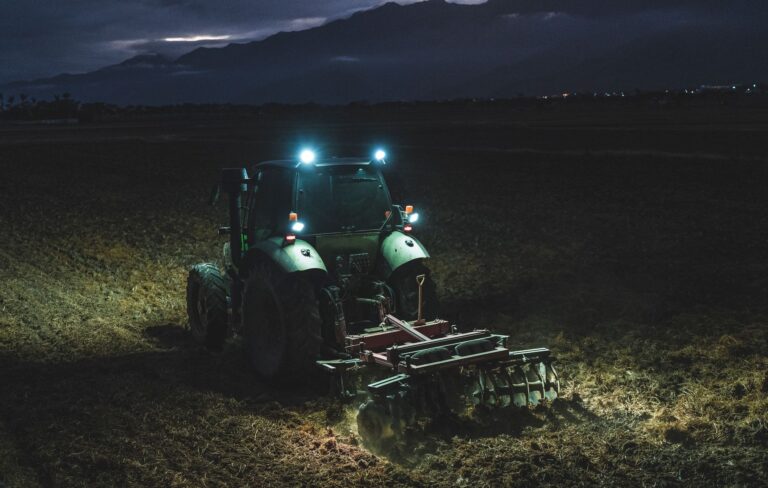
A work light beam pattern is the shape of the light cone a lamp projects onto the ground. Spot beams throw a narrow cone of bright light up to 150 metres ahead. Flood beams spread a wide cone of softer light across 10 to 30 metres of working area. Combo beams mix the two. The choice of beam pattern matters more than the headline lumen figure because two 5,000-lumen lamps with different optics light up completely different patches of ground. This article sets out how each beam pattern works, which tractor task each suits, and how to combine patterns across a single tractor so every corner of the field, headland, and yard is covered. For the related question of how bright each lamp needs to be, see the companion guide to tractor work light lumens.
What a Work Light Beam Pattern Is
A work light beam pattern is the angular distribution of light that a work lamp produces. Reflector shape, lens optics, and LED chip placement determine the pattern. The pattern is expressed as a beam angle in degrees, which is the angle between the two points at which the light intensity drops to 50% of its peak value. A 20° beam concentrates light into a narrow cone. A 90° beam spreads light across nearly a quarter of a sphere.
Beam patterns fall into 4 common categories: pencil (under 10°), spot (10° to 30°), combo (spot core plus flood halo), and flood (60° to 120°). Agricultural tractor work lights almost always sit in the spot, combo, and flood categories. Pencil beams belong to searchlights and driving lamps, not work lights.
Two numbers describe any work light: the lumen output and the beam angle. Lumens tell you how much light the lamp makes. Beam angle tells you how that light is distributed. Ignoring either number leads to mismatched lighting that looks bright on paper but fails in the field.
How Spot Beams Work
A spot beam work light concentrates 80% or more of its lumens into a narrow cone between 10° and 30° wide. A parabolic or projector-style reflector collects the light from the LED and focuses it into a tight column. The result is a bright, far-reaching beam that throws useful light 50 to 150 metres ahead of the lamp.
Spot beams do 3 things well. They reach long distances. They hold their intensity at range: a 5,000-lumen spot delivers around 250 lux at 50 metres, compared with 24 lux for a flood beam of the same output. They give the operator advance warning of headland, obstacles, and approaching traffic.
Spot beams have 3 clear weaknesses. They leave the area immediately next to the tractor in darkness because the beam is too narrow to cover it. They create a pronounced dark zone on either side of the beam cone, which feels claustrophobic over a full shift. They cause glare and dazzle for other road users if pointed anywhere other than the ground ahead.
Spot beams belong on the front of a tractor pointed forward at the working distance, or on the outside of a combine header aimed at the cutting edge. They are poor choices for rear-facing coverage of an implement or for yard work close to buildings.
How Flood Beams Work
A flood beam work light spreads 80% or more of its lumens across a wide cone between 60° and 120°. The reflector is a multi-facet or scatter design that breaks the LED output into a broad, even pattern. Flood beams reach 10 to 30 metres with uniform coverage and no hot spots.
Flood beams do 3 things well. They cover area. A single flood lamp lights up the full width of a 3-metre implement behind the tractor with no dark patches. They produce a soft, even light that causes minimal glare at close range, which reduces operator fatigue over long night shifts. They work well bounced off light-coloured surfaces (yard walls, crop foliage) because the wide beam naturally fills the scene.
Flood beams have 3 weaknesses. They do not reach distance: a 5,000-lumen flood lamp drops to 24 lux at 50 metres, which is too dim for long-range visibility. They wash out at distance because the lumens spread too thinly. They light up rain, dust, and snow at close range, which can reduce visual contrast in poor conditions.
Flood beams belong on the sides, rear, and roof corners of a tractor for implement coverage, yard work, and close-range task illumination.
Combo Beams: Distance and Coverage in One Lamp
A combo beam work light mixes a spot-beam core with a flood-beam halo inside a single housing. The spot core (typically a 10° to 30° cone from the central LEDs) gives the lamp distance. The flood halo (a 60° to 90° ring from the outer LEDs) fills in the near-field. Combo beams give the operator an all-round working envelope from a single lamp: roughly 50 metres of distance combined with 20 metres of useful width.
Combo beams are the most common beam pattern sold for agricultural use today because one lamp covers most tasks. A 4-lamp array of combo work lights on a mid-size tractor handles ploughing, cultivating, spraying, and yard work without changing the lighting setup between jobs.
Combo beams carry a small trade-off. The spot core sacrifices a little raw distance compared with a pure spot lamp. The flood halo sacrifices a little peak width compared with a pure flood lamp. For operators who work one specific task over long shifts, a dedicated spot or dedicated flood outperforms a combo. For operators who switch between tasks, the combo wins on flexibility.
Spot vs Flood vs Combo: Side-by-Side Comparison
The table below compares the three beam patterns across the 6 factors that matter for a tractor work light purchase.
| Factor | Spot | Flood | Combo |
|---|---|---|---|
| Beam angle | 10° to 30° | 60° to 120° | 10° core + 60° to 90° halo |
| Typical range | 50 to 150 m | 10 to 30 m | 50 m + 20 m width |
| Lux at 10 m (5,000 lm lamp) | ~1,800 lux | ~600 lux | ~1,000 lux (core) |
| Lux at 50 m (5,000 lm lamp) | ~250 lux | ~24 lux | ~100 lux (core) |
| Glare at close range | High | Low | Medium |
| Best use | Distance and headland | Area and implement | All-round tractor work |
| Typical price range (48W LED) | £40 to £150 | £35 to £140 | £45 to £160 |
The lux figures are approximate and depend on lamp optical efficiency, but the pattern holds: spots win at distance by a factor of 10, floods win at close-range spread by a factor of 3, and combos sit between the two.
Matching Beam Pattern to Tractor Task
Each common tractor task maps to a preferred beam pattern. The table below gives the recommended pattern for the 8 most frequent night-time farm jobs.
| Task | Recommended beam pattern | Why |
|---|---|---|
| Ploughing | Combo (spot-heavy) | Long sight-line to headland + side coverage for implement |
| Cultivating and drilling | Combo | Similar to ploughing with slightly wider near-field need |
| Combine harvesting | Spot front, combo on header | Distance for tracking the cut, area on the header |
| Spraying | Flood (medium, low-glare) | Wide coverage of boom width, avoids blinding the operator |
| Baling and wrapping | Flood (rear) | Full implement visibility, no distance needed |
| Muck spreading | Combo | Spread pattern visibility plus forward track visibility |
| Silage work | Combo | Fast-moving, mixed distance and close-range needs |
| Yard work and reversing | Flood (wide) | Close-range coverage between buildings, no long throw |
Two principles follow. Applications where the operator needs to see what is 50+ metres ahead (ploughing, combine running, long-range track visibility) favour spot or spot-heavy combo beams. Applications where the operator needs to see what is 0 to 20 metres around the tractor (yard work, implement coverage, spraying) favour flood beams. Applications that require both simultaneously (most field operations) favour combo beams.
Mixing Beam Patterns on a Single Tractor
Most working tractors benefit from 2 or more beam patterns used together rather than a single pattern repeated across every lamp position. Mixing patterns delivers a complete lighting envelope: distance, width, and rear coverage from a single array.
Example 4-Lamp Setup (Mid-Size Tractor)
- 2 combo beams on the roof front (for track and near-field)
- 2 flood beams on the rear of the cab (for implement visibility)
This setup handles ploughing, cultivating, and baling without repositioning lamps. Total typical array: 12,000 to 20,000 effective lumens.
Example 6-Lamp Setup (Large Tractor)
- 2 spot beams on the roof front (long-range)
- 2 combo beams on the front fender or A-pillar (mid-range and near-field)
- 2 flood beams on the rear (implement)
This setup suits combine harvesters pulling long-distance field edges, articulated tractors running 6 m cultivators, or any operation that mixes long sight-lines with wide implements. Total typical array: 25,000 to 50,000 effective lumens.
Example 8-Lamp Setup (Articulated Tractor or Combine)
- 4 spot or spot-heavy combo beams on the roof (long-range, wide sweep)
- 2 flood beams on the side (turn-line and near-field)
- 2 flood beams on the rear (implement or chaser)
This setup provides the full 360° lighting envelope a combine harvester or articulated tractor needs during harvest. Total typical array: 40,000 to 80,000 effective lumens.
For wiring multi-lamp arrays safely, see the guide to wiring tractor lights with a relay. For the UK legal rules on when work lights can be switched on during road use, see the tractor lighting regulations guide.
Common Beam Pattern Mistakes
Beam pattern mistakes account for a high share of tractor work lights that get returned, swapped, or simply ignored after the first night shift. The 5 mistakes below cover most of them.
All Spot, No Flood
A tractor fitted only with spot beams sees 100 metres ahead and nothing within 5 metres of the cab. The operator compensates by leaning forward, squinting at the edges, and losing awareness of implement position. Every tractor with spot beams needs at least one flood or combo lamp for close-range coverage.
All Flood, No Distance
A tractor fitted only with flood beams sees 20 metres in every direction and nothing beyond. The operator cannot spot headland, approaching vehicles, or obstacles in time to react. Every tractor with flood beams needs at least one spot or combo lamp aimed at the working distance.
Wrong Pattern for the Task
Using a pair of pure spot beams for yard work floods a narrow strip with light and leaves the rest of the yard in darkness. Using a pair of pure flood beams for combine harvesting lights the first 20 metres of the field and leaves the cutting line invisible. Match the pattern to the task before buying the lamp.
Ignoring Glare to Other Road Users
Spot beams pointed horizontally dazzle oncoming drivers. UK Road Vehicles Lighting Regulations 1989 prohibit work lights being used whilst in motion on public roads, and glare from a misaimed spot beam on the road turns a legal fitting into an enforcement stop. Fit a dedicated switch for work lights and keep them off during road transit.
Over-Focusing on Lumens and Ignoring the Pattern
A 10,000-lumen spot beam on a baler produces a hot bright stripe across the middle of the implement and leaves the edges dark. A 5,000-lumen flood beam on the same baler lights the full width evenly. More lumens in the wrong pattern is worse than fewer lumens in the right pattern. Specify the pattern first and let the lumen figure fall out of that decision.
Beam Pattern Checklist
Use this checklist to confirm a tractor work light array matches the actual working tasks.
- Primary task identified (ploughing, harvesting, yard work, spraying, etc.)
- Pattern selected for the primary task (spot, flood, or combo)
- Secondary tasks considered (do they need different patterns?)
- At least one combo or flood lamp present for close-range coverage
- At least one spot or combo lamp present for distance visibility
- Pattern distribution balanced front, side, and rear
- Lamps aimed to avoid horizontal dazzle on public roads
- Work light circuit wired to a dedicated switch (off on public roads)
- Lumen figures checked for the chosen pattern (effective, not raw)
Browse the full range of work lamps at Agri Lighting, including spot, flood, and combo LED work lights from leading UK and European brands, with free UK delivery over £75. For a broader overview of tractor lighting and how beam pattern fits into a complete tractor lighting setup, visit the pillar guide.