Tractor Plough Lights: What You Need for Safe Night Ploughing
In this guide
- What Tractor Plough Lights Are and Why They Differ from Headlights
- Beam Pattern: Flood Wins for Ploughing
- Where to Mount Tractor Plough Lights
- How Many Lumens You Need to Plough at Night
- IP Rating and Dust Performance for Plough Work
- Wiring and Switching Plough Lights
- Plough Lights and the Road
- Choosing a Tractor Plough Light Set-Up
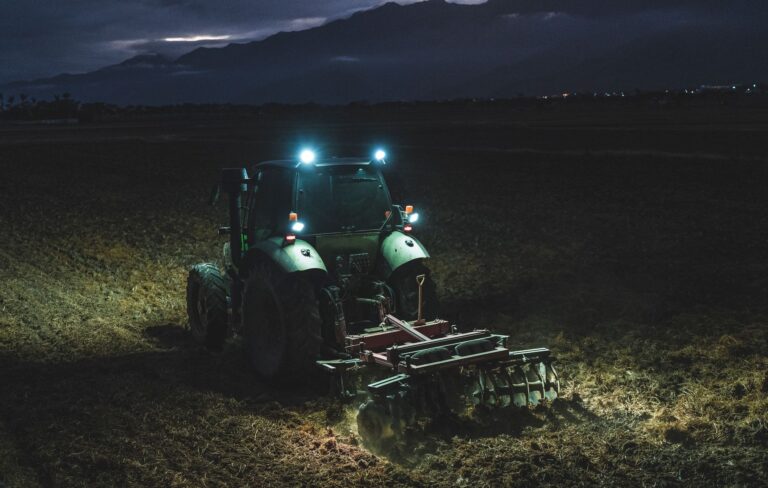
A tractor plough light is a rear-facing work lamp fitted to a tractor specifically to illuminate the plough body, the furrow, and the freshly turned ground during night-time ploughing. Plough lights use a wide flood beam pattern, mount low on the rear of the cab or on the rear fender, and produce 2,500 to 12,000 lumens per lamp depending on plough size. The right set-up shows the operator the share, the depth, the headland, and any obstacles in the work area. This guide covers what plough lights are, the correct beam pattern, the mounting positions, the lumen requirement, the dust performance, the wiring approach, and the legal position for road movement after dark.
What Tractor Plough Lights Are and Why They Differ from Headlights
A tractor plough light is a rear-facing work lamp fitted to illuminate the plough and the furrow behind the tractor at night. Plough lights differ from front headlights in 3 measurable ways: direction (rear-facing not forward), beam pattern (flood not driving), and approval (work lamp not road headlamp).
Direction. Headlights on a tractor face forward to light the path of travel. Plough lights face rearward to light the working tool. The operator does most of the visual work during ploughing by turning to look back along the plough body, watching the share enter the soil, the depth, the consistency, and any change in surface. Forward-facing headlights do not light any part of this work area.
Beam pattern. Headlights produce a sharp horizontal cut-off pattern (low beam) or a focused long-range beam (high beam) that throws light 70 to 200 metres ahead. Plough lights produce a wide flood pattern that spreads light across a 60 to 120 degree horizontal arc and 30 to 60 degree vertical arc, putting useful light on a 4 to 8 metre wide work area immediately behind the tractor.
Approval. Headlights carry ECE Regulation 112 (low/high beam) or ECE Regulation 19 (front fog) approval for road use. Plough lights carry ECE Regulation 23 (reversing) or simply work-lamp approval, which permits use on a private working area but not on public roads while moving.
For the wider tractor lighting picture, see The Complete Guide to Tractor Lighting and Tractor Work Lights.
Beam Pattern: Flood Wins for Ploughing
A flood beam is the correct beam pattern for plough lights. A flood lamp puts a wide, even pool of light on the work area immediately behind the tractor, which is exactly what the operator needs to see the plough body, the furrow, and the headland.
Flood beam characteristics. Wide horizontal spread, typically 60 to 120 degrees. Wide vertical spread, typically 30 to 60 degrees. No long-range throw (light intensity drops sharply beyond 15 metres). Even intensity across the lit area without hot spots. Designed to light the close-in work zone, not far-distance objects.
Why flood beats spot for ploughing. A spot beam concentrates light into a narrow 8 to 30 degree cone with long-range throw of 200 to 600 metres. The narrow beam misses the wider work area, leaves dark zones either side of the centre, and creates dazzle patches in the operator’s mirrors. A wide flood spreads light evenly across the whole plough body and the headland turn area.
Combo beams (driving plus flood). Some operators fit combo lamps with a central spot for distance and a flood surround. Combo is useful on tractors that do night transport between fields, but pure flood gives the cleanest plough-body illumination.
Beam angle by plough type. 3-furrow plough, 60 to 80 degree flood. 4 to 5 furrow plough, 80 to 100 degree flood. 6 to 8 furrow plough, 100 to 120 degree flood or twin lamps angled outward. Larger ploughs need wider beam coverage to reach the outside furrows.
For the full beam pattern explanation, see Flood vs Spot Beam and Work Light Beam Patterns.
Where to Mount Tractor Plough Lights
Plough lights mount in 4 standard positions: rear cab corners, rear fender, sunroof rear edge, and on the plough itself. Each position has a measurable trade-off between coverage, durability, and ease of installation.
Rear cab corners. Most common position. Lights mount on the upper rear corners of the cab roof, typically 2.4 to 3.0 metres above ground. Corner mounting gives a high vantage point that throws light over the whole plough body. Two lights per cab (one each corner) cover a 6 to 8 metre wide work area. Drawback: cab roof brackets need careful sealing to avoid water ingress through the cab roof skin.
Rear fender position. Lights mount on the rear of the rear mudguard, typically 1.5 to 2.0 metres above ground. The lower position gives a flatter angle of incidence on the soil surface, which shows soil texture and depth more clearly than the high cab-corner mount. Drawback: more vulnerable to mud, debris, and impact damage from heavy clods or stubble.
Sunroof rear edge. Used on tractors with a glazed sunroof or roof hatch. Lights mount on the rear edge of the sunroof frame at 2.6 to 3.2 metres above ground. The high mount gives good coverage of the headland turn area as well as the immediate plough body. Drawback: sunroof frames are not always strong enough; check the bracket rating before fitting.
On-plough mounting. Some reversible ploughs and large semi-mounted ploughs come with factory-fitted lights on the headstock. The on-plough position keeps light on the working tool regardless of plough position (raised, lowered, or turning over). Drawback: wiring runs through the rear linkage area and is exposed to flexing and abrasion, which shortens loom life.
Mount height summary. Cab corner, 2.4 to 3.0 metres, wide overall view. Fender, 1.5 to 2.0 metres, flatter texture-revealing angle. Sunroof edge, 2.6 to 3.2 metres, best headland visibility. On-plough, 1.0 to 1.5 metres, closest to the work, most exposure to damage.
For the broader mounting decision, see Mounting Positions for Tractor Lights and How to Mount Work Lights.
How Many Lumens You Need to Plough at Night
A pair of 4,000 lumen LED work lights gives adequate illumination for a 3 to 5 furrow plough. Larger ploughs need 6,000 to 12,000 lumens per lamp, or twin lamps each side. Lumen choice depends on plough width, soil colour, dust conditions, and operator preference.
Lumen output by plough size. 2 to 3 furrow plough, 2,500 to 4,000 lumens per lamp, single lamp each side. 4 to 5 furrow plough, 4,000 to 6,000 lumens per lamp, single or twin lamp each side. 6 to 8 furrow plough, 6,000 to 12,000 lumens per lamp, twin lamps each side recommended.
Why soil colour matters. Dark, moist soil absorbs 60% to 80% of incident light. Light-coloured chalky or sandy soil reflects 40% to 60%. Dark soils need 50% to 100% more lumens for equivalent visual contrast. East Anglian fenland operators often fit 8,000 lumen pairs on a 4-furrow plough for this reason; chalky downland operators get away with 4,000 lumen pairs.
Dust effect. Ploughed dry soil creates a fine dust cloud that scatters light back at the operator (back-scatter). High-output lamps make back-scatter worse. The fix is not more lumens but better beam control: lamps with a sharp horizontal cut-off above the work area reduce back-scatter, and yellow-tinted (4,000K to 4,500K) work lamps cut back-scatter compared with cool-white (6,000K to 6,500K) lamps.
Colour temperature for ploughing. 4,000K to 5,000K (warm to neutral white) gives the best soil-detail visibility. The yellow content emphasises the brown and grey tones of soil and reveals texture clearly. 6,000K to 6,500K (cool white) is brighter to the eye but flattens soil colour and washes out texture. For pure ploughing work, neutral white wins.
Lumens vs watts. A 50-watt halogen work lamp produces 700 to 1,200 lumens. A 50-watt LED work lamp produces 4,000 to 6,000 lumens. Comparing wattage between halogen and LED is misleading; compare lumens.
For full lumen guidance, see How Many Lumens Do You Need for Tractor Work Lights and Understanding Lumens, Lux, and Colour Temperature.
IP Rating and Dust Performance for Plough Work
Plough work generates the most punishing dust environment in farming. Plough lights should carry an IP67 minimum rating, with IP69K preferred for tractors that do daily ploughing through summer dust. The IP rating defines how well the lamp keeps dust and water out of the housing.
IP67 specification. First digit 6, fully dust-tight (no ingress at all). Second digit 7, protected against temporary immersion in water up to 1 metre depth for 30 minutes. IP67 is the minimum standard for any agricultural work light.
IP69K specification. Higher tier, dust-tight and protected against high-pressure, high-temperature water jets at 80 to 100 bar and 80 degrees C. IP69K matters when the tractor goes through a steam jet wash after ploughing, which is common at the end of a long autumn shift.
Why dust matters more than rain. Fine dust enters housings through the smallest gaskets gap, settles on internal lenses and reflectors, and reduces output by 10% to 30% in a single season. A non-IP-rated work lamp loses half its effective output after 200 hours of plough-dust exposure. An IP67 lamp loses under 5%.
Lens material. Polycarbonate lenses scratch under fine dust over 500 to 1,500 hours of plough use. Tempered glass lenses resist scratching almost indefinitely. For tractors that do over 200 plough hours a year, tempered glass justifies the GBP 15 to GBP 30 price premium.
Sealed connectors. The wiring connector is the weak point on most work lamps. Deutsch DT or AT-series connectors give an IP67 seal at the plug. Cheap blade-type connectors do not seal at all and let dust into the loom side. The connector cost difference is GBP 1 to GBP 4 per lamp.
For the full IP rating breakdown, see IP67 vs IP69K Work Lights and What IP Rating Do You Need for Agricultural LED Lights.
Wiring and Switching Plough Lights
Plough lights wire through a relay, a fuse, and a dedicated dashboard switch. The standard set-up uses a 30 to 40 amp relay, a 15 to 25 amp fuse, and a labelled rocker switch on the auxiliary switch panel. Most modern tractors have a “rear work light” pre-wired output that simplifies the install.
Pre-wired tractors. John Deere 6R, 7R, 8R; New Holland T6 to T9; Case IH Maxxum, Puma, Magnum; Massey Ferguson 6700S, 7700S, 8700S; Fendt 700 to 1000 Vario; Claas Arion to Xerion. These tractors have factory dashboard switches and wiring stubs in the cab roof for rear work lights. Connection to a single auxiliary lamp pair is a 20 to 30 minute job.
Tractors without pre-wiring. Older Massey Ferguson 35X to 4280, Ford 5000 to 8210, John Deere 50/55/56 series, vintage tractors. These need a relay, fuse, switch, and dedicated wiring loom run from the battery to the cab roof. Allow 2 to 4 hours for the install.
Wiring specification for a 4,000 lumen LED pair (2 lamps, 50W total). Battery feed cable, 4 mm² minimum, fused at 15 amps within 200 mm of the battery. Relay, 30 amp, mounted within 500 mm of the battery, ideally in a sealed relay box. Switch wire, 1 mm² from the dashboard switch to the relay control pin. Earth, dedicated 4 mm² earth from the relay output back to the battery negative or to a clean chassis earth.
Switch labelling. UK type approval requires a clear symbol or text label on any rear work light switch. The international symbol is a stylised lamp icon with arrows pointing rearward. A text label “Rear Work” is also acceptable. The switch should be illuminated when active so the operator does not leave it on accidentally during road transport.
Interlock with road movement. Best practice is to wire the rear work light circuit through an interlock that switches the lamps off when the road-driving lamps (headlamps, sidelights, indicators) are on. The interlock prevents accidental dazzle of following drivers and removes the need to remember to switch off before leaving the field.
For wider wiring guidance, see How to Wire Tractor Lights and How to Wire Work Lights to a 12V System with a Relay.
Plough Lights and the Road
Plough lights are work lamps and must not be used on the public road while the tractor is moving. UK law (Road Vehicles Lighting Regulations 1989, regulation 11) prohibits the use of any lamp on a moving road vehicle that dazzles or distracts other road users.
The legal position. Work lamps may be fitted to a tractor at any time. They must not be illuminated when the tractor is moving on a public road. They may be illuminated when the tractor is stationary in a layby, in a farmyard, or at the field margin off the public road. Using them on the road carries a fixed-penalty notice (GBP 50 to GBP 100) and a careless driving charge in serious cases.
The off-road exception. On private farmland the operator may run any combination of lights at any time. Field tracks and farmyards count as private. Public roads, byways, and bridleways count as public.
Switch-off discipline. Operators should switch the rear work light off as the tractor leaves the field gate. The dashboard tell-tale on a properly wired set-up reminds the operator. Tractors with the road-light interlock described in the previous section switch off automatically.
For the full legal background, see Tractor Lighting Regulations UK and Tractor Road Legal Lights.
Choosing a Tractor Plough Light Set-Up
A complete tractor plough light upgrade costs GBP 80 to GBP 600 depending on lamp output, mounting hardware, and whether the operator fits a single pair (GBP 80 to GBP 250) or twin pairs for a large plough (GBP 200 to GBP 600).
Three buying checks before fitting. Lamp output of at least 4,000 lumens per lamp for a 3 to 5 furrow plough; at least 6,000 lumens for a 6+ furrow plough. IP67 minimum, IP69K preferred, with sealed Deutsch connectors. Beam pattern flood (60 to 120 degrees), not spot.
Brand and price tier. Budget LED work lamps (GBP 25 to GBP 40 each) work for occasional ploughing. Mid-range (GBP 50 to GBP 100) suits 100 to 300 hours per year of plough work. Premium (GBP 120 to GBP 250) such as Nordic Lights, Hella, or PIATA suits contractors doing 400+ hours per year.
Agri Lighting stocks LED, halogen, and xenon work lamps suitable for plough lighting on John Deere, New Holland, Massey Ferguson, Case IH, Fendt, Claas, Valtra, and Kubota tractors. Browse the universal LED work lamp range for the full selection, with brackets and wiring kits available for direct fit on most tractor cab corners and fenders.
For the wider tractor lighting context, see The Complete Guide to Tractor Lighting, Tractor Work Lights, and Best Tractor Lights for Night Harvesting.