Forklift Lights: Safety Lighting for Warehouse and Yard Work
In this guide
- What Forklift Lights Are
- Blue Spot Lights
- Red Zone and Arc Warning Lights
- Laser Line Pedestrian Lights
- Amber Rotating Beacons for Forklifts
- Work Lamps for Forklifts
- Indoor vs Outdoor Forklift Lighting
- LED Upgrades from Halogen
- HSE Rules and PUWER Duties
- Common Questions About Forklift Lights
- Summary
- Internal Links Pending Future Articles
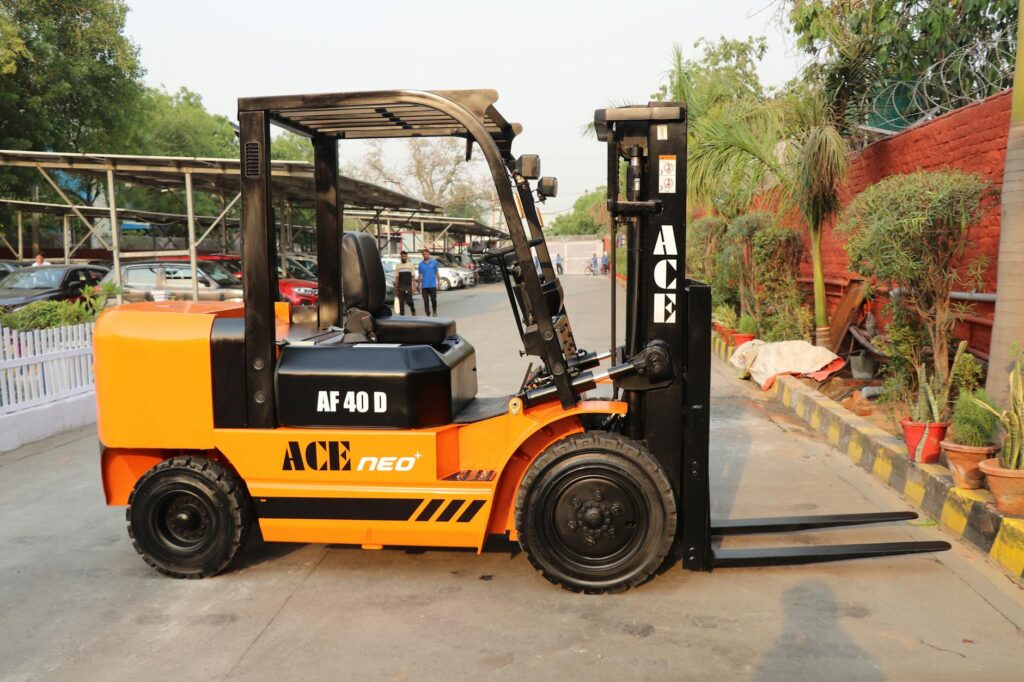
Forklift lights split into 5 categories: pedestrian warning lights (blue spot, red zone, arc, and laser), amber rotating beacons, white work lamps, road-legal lighting on outdoor trucks, and indoor strobes. Each category solves a different safety problem in a warehouse, a yard, or a loading bay. This guide explains how each forklift light works, where it mounts, what it draws on the truck’s 12V, 24V, 36V, 48V, or 80V supply, and how the choices map to the duties placed on operators by the Provision and Use of Work Equipment Regulations 1998 (PUWER) and HSE guidance HSG6.
What Forklift Lights Are
Forklift lights are the complete set of warning, work, and signalling lamps fitted to a forklift truck for indoor and outdoor operation. The set covers 5 functions: warning pedestrians of the truck’s path, signalling the truck’s presence to other vehicles, illuminating the work area, lighting the road if the truck travels on a public road, and signalling the operator’s intent.
Forklift lights are not road-legal lighting on most trucks because most forklifts never use a public road. The lamps are fitted to satisfy site safety policy, PUWER, and HSE pedestrian-protection duties. A forklift that does travel on a public road must additionally carry the same road-legal lighting kit as any other works vehicle.
Forklift lights mount at 4 zones on the truck: the overhead guard (the cage above the driver), the chassis or counterweight, the mast, and the wheel arches. Each zone suits a different lighting function. Blue spot, red zone, and laser lights mount on the overhead guard or counterweight. Amber beacons mount on the overhead guard. Work lamps mount on the overhead guard or mast. Road-legal lights mount on the chassis.
Blue Spot Lights
A blue spot light projects a bright blue circle onto the floor 3 m to 5 m in front of or behind the forklift. The blue circle warns pedestrians that the truck is approaching even when the operator is not yet visible.
Blue spot lights work because:
- Blue is a non-natural colour on warehouse floors, so a pedestrian’s eye catches it instantly.
- The projected circle reaches well beyond the truck before the truck arrives.
- The blue circle works around blind aisle ends, where the truck cannot be seen but the light spills onto the cross-aisle.
- The light operates whenever the truck is powered, with no operator action needed.
A typical blue spot light uses a 10W LED chip with a focusing lens, projects a circle 600 mm to 1,000 mm in diameter at 3 m to 5 m range, draws 0.4 A to 0.8 A at 12V, and lasts 30,000 hours. Most are IP67 rated to survive cleaning down.
Blue spot lights mount in 2 positions per truck: one at the front and one at the rear. The front lamp warns pedestrians when the truck travels forward. The rear lamp warns pedestrians when the truck reverses, which is the higher-risk direction because operator visibility is poorer.
A blue spot does not replace a horn, a beacon, or operator awareness. HSE guidance HSG6 lists blue spot warning lights as a supplementary control, not a primary one.
Red Zone and Arc Warning Lights
A red zone light projects a long red rectangle onto the floor along the side of the forklift to mark the swing radius and the no-go area. An arc warning light projects a curved red line at the rear of the truck to mark the turning arc.
Red zone lights protect pedestrians from being caught by the swinging counterweight when the forklift turns in a tight space. The counterweight on a 3-tonne forklift swings out by 600 mm to 800 mm during a tight turn, which is enough to crush a pedestrian standing close to the truck.
A red zone light typically uses a 5W to 10W LED with a slot lens, projects a rectangle 1.5 m to 4 m long by 200 mm to 400 mm wide at floor level, draws 0.4 A to 0.7 A at 12V, and lasts 30,000 hours.
Arc warning lights work the same way but project a curved line that follows the actual swept area of the counterweight. Arc lights are more accurate than rectangular red zone lights when the operator works in tight spaces with mixed traffic.
Red zone and arc lights mount in pairs (one each side) on the chassis or the counterweight. The lights activate whenever the truck is powered and remain on continuously.
Laser Line Pedestrian Lights
A laser line forklift light projects a single bright red or green line across the floor in front of and behind the truck. The line marks a stop zone that pedestrians can see at long range, even in poorly lit warehouse aisles.
Laser line lights work where blue spots fail. A blue spot can be washed out by overhead lighting at distances over 5 m. A laser line stays visible at 10 m to 15 m because the line is concentrated in a narrow band rather than spread over a circle.
A typical forklift laser line uses a Class 1 or Class 2 laser diode (eye-safe under normal use), projects a line 3 m to 6 m long, draws 0.2 A to 0.5 A at 12V, and is rated to IP65. Class 1 lasers are safe to view directly. Class 2 lasers are safe under the natural blink reflex.
Laser lines suit 4 environments:
- Long warehouse aisles with overhead fluorescent lighting that washes out blue spots
- Cold stores and chillers where condensation reduces blue spot contrast
- Outdoor yards in daylight where blue spots are barely visible
- Mixed-pedestrian, mixed-traffic operations where a clear stop line is needed
Laser line lights mount on the overhead guard or the counterweight in pairs. One projects forward, one projects rearward.
Amber Rotating Beacons for Forklifts
An amber beacon on a forklift signals that the truck is operating and that pedestrians and other vehicles must give way. Amber beacons fit forklifts that work in mixed-traffic yards, on public roads, or under site policies that require them.
Amber beacons for forklifts come in 4 styles:
| Style | How it works | Typical use |
|---|---|---|
| Rotating halogen | A 21W H1 bulb spins behind a clear lens via a small motor | Older trucks, simple replacement |
| Static-flash LED | A ring of LEDs flashes in a programmed pattern | Modern trucks, low current draw |
| Simulated-rotation LED | LEDs sequence around the lens to mimic rotation | Trucks where the appearance of rotation matters |
| Strobe | A xenon tube flashes 2 to 4 times per second | High-visibility yards |
LED beacons draw 0.5 A to 2 A at 12V or 24V, weigh 250 g to 700 g, and last 30,000 to 50,000 hours. Halogen rotating beacons draw 2 A to 5 A and last 500 to 1,500 hours.
Amber beacons mount on the overhead guard via a DIN pole, a flexi DIN mount, a magnetic base, or a 3-bolt fixed plate. A forklift used outdoors and on public roads must use a beacon approved to ECE R65 and ECE R10. Indoor-only beacons do not need ECE approval, though most reputable brands carry it anyway.
For more on R65 approvals, see our ECE R65 beacons article and the amber beacon meaning explainer.
Work Lamps for Forklifts
Work lamps illuminate the load, the racking, and the floor area around the forks. Work lamps suit night-shift warehouses, outdoor yards, cold stores, and any area where ambient lighting is below 200 lux.
Forklift work lamps come in 3 lumen ranges:
- 1,500 to 2,500 lumens: small compact LED lamps for chassis or fender mounts. These light the immediate ground around the truck.
- 2,500 to 4,500 lumens: standard LED work lamps for overhead guard or mast mounts. These light the racking face and the load.
- 4,500 to 9,000 lumens: high-output LED work lamps for outdoor yard trucks. These light long aisles or open yards.
Mast lights are a forklift-specific category. A mast lamp mounts on the lift carriage and rises with the forks, lighting the load wherever it is positioned. Mast lamps draw 1 A to 3 A and use a coiled or chain-routed cable to handle the mast travel.
Work lamp choice depends on the truck’s voltage. Most electric forklifts run on 24V, 36V, 48V, or 80V battery packs. Most diesel and gas forklifts run on 12V. A work lamp must match the truck’s voltage or use a DC-DC converter. Universal-voltage LED work lamps cover 9V to 32V or 9V to 80V and are the simplest option for mixed fleets.
For lumen guidance and beam pattern selection, see our tractor work light lumens article and the flood vs spot beam guide.
Indoor vs Outdoor Forklift Lighting
Indoor and outdoor forklifts need different lighting setups because the ambient conditions differ.
Indoor forklift lighting prioritises pedestrian warning. Indoor warehouses have overhead lighting at 200 to 500 lux, which makes work lamps redundant for most tasks. The lighting kit is dominated by blue spot, red zone, arc, laser, and amber beacon. White work lamps are fitted only for cold-store, dark-aisle, or shift-overlap use.
Outdoor forklift lighting balances pedestrian warning, work illumination, and road-legal compliance. Outdoor yards drop to 1 to 5 lux at night, which makes high-output work lamps essential. The kit adds road-legal headlamps, brake lights, indicators, and a number plate light if the truck travels on a public road. The amber beacon must be ECE R65 approved.
A typical indoor lighting kit costs GBP 200 to GBP 600 (2 blue spots, 2 red zones, 1 amber beacon). A typical outdoor lighting kit costs GBP 500 to GBP 1,500 (the indoor kit plus 4 work lamps and a road-legal lamp set).
LED Upgrades from Halogen
LED upgrades on a forklift replace halogen rotating beacons, halogen work lamps, and incandescent indicator bulbs with LED equivalents. The upgrade pays back through 4 mechanisms:
- Lower current draw extends battery runtime on electric trucks. A pair of halogen 70W work lamps draws 11 A at 12V (132 W). A pair of LED 4,500-lumen work lamps draws 4 A (48 W). On a 12V electric forklift, the saving extends shift time by 5 to 10 percent.
- Longer life cuts replacement labour. Halogen bulbs last 500 to 1,500 hours. LED lamps last 30,000 to 50,000 hours.
- Vibration tolerance suits forklifts that run over rough yards or chillers. LEDs have no filament to break.
- Lower heat output reduces lens cracking on cold-store trucks moving between -25°C and +5°C.
LED upgrades on older trucks may need CANbus-compatible bulbs because some modern forklifts (Linde 393 series, Toyota 8-series, Yale ERP series) monitor bulb current and throw warnings when LEDs draw too little. The fix is a CANbus-compatible bulb with a built-in load resistor.
For wider technology comparison, see our LED vs halogen guide and the halogen to LED upgrade article.
HSE Rules and PUWER Duties
HSE guidance HSG6 (Safety in working with lift trucks) and the Provision and Use of Work Equipment Regulations 1998 (PUWER) place 3 lighting-related duties on forklift operators and employers:
- Pedestrians and trucks must be segregated where reasonably practicable. Where they cannot be fully segregated, additional measures must reduce risk. Blue spot, red zone, arc, and laser lights are recognised additional measures.
- Lift trucks must be fitted with means to warn other workers of approach. A horn or warning device is the primary control. Lights are recommended supplementary controls.
- Lighting in the work area must be sufficient for safe operation. Where ambient light drops below operational levels, the truck must carry adequate work lamps.
PUWER does not specify the type or output of forklift lighting. The duty is risk-based. A risk assessment determines what lights are needed for the specific site, traffic pattern, and pedestrian density.
Site safety policies often go beyond the legal minimum. A typical large warehouse policy specifies amber beacons on all trucks, blue spots on all reach trucks, red zone lights on all counterbalance trucks, and laser lines on all order pickers.
Common Questions About Forklift Lights
What is the blue light on a forklift for? A blue spot light projects a blue circle 3 m to 5 m in front of or behind the truck to warn pedestrians of an approaching forklift. The blue colour stands out against warehouse floors and is visible around blind corners.
What does a red zone light mean? A red zone light projects a red rectangle along the side or rear of the forklift to mark the swing area of the counterweight. Pedestrians must stay outside the red rectangle to avoid being struck during a turn.
Are forklifts required to have warning lights by law? Forklifts are not required by UK law to have specific warning lights. PUWER and HSG6 require risk-based controls to protect pedestrians. Most large sites adopt blue spot, red zone, and amber beacon lighting as standard.
What colour beacon does a forklift need? A forklift uses an amber rotating or flashing beacon. Amber signals slow-moving or working vehicles. Green, red, and blue beacons are reserved for emergency services, doctors, and other regulated uses.
Can you fit LED lights to an older forklift? An older halogen forklift can be upgraded with direct-replacement LED beacons, work lamps, and indicator bulbs. The LED units fit the original brackets and use the original connectors. CANbus trucks may need load-resistor LEDs.
Summary
Forklift lights split between pedestrian warning (blue spot, red zone, arc, laser), amber beacons, work lamps, and road-legal lights for outdoor trucks. The right combination is decided by risk assessment under PUWER and HSE HSG6 guidance. Indoor trucks lean heavily on warning lights and a beacon. Outdoor trucks add work lamps and a road-legal kit. LED upgrades cut current draw, extend life, and pay back within 12 to 24 months on most fleet sizes.
Browse the full forklift lighting range at agri-lighting.co.uk or contact our team for fitment advice on a specific truck model.
Internal Links Pending Future Articles
- Cluster 6 pillar page (pending)
- /tractor-lighting/led-vs-halogen-tractor-lights/ (existing)
- /work-lights/work-lights-for-telehandlers/ (now published, 6.14)