Tractor Sprayer Lights: Illumination for Late-Season Spraying
In this guide
A sprayer light is a work lamp fitted to a crop sprayer to illuminate the boom, the nozzles, and the working area for spraying in low light and darkness. Sprayer lights let an operator apply crop protection products outside daylight hours, when wind is lower and conditions favour accurate application with less drift. A full sprayer lighting setup combines forward work lights, boom lights along the spray width, and nozzle lights that confirm each jet is spraying correctly. This guide covers what sprayer lights are, the case for night spraying, the lamp types, self-propelled fitment, wiring, and how to choose the right lights.
What Sprayer Lights Are and Why Farmers Spray at Night
A sprayer light is a work lamp dedicated to lighting the spraying operation rather than the road or the field ahead. The lights mount on the sprayer body, the cab, and the boom. They illuminate the spray pattern, the crop, and the tramlines so the operator works accurately after dark.
Night and early-morning spraying is a deliberate agronomic choice, not a last resort. Three conditions drive it.
Lower wind speed. Wind often drops in the evening and overnight, and lighter wind means less spray drift, which keeps the product on the target crop and off the field margins and watercourses. Completely still air at night is not ideal, though: it often goes with a temperature inversion, where fine droplets hang in the air and can drift a long way. Check conditions and the product label before spraying after dark.
Cooler temperature and higher humidity. Cooler, damper night air slows evaporation of fine droplets, which improves the amount of product that reaches the leaf. Some products work better applied in these conditions.
Workload across the spraying window. Arable farms face narrow spraying windows set by weather, crop growth stage, and product timing. Spraying through the night doubles the available hours and lets an operator cover the acreage before conditions change.
Night spraying demands lighting that the standard tractor headlamps cannot provide. Headlamps light the road and the field ahead, but they do not light the boom behind or beside the cab, and they do not reveal a blocked nozzle. Dedicated sprayer lights fill that gap.
For the full lighting system, see The Complete Guide to Tractor Lighting. For the dedicated self-propelled guide, see Self-Propelled Sprayer Lights: Night Spraying Safely.
Work Lights for the Sprayer and Cab Area
Sprayer work lights illuminate the immediate working area around the cab, the fill point, and the path of travel. These are the same LED work lamps used across agricultural machinery, mounted to suit the sprayer’s tasks. They give the operator a lit zone to work in beyond the headlamp beam.
A sprayer work-light setup covers 3 zones.
The forward and side field zone. Roof-mounted flood work lights of 3,000 to 5,000 lumens each light the crop on either side of the cab, so the operator sees the tramlines and the crop edge.
The fill and chemical-handling zone. A work light aimed at the induction hopper and the fill point lets the operator load and mix products safely in the dark, where spills and dosing errors carry real risk.
The rear and boom-fold zone. A rear-facing work light lights the boom as it folds and unfolds, which is the moment most likely to catch an obstacle or a person.
Work lights for a sprayer should be LED for the low power draw and long life, sealed to IP67 or IP69K against the wash-down and chemical exposure a sprayer sees, and a flood beam pattern for an even spread across the working zone rather than a long throw.
For the output selection, see How Many Lumens Do You Need for Tractor Work Lights. For mounting, see How to Mount Work Lights: Brackets, Bolts, and Magnetic Options.
Boom Lights: Lighting the Full Spray Width
A boom light is a work lamp mounted along the spray boom to light the nozzles and the spray pattern across the full working width. Modern booms reach 24 to 36 metres, far beyond the spread of any cab-mounted light. Boom lights distribute illumination along that width so the operator can watch the spray behave from end to end.
Boom lights mount at intervals along the boom, typically every 3 to 6 metres, and angle down and back toward the nozzle line. The angle lights the spray fan as it leaves the nozzles and falls to the crop, which lets the operator spot a boom section that has stopped spraying or a fan that has collapsed.
Boom lights serve 2 functions on a night spraying run. Function one, application monitoring, by showing the spray pattern across the width so the operator confirms even coverage. Function two, obstacle awareness, by lighting the boom ends as they pass close to hedges, poles, and field furniture in the dark.
Boom lights must be compact, low-profile, and robust against the boom’s constant vibration and flex. Small LED work lights of 1,000 to 2,000 lumens, or purpose-made slim boom light strips, suit the job. The lamps wire back to the sprayer’s electrical system through a loom run along the boom, protected against snagging and chemical exposure.
For the beam pattern behind even coverage, see Work Light Beam Patterns: Flood, Spot, and Combo Explained.
Nozzle Lights: Checking the Spray Pattern in the Dark
A nozzle light is a small focused lamp aimed directly at a spray nozzle to confirm the jet is spraying correctly. The nozzle light reveals the spray fan in detail, so the operator sees a blocked nozzle, a worn nozzle throwing an uneven pattern, or a dripping nozzle that should have shut off. A blocked or worn nozzle wastes product and leaves untreated strips that show as weed or disease later in the season.
Nozzle lights matter more at night than any other sprayer light, because a fault that is obvious in daylight is invisible in the dark. A single blocked nozzle on a 36-metre boom leaves a 0.5-metre untreated strip down the length of the field. In daylight the operator sees it; at night, without nozzle lighting, the fault runs unnoticed for the whole pass.
Two approaches light the nozzles. Approach one, individual LED nozzle lights clipped at each nozzle body, giving direct view of every fan. Approach two, closely spaced boom lights angled to wash the full nozzle line, which covers the same job with fewer fittings.
Nozzle lights produce a low output, often 100 to 500 lumens each, because they light a target 300 to 600 mm away. The value is in the angle and the focus, not raw brightness. A bright flood light from the cab cannot reveal a nozzle fault the way a dedicated nozzle light can, because the cab light flattens the spray fan against the crop.
For the wider work-lighting selection, see Tractor Work Lights: How to Choose the Right Output and Beam Pattern.
Self-Propelled Sprayer Lighting
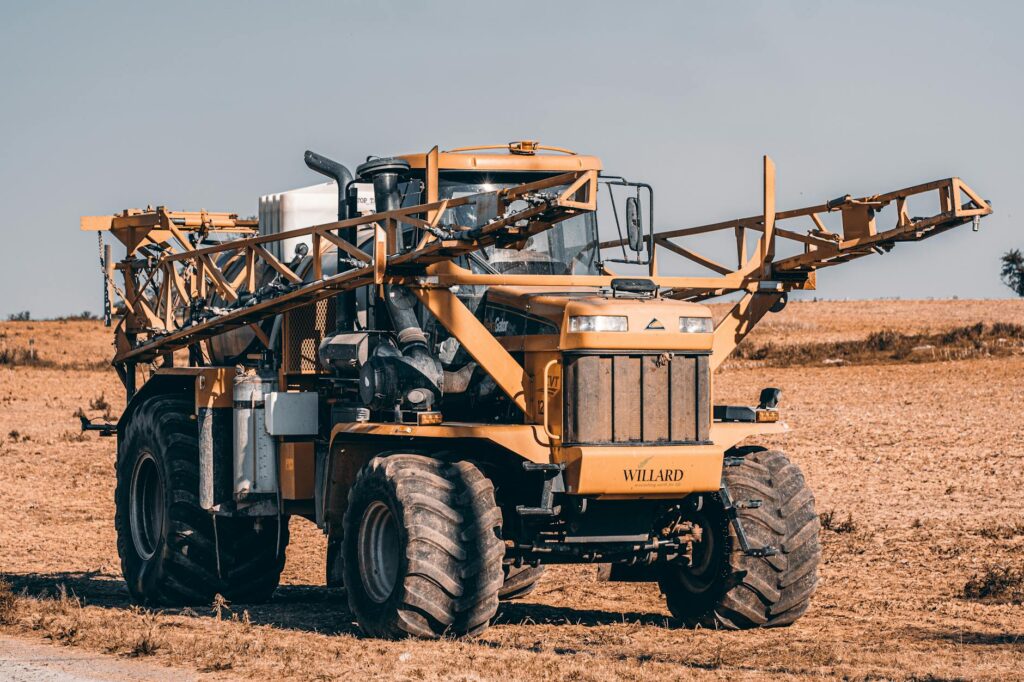
A self-propelled sprayer carries a more extensive lighting setup than a mounted or trailed sprayer because it is a dedicated machine with its own cab, chassis, and electrical capacity. Self-propelled sprayers from Bateman, Househam, Agrifac, and similar makers leave the factory with multiple work-light positions, and operators add more for night work.
A self-propelled sprayer lighting setup runs to 3 layers.
Road and travel lighting. Headlamps, beacons, and marker lights for moving the machine between fields on the road, the same legal lighting any road-going farm vehicle needs.
Field work lighting. Roof and cab-corner flood lights of 4,000 to 6,000 lumens that light the crop and tramlines, plus rear lights for reversing and tank checks.
Boom and nozzle lighting. The same boom lights and nozzle lights described above, scaled to the wide booms (30 to 48 metres) that self-propelled machines carry.
The self-propelled sprayer’s larger alternator and dedicated wiring support a fuller LED setup than a tractor running a mounted sprayer off its auxiliary circuits. The principle of layered lighting (travel, work, application) stays the same across machine types.
For the dedicated guide and trailer-mounted setups, see Self-Propelled Sprayer Lights: Night Spraying Safely and Agricultural Trailer Lights: Complete Guide.
Powering and Wiring Sprayer Lights
Sprayer lights draw power from the tractor’s auxiliary lighting circuit or the self-propelled machine’s dedicated supply, wired through a relay and fused for the load. A full sprayer lighting setup adds 10 to 30 A of demand, which the wiring must carry without overloading the standard work-light circuit.
The wiring follows 4 principles.
A relay carries the lamp current. The cab switch triggers a relay, and the relay feeds the lights direct from the battery through heavy cable. This keeps the high current out of the switch and the cab loom.
An inline fuse protects each circuit. The fuse rating matches the total lamp draw on that circuit, so a fault blows the fuse rather than the wiring.
The boom loom is protected and flexible. Cable run along the boom must flex with the boom and resist snagging, abrasion, and chemical exposure, run inside conduit or spiral wrap and clipped clear of moving parts.
Connectors are sealed. Deutsch or equivalent sealed connectors keep water and chemical out of the joints, which a sprayer’s wash-down routine would otherwise corrode.
A mounted or trailed sprayer takes its power from the tractor through a dedicated lighting connector, separate from the road-light socket, so the work and boom lights switch from the cab independently of the road lighting.
For the wiring detail, see How to Wire Work Lights to a 12V System with a Relay and Fuses and Circuit Protection for Vehicle Lighting.
Choosing Sprayer Lights
Sprayer lights are chosen on 5 specifications: function, output, beam pattern, sealing, and voltage. Each lamp position on the sprayer calls for a different combination, so the choice runs position by position rather than one lamp for the whole machine.
Specification one, function. Flood work lights for the working zone, slim lights for the boom, and focused nozzle lights for the spray fans. Match the lamp to its job.
Specification two, output. Work lights at 3,000 to 5,000 lumens, boom lights at 1,000 to 2,000 lumens, nozzle lights at 100 to 500 lumens. More is not better; over-bright lights flatten the spray pattern and dazzle the operator.
Specification three, beam pattern. Flood for the working zone and the boom, focused or narrow for the nozzles. A spot beam has no place on a sprayer except for distant obstacle checks.
Specification four, sealing. IP67 as a minimum, IP69K where the machine sees pressure wash-down. A sprayer endures more water and chemical than almost any other farm lamp position, so sealing decides the lamp’s working life.
Specification five, voltage. 12 V for tractor-mounted sprayers, 24 V for many self-propelled machines, or a multi-voltage 9 to 33 V LED unit that suits a mixed fleet.
A quality LED sprayer light from Hella, Nordic Lights, LED Autolamps, or a comparable maker resists the vibration, water, and chemical of the sprayer environment for 30,000 to 50,000 hours. A generic marketplace work light often fails the sealing test within a season of wash-downs.
For the buying decision, see Cheap vs Premium LED Work Lights and IP67 vs IP69K Work Lights: Which Ingress Protection Rating Do You Need. For products, browse the work lamps category.
The summary picture for sprayer lights: night spraying gives lower wind and better coverage, work lights light the cab and fill zones, boom lights light the full spray width, nozzle lights reveal blocked jets that would otherwise leave untreated strips, and IP69K sealing decides how long any sprayer lamp survives the wash-down routine.