Tractor Lighting for Silage Season: What to Fit and Where
In this guide
- Why Silage Season Lighting Needs More Than the Factory Setup
- Mower and Conditioner Tractor Lighting
- Forager and Self-Propelled Harvester Lighting
- Trailer Tractor and Trailer Lighting
- Buckrake and Clamp Tractor Lighting
- Silage Clamp Site Lighting
- Road-Legal Lighting Between Fields
- Building a Silage Season Lighting Kit
- Frequently Asked Questions
- Notes on Internal Links
Silage season tractor lighting is the full lighting setup fitted across the mower, the forager, the trailer tractors, the buckrake and the clamp area to allow safe work through dusk, night and early-morning shifts. The silage window in the UK runs from mid-May to late August, and the typical first cut runs 14 to 18 hours a day for 3 to 5 days. A correctly equipped silage tractor fleet runs 4 to 12 LED work lamps per machine, beacons that meet ECE R65, and trailer lighting that meets the Road Vehicles Lighting Regulations 1989. This guide covers what to fit on each machine, where to mount it, and how to stay road-legal between fields.
Why Silage Season Lighting Needs More Than the Factory Setup
Factory lighting on a tractor covers road use and short field tasks in daylight. Silage season demands more because the work runs through the night, the air is full of dust and chopped grass, and 4 to 6 different machines need to coordinate in a small clamp area. The standard factory lamps fitted to a 100 to 200 hp tractor produce 1,500 to 3,500 lumens per side. A working silage tractor needs 8,000 to 30,000 total lumens to light the swath, the forager intake, the buckrake working face, or the trailer body without shadow.
Three reasons silage lighting demand is higher than normal field work.
- Longer shifts. Silage work runs 14 to 18 hours per day during peak cutting, so the lighting must work in full darkness from 22:00 to 04:00.
- Tighter operating areas. Foragers, tractors and trailers work within 5 to 20 metres of each other at the clamp, where a poorly lit machine is a collision risk.
- Higher fatigue load. Health and Safety Executive figures show being struck by a moving vehicle accounted for 23% of agricultural deaths in 2024-2025, with fatigue cited as a contributing factor.
Three lighting upgrades that pay back fastest.
- Adding 2 to 4 LED work lamps to the rear of the trailer tractor. Cost GBP 80 to GBP 240. Benefit, full visibility of the clamp face when tipping.
- Replacing the original-fit halogen work lamps with LED equivalents. Cost GBP 200 to GBP 800 per tractor. Benefit, 3 to 5 times the output for the same wattage.
- Fitting an ECE R65 amber beacon to every machine on the road. Cost GBP 25 to GBP 90 each. Benefit, road legality and full visibility to other drivers.
For the underlying technology choice, see LED Work Lights and the broader The Complete Guide to Tractor Lighting.
Mower and Conditioner Tractor Lighting
The mower tractor cuts and conditions grass at 8 to 15 km/h, often into the headland after sunset. The mower tractor needs lighting that covers the cutting line in front of the conditioner, the swath behind, and the area immediately around the machine for turning.
Recommended mower-tractor lamp setup.
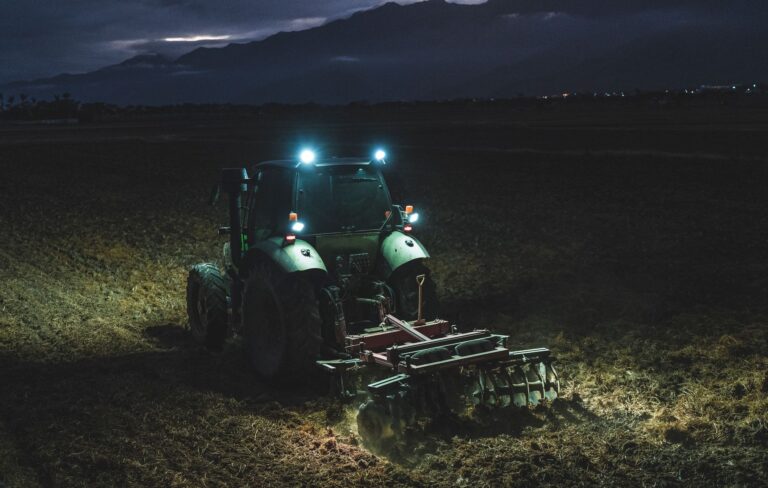
- Forward lighting. 2 LED work lamps on the front roof or A-pillar, 3,500 to 5,500 lumens each, flood beam. The flood pattern lights the full cut width of a 3 to 9 metre mower.
- Side lighting. 2 LED work lamps on the cab roof corners, 2,500 to 4,000 lumens each, flood beam. Side lighting helps the operator track the conditioner output and check the swath shape.
- Rear lighting. 2 LED work lamps on the rear cab roof, 3,000 to 5,000 lumens each, flood beam. Rear lamps light the conditioner rotor and the swath line for any operator looking back to check the cut quality.
- Beacon. 1 ECE R65 amber LED beacon mounted high on the cab. The beacon is required for any agricultural vehicle exceeding 25 mph capability or carrying a wide implement on the road.
Mounting positions. Use the factory roof brackets if fitted. For tractors without roof channels, fit a clamp-on light bar to the cab gutter rather than drilling the cab structure. The clamp-on bar takes 4 to 6 lamps on a 1 to 1.5 metre rail.
The conditioner attachment. The conditioner itself rarely carries lighting, but front-mounted mowers can block headlight beam coverage on the cut line. Fit 2 small LED bullet lamps to the front weight or front linkage to underlight the cutter bar, 1,500 to 2,500 lumens each.
Forager and Self-Propelled Harvester Lighting
The forager picks up the swath and chops it into the trailer alongside. The forager operates at 10 to 20 km/h, blowing chopped grass over a spout 4 to 6 metres long into a moving trailer. Forager lighting needs to cover the swath pickup, the spout target zone, and the area around the cab for situational awareness.
Recommended forager lamp setup. A modern self-propelled forager carries 12 to 24 work lamps in the factory specification. Older trailed foragers towed behind a tractor often have only the towing tractor’s lights and need supplementary lamps fitted to the forager body itself.
For trailed foragers, fit these supplementary lamps.
- 2 LED work lamps on the forager body facing forward over the pickup reel, 3,500 to 5,500 lumens each, flood beam.
- 2 LED work lamps on the rear of the forager body facing the trailer, 3,000 to 4,500 lumens each, flood beam.
- 1 LED work lamp on the spout itself, 2,500 to 3,500 lumens, spot beam. The spot beam lights the trailer body target zone.
For self-propelled foragers, the upgrade is usually a swap from halogen to LED on the existing OEM bracketry. The factory wiring loom takes the new lamps directly. Match the LED draw to the existing fuse rating to avoid an overload. A 9-inch LED work lamp drawing 12 watts replaces a 70-watt halogen with no wiring change.
Spout lighting matters most. The forager driver must aim the spout into a moving trailer that may be 8 to 15 metres away in full darkness. A dedicated spout lamp reduces overshoot, undershoot and spillage. The same lamp helps the trailer driver hold the correct line under the spout.
For the wider beam-pattern choice, see Flood vs Spot Beam Tractor.
Trailer Tractor and Trailer Lighting
The trailer tractor pulls a silage trailer alongside the forager, then runs the load to the clamp. The trailer tractor needs road-legal lighting because the round trip from field to clamp usually crosses public roads, plus working lights for the loading approach and the clamp tip.
Trailer tractor lighting setup.
- Front. 2 to 4 LED work lamps on the cab roof, 3,500 to 5,500 lumens each, flood beam.
- Side. 2 LED work lamps on the cab roof corners facing outward, 2,500 to 4,000 lumens each, flood beam. Side lighting is critical because the trailer tractor runs parallel to a moving forager and needs to read the spout position and trailer fill level.
- Rear. 2 LED work lamps on the rear cab roof, 3,500 to 5,500 lumens each, flood beam. Rear lamps light the trailer body and the coupling.
- Reversing lamps. 2 white LED reversing lamps wired through the reverse switch. The clamp tip requires accurate reversing under a tipped trailer body.
- Beacon. 1 ECE R65 amber LED beacon on the cab roof.
Silage trailer lighting (the trailer itself).
- 2 red tail lamps with stop and indicator functions, fitted to the rear corners.
- 2 white front position lamps or marker lamps, fitted to the front corners.
- Side marker lamps every 3 metres along the trailer body for trailers over 6 metres long.
- 1 white reversing lamp on the trailer rear.
- 1 amber beacon on the trailer body, optional but recommended for road use.
Trailers manufactured after 1 October 2012 fitted with brakes must carry a reversing lamp under UK road law. Trailers exceeding 6 metres in length require 2 reversing lamps, one on each side.
For the full trailer requirement, see Agricultural Trailer Lights and Agricultural Trailer Lighting Requirements UK.
Buckrake and Clamp Tractor Lighting
The buckrake tractor sits at the clamp, pushing the freshly tipped grass up the clamp face and rolling it to drive out air. The buckrake tractor works on a 30 to 60 degree slope in the dark, with trailers reversing toward the clamp every 5 to 15 minutes. Lighting at the clamp tractor must cover the working face, the area behind the tractor, and the path of approaching trailers.
Buckrake tractor lighting setup.
- Forward lighting. 2 to 4 LED work lamps on the cab roof front and the buckrake itself, 3,500 to 5,500 lumens each, flood beam. The buckrake-mounted lamp throws light low onto the clamp surface that the cab-mounted lamps cannot reach over the bucket lip.
- Rear lighting. 4 LED work lamps on the rear cab roof, 3,500 to 5,500 lumens each, flood beam. The rear-facing lamps light the trailer approach and the tipping zone.
- Side lighting. 2 LED work lamps on the cab roof corners, 2,500 to 4,000 lumens each, flood beam.
- Beacon. 1 ECE R65 amber LED beacon on the cab roof, high enough to be visible above the buckrake when raised.
Buckrake-mounted lighting is the upgrade that most clamp operators add first. The buckrake blocks 60% to 80% of the forward beam from cab-mounted lamps when the bucket is raised. A pair of LED bullet lamps mounted to the top edge of the buckrake, wired through a coiled cable to a relay in the cab, gives uninterrupted light onto the clamp face.
Reversing lamp output. Standard 21-watt halogen reversing lamps are inadequate for clamp work. Upgrade to LED reversing lamps producing 1,500 to 3,000 lumens per side. The brighter reverse lighting helps the buckrake operator judge the closing distance of an approaching trailer in heavy dust.
For the rear-light deep dive, see Tractor Reversing Lights: Fitment, Regulations, and Best Options.
Silage Clamp Site Lighting
The silage clamp itself needs fixed lighting for the working face and the trailer turning area. Fixed clamp lighting reduces the load on machine-mounted lamps and improves visibility for foot traffic moving around the clamp.
Recommended fixed clamp lighting.
- 2 to 4 mast-mounted floodlights, 100 to 200 watts each LED equivalent, mounted on a 6 to 10 metre pole at the back corners of the clamp pit. Total output 15,000 to 50,000 lumens.
- 1 to 2 wall-mounted floodlights on the clamp side walls if walled, 50 to 100 watts each LED equivalent, 6,500 to 13,000 lumens each.
- A motion-sensor flood at any pedestrian gate or walkway from the farm yard to the clamp.
Power supply. Mains power is the cheapest long-term solution where the clamp is within 50 metres of an outbuilding. Where mains is not practical, a diesel-generator floodlight tower delivers 100,000 to 250,000 lumens for 8 to 12 hours on a single 30 to 50 litre tank. Battery-powered LED towers run 6 to 10 hours on a charge and produce 40,000 to 80,000 lumens with no diesel cost.
Glare control. Aim fixed clamp lighting away from public roads and away from the trailer driver’s eye line on approach. A floodlight aimed at the trailer cab dazzles the driver during the critical reversing manoeuvre. Use shrouded or asymmetric floodlights that throw light down rather than out.
Road-Legal Lighting Between Fields
Tractors moving between fields, the clamp, and the farm yard during silage season use public roads. UK road law applies in full to any agricultural vehicle on the highway, even when the vehicle is doing the same work as in the field a minute earlier.
The minimum road lighting kit for a silage tractor.
- 2 white headlamps, dipped and main beam.
- 2 white front position lamps.
- 2 red rear position lamps.
- 2 amber indicators front, 2 amber indicators rear.
- 2 red stop lamps.
- 1 white rear number plate lamp.
- 1 red rear fog lamp on tractors first registered after 1 April 1980.
- 2 red rear reflectors and 2 amber side reflectors.
- 1 ECE R65 amber beacon if the tractor exceeds 25 mph or carries a wide implement.
Work lights and the road. Work lights must be off when the tractor is on a public road, except for reversing lamps which can be lit only while the tractor is moving backwards. A rear-facing work light lit on a road tractor is an offence because the bright white beam dazzles following drivers. Most modern tractors include a separate switch that isolates the work lights from the road-light circuit. Older tractors fitted with retro-fitted work lamps may need a dashboard switch added to make the isolation easy.
For full road compliance, see Tractor Lighting Regulations UK and Tractor Road Legal Lights.
Building a Silage Season Lighting Kit
A silage lighting kit for one tractor breaks down into 4 cost tiers based on budget and machine value.
Tier 1, road-legal refresh, GBP 50 to GBP 150 per tractor. Replace any failed bulbs in headlamps, tail lamps, indicators and stop lamps. Add a magnetic ECE R65 amber beacon. This tier suits a backup or contractor tractor that does limited night work.
Tier 2, basic LED upgrade, GBP 250 to GBP 600 per tractor. Replace 4 OEM halogen work lamps with 4 LED equivalents at 3,500 to 5,500 lumens each. Add a permanent-fit LED beacon. Add a coiled cable accessory feed for 1 or 2 additional implement-mounted lamps. This tier suits a primary mower or trailer tractor.
Tier 3, full silage build, GBP 600 to GBP 1,500 per tractor. Upgrade all forward, side and rear work lamps to LED. Add a roof-mounted LED light bar, 30 to 50 inches, for the buckrake or trailer tractor. Add LED reversing lamps. Add a second amber beacon visible from the rear. This tier suits the clamp tractor and any machine that does the full 14 to 18 hour shift.
Tier 4, contractor specification, GBP 1,500 to GBP 4,000 per tractor. Full LED rebuild with 8 to 12 work lamps, dual beacons, light bars front and rear, premium ECE-marked components, and a switched relay panel for individual lamp control. This tier suits silage contractor fleets where downtime cost outweighs upfront spend.
For a complete budget walkthrough, see Budget Tractor Lighting Upgrade Under GBP 200 and How Much Does It Cost to Fit LED Lights to a Tractor.
Browse the Agri Lighting work lamp range for LED, halogen and beacon options that fit common silage-season requirements.
Frequently Asked Questions
What lights do I need for silage? A silage tractor needs the road-legal lighting kit plus 4 to 12 LED work lamps and an ECE R65 amber beacon. The exact mix depends on whether the tractor is the mower, the forager, the trailer or the buckrake.
Are work lights legal at night on a tractor? Work lights are legal in a field at any time. Work lights are not legal on a public road, except for reversing lamps wired through the reverse switch which can be lit only while the tractor is moving backwards.
Do silage trailers need beacons? UK law does not compel an amber beacon on a silage trailer, but a beacon is strongly recommended. Most trailers used for silage carry an amber LED beacon on the front headboard or the rear corner.
How bright should silage tractor lights be? A working silage tractor needs 8,000 to 30,000 total work-lamp lumens, split across forward, side and rear lamps. Individual LED work lamps deliver 2,500 to 5,500 lumens at 12 to 70 watts.
When should I start checking the silage lighting kit? Check the kit 4 to 6 weeks before the planned first cut. Earlier checks allow time to source replacement lamps without paying express delivery during peak season.
Notes on Internal Links
Some internal links above point to articles or product categories not yet live. The unwritten or pending targets are:
- /buying/budget-tractor-lighting-upgrade/ (article 14.2, exists)
- /buying/cost-fit-led-lights-tractor/ (article 14.4, exists)
- /farm-lighting-ideas/agricultural-trailer-lights/ (article 11.8, exists)
- /safety/agricultural-trailer-lighting-requirements/ (article 8.3, exists)
- /tractor-lighting/tractor-reversing-lights/ (article 1.21, written today)
All links above resolve to articles in the published set or being written in this session.