Best Tractor Lights for Night Harvesting: Lumens, Beam Patterns, and Mounting
In this guide
- What Counts as the Best Light for Night Harvesting
- How Many Lumens You Need for Night Harvest Work
- Beam Patterns: Flood, Spot, and Combo for Harvest Tasks
- Where to Mount Work Lights on Tractors and Combines for Harvest
- Power Draw, Voltage, and EMC on Modern Tractors
- Lighting Setups by Harvest Type
- Buying Checklist for Harvest Work Lights
- Example Lighting Layouts for Three Harvest Scenarios
The best tractor lights for night harvesting deliver between 6,000 and 12,000 lumens per pair at the cab roof, throw a usable beam to 80 metres, and draw under 80 W per lamp. LED work lights with IP67 or IP69K dust and water resistance handle the chaff, dust, and moisture of a UK harvest. Beam pattern depends on the task, with flood for header viewing, spot for trailer guidance, and combo for general field illumination. This guide covers the lumens needed, the beam patterns to choose, the mounting positions that work, the power and EMC considerations on modern tractors, and the layouts for cereal, forage, and root crop harvest.
What Counts as the Best Light for Night Harvesting
The best tractor light for night harvesting is the light that matches the harvest task to the right output, beam, mounting, and electrical compatibility. Best does not mean brightest or most expensive. Best means a light that produces enough lumens for the task, throws the right beam pattern, mounts in the right position on the tractor or combine, draws power within the alternator’s spare capacity, and meets EMC standards so it does not interfere with GPS auto-steer.
Three criteria filter the harvest market down to credible options. Output, expressed in lumens or candela, sets the visible distance and area covered. Beam pattern, expressed in degrees of spread, sets the shape of the lit zone. Build standard, expressed as IP rating and EMC compliance, sets the durability and electronic compatibility.
Five harvest light requirements separate genuine options from poor options. Real lumen output (measured, not theoretical), durable IP67 or IP69K housing, ECE compliance for road use, EMC R10 compliance for GPS-equipped tractors, and a wiring connector that survives chaff dust without seizing.
The harvest tractor light therefore differs from a general work light in two ways. The harvest light tolerates higher dust and moisture than a yard light. The harvest light meets stricter EMC limits than a road light, because cereal harvest in the UK runs through some of the heaviest GPS auto-steer use of the year.
For the foundation of work light selection, see Tractor Work Lights and the cluster pillar Complete Guide to Tractor Lighting.
How Many Lumens You Need for Night Harvest Work
Lumen requirements for harvest scale with the size of the area being lit and the speed of work. A combine harvester header at 7 km/h needs more lumens than a tractor unloading on a stationary trailer at the field edge. The figures below come from operator practice across UK arable and forage farms during the 2024 and 2025 harvests.
Combine header viewing: 6,000 to 10,000 lumens per pair, mounted at the front of the cab roof or on the header itself. The header sits 4 to 12 metres ahead of the operator, so the light must reach 15 metres minimum and ideally 25 metres. Two 5,000 to 6,000 lumen LED work lights with combo beams meet the requirement.
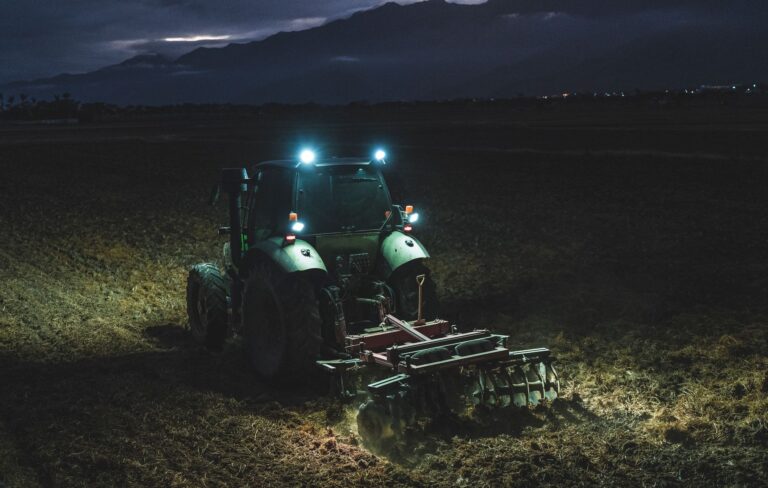
Tractor cab roof for general field illumination: 8,000 to 12,000 lumens total spread across 4 lamps. Four lamps at 2,000 to 3,000 lumens each give 360 degree coverage at the working area. The setup costs less than two high-output lights, gives better visibility around the cab, and survives single-lamp failure with no blackout.
Trailer or chaser bin loading: 2,000 to 4,000 lumens at the rear of the tractor or hopper, pointing back into the trailer. Loading visibility needs the light pointing into the trailer body, not flooding the field behind. A single 2,000 to 4,000 lumen flood lamp on the hopper or rear of the tractor cab does the job.
Hopper or tank visibility: 1,500 to 3,000 lumens close-mounted (within 1 metre of the hopper opening). The driver needs to see the grain or forage entering the trailer, not the trailer’s wider surroundings. A short-throw flood mounted on the hopper edge gives that.
For the fundamentals of lumen choice, see How Many Lumens Do You Need for Tractor Work Lights.
Beam Patterns: Flood, Spot, and Combo for Harvest Tasks
Beam pattern decides whether the harvest light covers a wide area at short range, a narrow area at long range, or a mix of both. Three beam patterns cover all harvest tasks: flood, spot, and combo (sometimes called drive or all-round).
Flood beam, 60 to 120 degree spread. Flood lights cover a wide area at 5 to 30 metres from the lamp. Flood is the right beam for header viewing, hopper loading, and trailer coupling. The wide spread gives the operator peripheral vision around the immediate work area.
Spot beam, 8 to 30 degree spread. Spot lights throw a narrow beam to 80 to 200 metres. Spot is the right beam for trailer guidance from a distance, for spotting field obstacles ahead of the combine, and for end-of-field manoeuvring where the operator needs to see the gateway from 100 metres away.
Combo beam, mixed flood and spot in a single lamp. Combo lights include both wide-angle LEDs and narrow projector LEDs in one housing. Combo is the right beam for cab roof general illumination, where one lamp covers both the close working area and the longer field view. Most modern LED tractor work lights ship with a combo pattern.
Three rules of thumb decide beam choice. Close work (under 20 metres), choose flood. Distance work (over 50 metres), choose spot. Mixed-distance work (typical cab roof position), choose combo.
A typical harvest tractor light setup uses a mix. Two combo lights at the front of the cab roof for combine header view and forward field view. Two flood lights at the side of the cab roof for trailer loading and field margin visibility. Two spot lights low on the bonnet or grille for end-of-field manoeuvring at distance.
For the beam pattern decision in detail, see Flood vs Spot Beam: Which Beam Pattern for Which Tractor Task.
Where to Mount Work Lights on Tractors and Combines for Harvest
Mounting position decides what the light actually illuminates. The same lamp at 1.5 metres above the ground lights a different scene than the same lamp at 3.2 metres. Harvest mounting positions fall into 6 standard locations, each with a specific job.
Cab roof front, 2.8 to 3.2 metres high. Front roof mounting throws light over the bonnet to the working area ahead. The roof position lifts the beam clear of the bonnet, the front loader, and the combine header. Front roof is the primary forward harvest light position.
Cab roof rear or sides, 2.8 to 3.2 metres high. Side and rear roof positions light the trailer being loaded, the hopper area, and the operator’s blind spots. Two side-mounted lamps and one rear-mounted lamp cover the loading scene from three angles.
Bonnet or grille, 1.0 to 1.5 metres high. Bonnet mounting puts a tight spot beam at low height, useful for spotting field obstacles, ruts, and gateways. Bonnet lights complement roof lights, they do not replace them.
Cab pillar (A-pillar), 2.0 to 2.4 metres high. Pillar-mounted lights throw a narrow flood to the side, useful for matched pair loading where the trailer runs alongside the tractor or combine.
Header (combine only), 2.5 to 4 metres high depending on header model. Header-mounted lights point down and forward at the cutting line. Header lights are the brightest single requirement on a combine, because the header sits 4 to 12 metres ahead of the cab.
Hopper or tank edge, 1.5 to 2.5 metres high. Hopper lights point inward into the loading area. Single short-throw floods at this position let the operator see grain or forage levels in real time without leaving the cab.
For the wider mounting topic, see How to Mount Work Lights and Mounting Positions for Tractor Lights (within the pillar).
Power Draw, Voltage, and EMC on Modern Tractors
Modern tractors run 12 V or 24 V electrical systems with alternator outputs of 90 to 240 amps. The combined draw of harvest work lights must stay within the alternator’s spare capacity (typically 30 to 60 amps after standard vehicle loads).
Power draw figures by lamp type, per lamp. LED work light, 18 to 80 W. Halogen H3 work light, 70 to 100 W. Xenon HID work light, 35 to 70 W (plus startup surge). The LED draws the least power for equivalent output, which is why LED dominates harvest work light fitment in 2026.
A typical 8-lamp LED harvest setup draws 18 to 22 amps at 12 V (216 to 264 W total). A typical 8-lamp halogen setup at the same lumen output would draw 50 to 60 amps at 12 V (600 to 720 W). The halogen draw exceeds the alternator’s spare capacity on most pre-2015 tractors. The LED draw fits within spare capacity on every modern tractor.
EMC compliance matters for two reasons during harvest. RTK GPS auto-steer needs interference-free reception. Tractor CAN bus systems need clean electrical environments. ECE Regulation 10 (R10) certification confirms a work light’s electromagnetic emissions sit within the limits set for vehicle equipment.
Three EMC pitfalls trap harvest operators. PWM dimmer circuits in cheap LED drivers create radio frequency noise that can disrupt RTK GPS at 1.5 GHz. Unshielded LED wiring acts as an antenna for ignition noise. Non-compliant LED bulbs retrofitted into halogen housings (without proper EMC filters) cause flicker and CAN bus errors on John Deere, Fendt, and Case IH tractors.
The right LED harvest lights ship with R10 EMC compliance, R23 work lamp compliance for road movement, and a CAN bus compatible driver where the tractor needs it. Look for those marks on the lamp body or in the data sheet.
For the GPS interference detail, see Do LED Lights Interfere with GPS and Auto-Steer Systems.
Lighting Setups by Harvest Type
Harvest type changes the lighting requirement. Cereal combining differs from forage harvesting differs from root crop lifting. Each harvest sets its own lumen, beam, and mounting requirements.
Cereal combine harvest. The combine cab sits 3 to 4 metres above the ground, and the header sits 4 to 12 metres ahead. The header view is the priority. Use 4 high-output combo lamps at the front of the cab roof (5,000 to 6,000 lumens each), 2 spot lamps on the header itself (3,000 to 4,000 lumens each, pointing down and forward at the cutting line), and 2 flood lamps at the rear for hopper unloading.
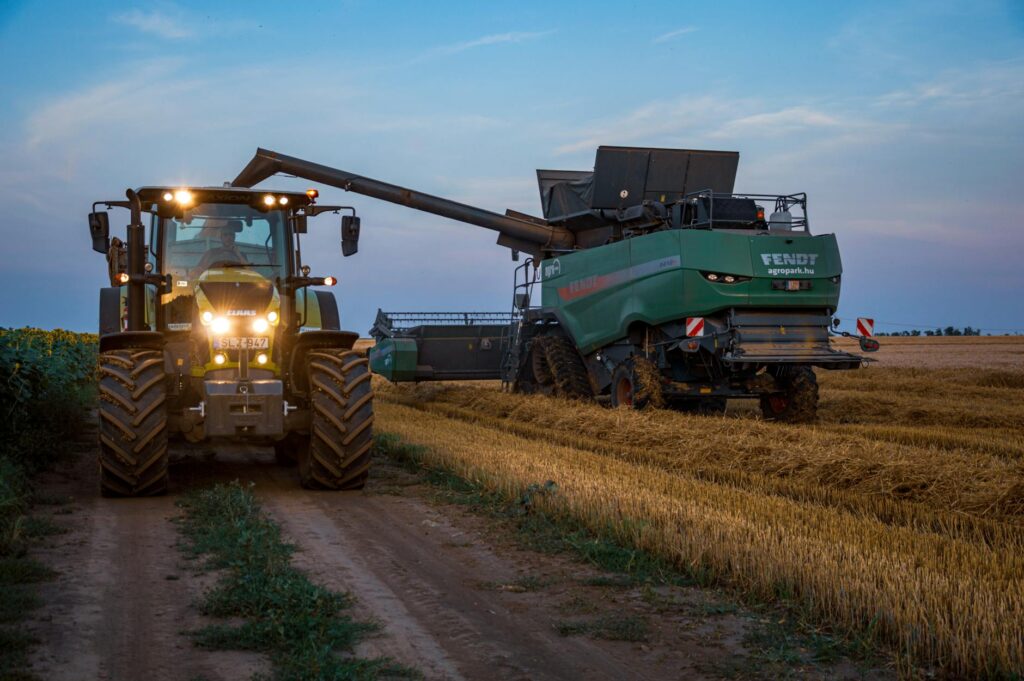
Tractor and chaser bin or trailer at combine. The tractor follows or runs alongside the combine collecting grain. Loading view is the priority. Use 4 combo lamps on the tractor cab roof (3,000 lumens each), 1 flood lamp at the rear of the cab pointing back into the trailer (2,000 to 3,000 lumens), and 1 short-throw flood on the trailer or hopper edge (1,500 to 2,500 lumens).
Forage harvester (self-propelled or trailed). Forage harvest typically runs through dust and chaff in heavier volumes than cereal harvest. The cutter, blower, and spout view all matter. Use 2 combo lamps at the front of the cab roof for cutter view, 2 spot lamps on the spout pivot for trailer-fill alignment (2,000 to 3,000 lumens each), and 2 flood lamps at the rear of the cab.
Root crop harvest (potatoes, sugar beet, onions). Root harvest runs at lower forward speed than cereal harvest, but the harvester unit sits behind or beside the tractor and the soil flow into the trailer or web is the visibility priority. Use 4 combo lamps on the tractor cab roof for general view, 2 flood lamps on the harvester unit pointing at the soil flow and grading area (2,500 to 3,500 lumens each), and 1 flood lamp on the trailer for fill view.
For the broader harvest lighting picture, see Harvest Lighting Guide and Combine Harvester Lighting.
Buying Checklist for Harvest Work Lights
A harvest work light meets nine specific requirements. Use this checklist before buying.
- Lumen output stated as real or effective lumens, not raw chip lumens. A real 4,800 lumen LED beats a raw-rated 9,600 lumen LED for harvest visibility.
- Beam pattern matches the intended task (flood, spot, or combo as set out above).
- IP rating IP67 minimum for water and dust ingress. IP69K is preferred for power-wash cleaning at end of harvest.
- Operating voltage matches the tractor (12 V or 24 V). Many modern lamps are 9 to 32 V range and fit both.
- EMC compliance, ECE R10. Mandatory for any tractor with GPS auto-steer.
- Road type approval, ECE R23 (for tractors driven on road with the lights connected). The R23 mark allows the lamp to be wired through the vehicle’s electrical system without violating Construction and Use Regulations.
- Connector type. Deutsch DT or Superseal connectors survive harvest dust. Bullet connectors and unsealed automotive connectors do not.
- Housing material. Die-cast aluminium dissipates heat better than plastic. Polycarbonate lens stands up to stone strikes better than glass on a tractor.
- Warranty. 3 to 5 year manufacturer warranties indicate genuine LED quality. 1 year or less warranties typically signal lower-grade chips and drivers.
For the wider buying framework, see Work Light Buyer’s Checklist.
Example Lighting Layouts for Three Harvest Scenarios
Three example harvest setups show how the principles above combine in practice. All figures cover real lumen output, total power draw, and lamp count.
Setup 1: 6 metre cereal combine with chaser tractor. Combine carries 4 cab roof combo lamps (4 x 5,500 lumens = 22,000 lumens) plus 2 header spot lamps (2 x 3,500 lumens = 7,000 lumens) plus 2 hopper flood lamps (2 x 2,500 lumens = 5,000 lumens). Combine total, 8 lamps, 34,000 lumens, 320 W draw. Chaser tractor carries 4 cab roof combo lamps (4 x 3,000 lumens = 12,000 lumens) plus 1 rear cab flood (2,500 lumens) plus 1 trailer flood (2,000 lumens). Tractor total, 6 lamps, 16,500 lumens, 175 W draw.
Setup 2: 200 hp tractor with self-propelled forage harvester following. Tractor and trailer combination only. Cab roof, 4 combo lamps (4 x 3,500 lumens = 14,000 lumens). Spout side, 2 spot lamps for trailer alignment (2 x 2,500 lumens = 5,000 lumens). Cab rear, 1 flood lamp for trailer fill view (2,500 lumens). Total, 7 lamps, 21,500 lumens, 180 W draw at 12 V.
Setup 3: Sugar beet harvest with trailed harvester and trailer alongside. Tractor cab roof, 4 combo lamps (4 x 3,000 lumens = 12,000 lumens). Harvester body, 2 flood lamps (2 x 3,500 lumens = 7,000 lumens) pointing at the lifting and webbing area. Trailer, 1 flood lamp for fill view (2,000 lumens). Total, 7 lamps, 21,000 lumens, 200 W draw.
Each setup gives the operator usable visibility from the cab to 80 metres ahead, full coverage of the immediate working area, and clear loading view at the trailer or hopper. Each setup stays within the alternator capacity of a modern 100 to 300 hp tractor.
For the complete LED work light range, browse the work lights category on Agri Lighting, and for the wider tractor lighting strategy see the pillar guide.