Work Light Beam Patterns: Flood, Spot, and Combo Explained
In this guide
A work light beam pattern is the shape of the light projected by a work lamp’s optical system, defined by the beam angle, the lux distribution at distance, and the cut-off characteristics. The beam pattern matters more than total lumen output for farm work because the same 5,000-lumen lamp covers a 4 m yard in flood form or a 30 m field strip in spot form. Three beam patterns dominate agricultural work lamp selection: flood (60° to 90° wide, 5 to 15 m range), spot (20° to 30° wide, 15 to 50 m range), and combo (a spot core inside a flood surround). This guide covers the optics, the measurement, and the task-to-pattern matching for any work lamp fitted to any farm vehicle.
What a Work Light Beam Pattern Is
A work light beam pattern is the 3-dimensional shape of light projected from a work lamp, defined by the angular spread of the beam and the lux delivered at any point within that spread. A wider beam covers more area at lower intensity. A narrower beam concentrates intensity at the cost of coverage. The beam pattern is determined by the lamp’s optical system: the reflector geometry, the lens design, and the LED chip arrangement.
A work light beam pattern is set at the factory by the lamp design and cannot be changed without replacing the lamp. A lamp marked as flood produces flood. A lamp marked as spot produces spot. Some premium work lamps offer interchangeable optical lenses, but most do not. The beam pattern selection happens at the point of purchase.
A work light beam pattern matters more than the lumen rating for matching the lamp to the task because the same lumen output spread across different beam patterns produces wildly different working light. A 5,000-lumen flood lamp delivers 50 to 100 lux across a 12 m radius arc. The same 5,000 lumens in a spot pattern delivers 200 to 400 lux on a 4 m circle at 30 m. Different work, different lamp.
Flood Beam
A flood beam is a wide-angle work light pattern that spreads light across a horizontal arc of 60° to 90° at moderate range (5 to 15 m). A flood beam suits close-range task lighting where lateral coverage matters more than reach.
Flood Beam Angle and Coverage
A flood beam angle is the horizontal angular spread of the lamp’s main light cone. Most agricultural flood beams measure 60° to 90° horizontally and 30° to 60° vertically. The asymmetric vertical-to-horizontal spread suits the typical work scene: a wide working area at roughly the same height as the operator.
| Flood beam angle | Coverage at 5 m | Coverage at 10 m |
|---|---|---|
| 60° horizontal | 5.8 m wide | 11.6 m wide |
| 75° horizontal | 7.7 m wide | 15.3 m wide |
| 90° horizontal | 10 m wide | 20 m wide |
| 120° horizontal (extra wide) | 17.3 m wide | 34.6 m wide |
Flood Beam Lux at Distance
A flood beam delivers higher lux at close range and falls off quickly with distance because the wide spread divides the lumen output across a larger illuminated area. A typical 4,500-lumen flood work lamp delivers approximately 1,000 lux at 3 m, 250 lux at 6 m, 60 lux at 12 m, and 15 lux at 25 m. Comfortable working light needs 100 to 200 lux for general work and 300 to 500 lux for precision tasks.
Flood Beam Use Cases
A flood beam suits these farm tasks: yard reversing, livestock loading and unloading, baler operation (wrap inspection), telehandler bucket and fork work, stack-block loading, trailer hitching, slurry spreading. The common factor is close-range work across a wide arc where the operator needs to see the full working scene rather than a narrow strip.
Spot Beam
A spot beam is a narrow-angle work light pattern that concentrates light into a cone of 20° to 30° at long range (15 to 50 m). A spot beam suits long-range field work where reach matters more than lateral coverage.
Spot Beam Angle and Coverage
A spot beam angle is the horizontal angular spread of the concentrated light cone. Most agricultural spot beams measure 20° to 30° horizontally and 15° to 25° vertically.
| Spot beam angle | Coverage at 20 m | Coverage at 40 m |
|---|---|---|
| 20° horizontal | 7 m wide | 14 m wide |
| 25° horizontal | 8.8 m wide | 17.7 m wide |
| 30° horizontal | 10.7 m wide | 21.4 m wide |
Spot Beam Lux at Distance
A spot beam delivers higher lux at long range than a flood of the same lumen rating because the concentrated cone divides the output across a smaller illuminated area. A typical 4,500-lumen spot work lamp delivers approximately 3,500 lux at 5 m, 900 lux at 10 m, 220 lux at 20 m, 100 lux at 30 m, and 40 lux at 50 m. The same lumen rating in flood form drops below useful brightness at 25 m.
Spot Beam Use Cases
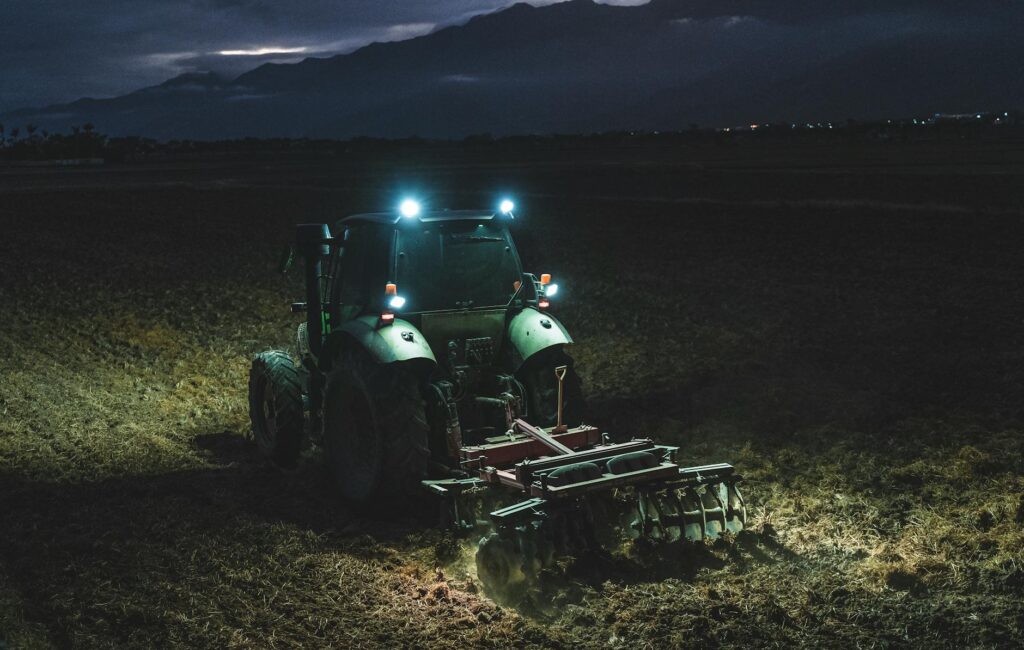
A spot beam suits these farm tasks: ploughing at night, cultivation, harvesting (combine cab roof front), spraying at long boom width, road haulage support, contractor escort work, fence line inspection. The common factor is long-range work along a narrower strip where the operator needs to see what is 20 to 50 m ahead.
Combo Beam
A combo beam is a hybrid work light pattern that combines a central spot section with a surrounding flood section in a single lamp. A combo beam suits mixed-use farm vehicles where one lamp must cover both close yard work and longer-range fieldwork.
Combo Beam Construction
A combo beam combines 2 optical systems in 1 housing. The standard arrangement is a spot core (typically 25° to 30° wide) at the lamp centre with a flood surround (typically 60° to 80° wide) around the outside. Some designs use separate LED clusters for each pattern; others use a single LED bank with a multi-zone lens that splits the output.
Combo Beam Lux Distribution
A combo beam lux distribution overlays the 2 patterns. The spot core delivers spot-like lux at long range (200 to 400 lux at 30 m). The flood surround delivers flood-like lux at close range (200 to 400 lux at 5 to 8 m). Total lumen output for a combo lamp is divided between the 2 sections, typically 60% spot, 40% flood.
Combo Beam Use Cases
A combo beam suits these farm vehicles: contractor tractors moving between road work and field work, telehandler boom ends working both close and far loads, mid-range tractors with limited mounting positions where 1 lamp must do 2 jobs, dual-purpose ATVs and pickups. Where mounting positions are abundant, fitting separate flood and spot lamps usually beats fitting combos.
Driving Beam vs Work Beam
A driving beam is a long-range narrow-cone beam (10° to 15°) designed for forward visibility while the vehicle is moving. A work beam is a flood, spot, or combo beam designed to illuminate a working area regardless of vehicle motion. The 2 beams serve different purposes and the lamps are not interchangeable on most regulatory grounds.
Driving Beam Characteristics
A driving beam concentrates light into a very narrow forward cone with high lux at long range (50 to 200 m). The beam is similar to a vehicle high-beam headlamp but typically narrower. UK regulations classify driving lamps separately from work lamps and headlamps; some are road-legal as auxiliary lamps subject to fitment rules.
Work Beam Characteristics
A work beam (flood, spot, or combo) is designed for stationary or slow-moving work where the operator needs to see a working scene rather than a road ahead. UK regulations on work lamps prohibit their use on the public highway in most cases. A work lamp switched on while driving on a public road is an offence even if the lamp itself meets E-mark requirements.
Why the Distinction Matters
A driving lamp on a tractor lights the road ahead at speed. A work lamp on a tractor lights the working area at slow speed or stationary. Fitting a work lamp where a driving lamp belongs (or vice versa) creates regulatory and operational problems: the wrong beam pattern, wrong lux distribution, wrong angle, and (potentially) wrong type approval. For the regulatory detail, see the tractor lighting regulations guide.
Beam Angle Measurement
A beam angle is the horizontal angular spread of the lamp’s main light cone, measured at the half-intensity points (the points where lux drops to 50% of the peak). The half-intensity definition is the international standard and the most useful for practical work light selection.
Reading the Beam Angle Spec
A work lamp specification states the beam angle as a single number (e.g. “30°”) or as a horizontal × vertical pair (e.g. “30° × 20°”). Both numbers reference the half-intensity points. A lamp specified as “60° flood” actually produces light beyond 60° at lower intensity; the 60° figure is where the working light effectively ends.
What the Numbers Mean in Practice
| Spec | Pattern | Practical use |
|---|---|---|
| 10° to 15° | Long-range driving / pencil spot | Driving lamp, contractor escort |
| 20° to 30° | Spot work beam | Fieldwork, harvest, ploughing |
| 30° to 45° | Tight flood / wide spot | Mixed-use general work |
| 60° to 90° | Standard flood | Yard, livestock, baler |
| 90° to 120° | Wide flood | Cab rear, livestock shed loading |
Why Lux at Distance Matters More Than Beam Angle
A beam angle alone does not tell you how usable the lamp is at the working distance. A 60° flood with 4,500 lumens delivers more useful working light than a 60° flood with 2,500 lumens at the same range. Always check the lux-at-distance figure (where supplied) alongside the beam angle.
Reflector vs Lens Optics
A work light optical system is either a reflector (a parabolic or compound mirror behind the LED) or a lens (a moulded acrylic or polycarbonate optic in front of the LED). Both produce all 3 beam patterns; the construction differs.
Reflector Optics
A reflector optic uses a curved metallised mirror behind the LED chip to project the light forward. Reflectors suit older halogen and HID work lamps where the light source emits light in all directions. Reflector LED units exist but are less common because LEDs emit light in a forward hemisphere rather than a full sphere, which makes lens optics more efficient.
Lens Optics
A lens optic uses a moulded clear or frosted lens in front of the LED chip to shape and direct the light. Most modern LED work lamps use lens optics because they convert the LED’s forward-hemisphere emission pattern into a defined beam shape with minimal loss. Lens optics produce sharper beam cut-offs and more consistent lux distribution than reflectors.
Hybrid Reflector-Lens Systems
A hybrid reflector-lens work light combines a reflector behind the LED with a secondary lens at the front. The hybrid suits high-output combo beams where the reflector creates the flood surround and the lens creates the spot core. Premium agricultural LED work lamps from Nordic Lights, Hella, and others use hybrid optics.
Matching Beam Pattern to Task
A beam pattern matches a task when the lux-at-distance and angular coverage match what the operator needs to see. Eight common farm tasks have a clear best-fit beam pattern.
| Task | Best beam pattern | Mounting position | Notes |
|---|---|---|---|
| Ploughing at night | Spot or driving | Front cab roof corners | Long-range strip illumination |
| Combine harvesting | Spot front, flood rear | Cab roof apex | Front sees the crop ahead, rear sees the unloading |
| Round baling | Combo or flood | Cab roof rear | Mixed close and mid-range coverage |
| Yard loader work | Flood | A-pillar + front grille | Wide close coverage |
| Livestock loading | Flood | Cab roof rear corners | Wide low-glare coverage |
| Sprayer boom work | Spot side-facing | Cab roof side panels | Long lateral reach along the boom |
| Telehandler stack work | Combo | Boom and cab roof | Spot for height, flood for ground |
| Trailer hitching | Flood | Cab roof rear | Close wide coverage |
For deeper task-to-lamp matching, see the tractor work lights guide and the flood vs spot beam selection walkthrough.
Mixing Beam Patterns on the Same Vehicle
A typical modern agricultural vehicle benefits from mixing 2 or 3 beam patterns across its lamp positions. A single beam pattern across all positions wastes capability or leaves gaps in coverage.
Standard Mix for a Mid-Range Tractor
A typical mid-range tractor (Massey Ferguson 6S, John Deere 6M, New Holland T6, Case IH Maxxum, Valtra N-series) benefits from this mix:
- 2 spot lamps front cab roof corners (long-range field reach)
- 2 flood lamps rear cab roof corners (close yard and reverse coverage)
- 2 combo lamps A-pillar (mixed-use loader work and night fieldwork)
- 1 spot lamp cab roof apex (long-range fill where fitted)
Standard Mix for a Combine Harvester
A typical combine harvester benefits from:
- 4 spot lamps cab roof front corners and apex (long-range crop visibility)
- 2 spot lamps cab roof side panels (lateral reach to boom or unloader)
- 4 flood lamps rear cab and unloader (close coverage during unloading)
- 2 combo lamps grain tank (mixed visibility for filling)
Standard Mix for a Telehandler
A typical telehandler benefits from:
- 2 spot lamps cab roof front corners (boom-tip reach at full lift)
- 2 flood lamps cab roof rear corners (yard reverse coverage)
- 2 combo lamps boom outer end (close and mid-range load coverage)
- 1 to 2 flood lamps fork carriage (close load illumination)
For the wider work lamp pillar context, see the LED work lights guide and the 12V LED work lights buyer’s guide.
Beam Pattern Buying Checklist
Use this checklist when selecting beam patterns for any farm vehicle work lamp installation.
- [ ] Primary task identified (close yard, long-range field, mixed)
- [ ] Working distance estimated (5 to 15 m for flood; 15 to 50 m for spot)
- [ ] Beam angle matched to working area width (60° to 90° flood; 20° to 30° spot)
- [ ] Lux at working distance checked (where lamp spec provides it)
- [ ] Lamp position matched to pattern (front for spot, rear for flood, A-pillar for flood)
- [ ] Lumen output matched to vehicle size (1,500 to 8,000 lm range)
- [ ] Beam pattern mix considered across all lamp positions
- [ ] Driving beam vs work beam distinction respected for road use
- [ ] Reflector vs lens optic noted for premium installations
- [ ] Combo beam considered where mounting positions are limited
- [ ] E-mark required for any road-use lamp
- [ ] Cut-off characteristics checked for lamp positions near operator vision (avoid glare)
Browse the full range of LED work lights in flood, spot, and combo beam patterns at Agri Lighting, including 60° to 120° flood units for yard and livestock work, 20° to 30° spot units for fieldwork and harvesting, hybrid combo lamps for mixed-use vehicles, and premium driving lamps for contractor escort and road-haulage support, with free UK delivery over £75 and same-day dispatch on orders placed before 3 pm. For wider context, see the LED work lights pillar guide, the 12V LED work lights buyer’s guide, and the flood vs spot beam selection walkthrough.