Side Marker Lights: UK Law, Colours, Spacing and Trailers
Side marker lights law explained: when vehicles and trailers over 6 m need them, amber and red colours, spacing, tractor exemptions and marker boards.
In this guide
- What Is a Side Marker Light
- UK Law: When Are Side Marker Lights Required
- Side Marker Light Colours
- Side Marker Light Spacing and Height
- End-Outline Marker Lamps
- Wide Loads and Marker Boards on Agricultural Vehicles
- Approval Marks on Side Marker Lights
- LED vs Bulb Side Marker Lights
- How to Choose and Fit Side Marker Lights
- Side Marker Lights and Annual Testing
- Keeping Side Marker Lights in Working Order
- Frequently asked questions
Side marker lights are amber lamps along the sides of a long vehicle or trailer that show its length at night. UK law requires them on most motor vehicles and trailers over 6 metres long, with the first lamp within 4 m of the front, the last within 1 m of the rear, and no more than 3 m between lamps.
This guide covers what side marker lights are, the UK law on when they are required (including the exemptions that apply to tractors and agricultural trailers), colours and spacing, end-outline marker lamps, marker boards for wide and projecting agricultural loads, LED versus bulb units, and fitting.
What Is a Side Marker Light
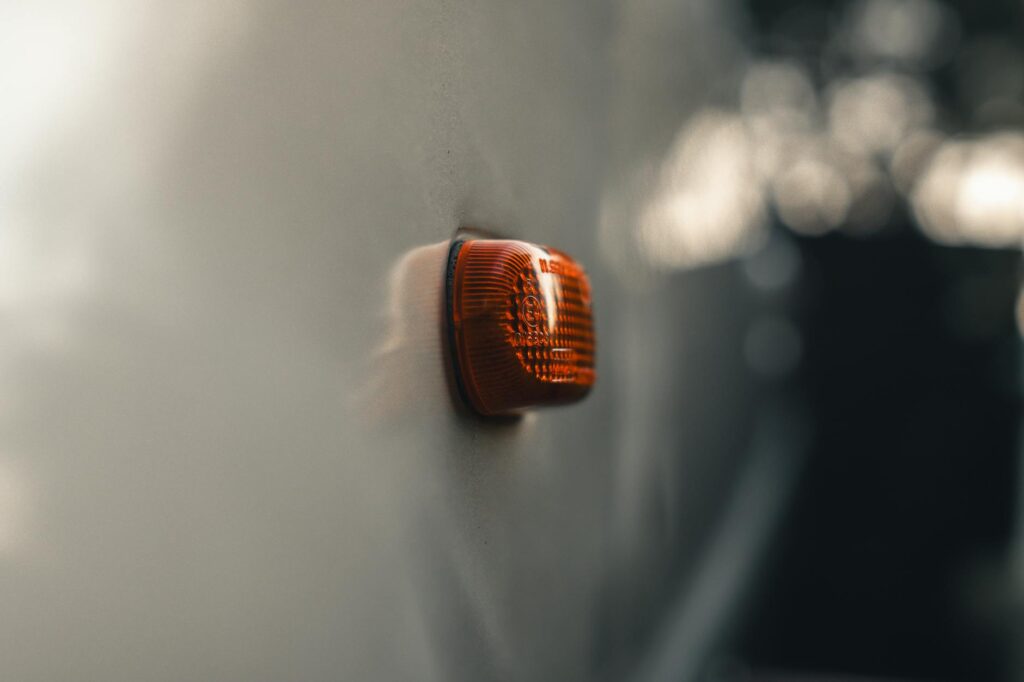
A side marker light is a small lamp fitted to the side of a vehicle or its load to make the vehicle more visible to other road users. That is how the Road Vehicles Lighting Regulations 1989 (RVLR) define it. Side marker lights face outward from the flanks of a vehicle, not forward or rearward, and their purpose is passive visibility. They tell drivers approaching from a side road or a junction that a long vehicle is there and roughly where it ends.
Side marker lights are distinct from side repeater indicators. A side repeater flashes amber to signal a turn. A side marker light stays on steadily whenever the vehicle’s position lamps are lit. Some combined units perform both functions in a single housing, with separate circuits.
Typical vehicles fitted with side marker lights include HGVs and their trailers, flatbed and curtain-side trailers, coaches, and many agricultural trailers, low loaders and long implements.
UK Law: When Are Side Marker Lights Required
Side marker lights are required by Regulation 18 and Schedule 1 of the RVLR, with the installation rules in Schedule 9. Whether a vehicle needs them depends on its length, its age, its maximum speed, and whether it is an agricultural vehicle.
Motor Vehicles
A motor vehicle needs side marker lights if its overall length exceeds 6 m and it was first used on or after 1 April 1991. These motor vehicles are exempt:
- Vehicles with a maximum speed not exceeding 25 mph
- Passenger vehicles (cars, minibuses and similar)
- Vehicles 6 m long or less
- Vehicles first used before 1 April 1991
- Incomplete vehicles travelling to be finished, stored or sold
Trailers
A trailer needs side marker lights if its overall length, not counting the drawbar and coupling, exceeds 6 m. For trailers made before 1 October 1990 the threshold is 9.15 m. Caravans, boat-launching trailers and agricultural trailers are exempt.
Tractors and Agricultural Trailers
This is where farm vehicles differ from haulage. A tractor with a maximum speed not exceeding 25 mph (which includes a 40 km/h tractor) is exempt from side marker lamps under the 25 mph rule. The RVLR also define an agricultural vehicle as including any trailer drawn by an agricultural vehicle, and agricultural vehicles are listed as an exception for trailer side marker lamps. So a 12 m bale trailer behind a tractor is not required to carry side markers under Schedule 1.
There is an important exception to that exemption. Regulation 22 applies to any vehicle or combination of vehicles whose overall length, including any load, exceeds 18.3 m, with no agricultural exemption (the only exceptions are a combination towing a broken-down vehicle and some specially marked long loads). A tractor pulling a long trailer, a pair of trailers, or a long implement can easily pass 18.3 m. In that case each side needs side marker lamps fitted so that:
- 1 lamp is no more than 9.15 m from the front of the combination
- 1 lamp is no more than 3.05 m from the rear
- No more than 3.05 m separates any lamp from the next
Those lamps must be kept lit between sunset and sunrise and in seriously reduced visibility. Even where the law does not require them, side marker lights on a long farm trailer make a real difference at night when a car approaches a field entrance from the side. Many agricultural trailers are now built with them.
Side Marker Light Colours
Side marker lights must be amber. Schedule 9 of the RVLR allows 2 exceptions:
- A side marker lamp within 1 m of the rear of the vehicle may be red.
- On a trailer made before 1 October 1990, a side marker may show white to the front and red to the rear.
White is not permitted on a modern vehicle’s side markers. The colour rule also applies to optional side marker lamps: any side marker you fit voluntarily must still be amber, or red in the last metre.
Side Marker Light Spacing and Height
On a motor vehicle first used on or after 1 April 1991, or a trailer made on or after 1 October 1990, Schedule 9 requires at least 2 side marker lamps on each side, plus as many more as needed to meet the spacing rules:
| Rule | Requirement |
|---|---|
| Foremost lamp | No more than 4 m from the front of the vehicle, including any drawbar |
| Rearmost lamp | No more than 1 m from the rear of the vehicle |
| Gap between lamps | No more than 3 m, or 4 m if 3 m is not practicable |
| Maximum height | 2,300 mm above the ground |
| Visibility | 45° to the left and right of a line at right angles to the side |
| Colour | Amber, or red within 1 m of the rear |
A trailer made before 1 October 1990 needs only 1 side marker each side, placed at or just behind the centre point of its length (no more than 1,530 mm behind).
As an example, a trailer with a 2 m drawbar and a 10 m body is 12 m long measured from the drawbar eye. A layout that works is 1 lamp 3.5 m from the eye, 1 at 6.5 m, 1 at 9.5 m and 1 at 11.5 m, which keeps the gaps at 3 m or less and the last lamp within 1 m of the rear. Check your own dimensions rather than copying a layout, because the drawbar counts towards the 4 m front limit.
End-Outline Marker Lamps
End-outline marker lamps are a different lamp with a different job. They sit at the outer corners of a wide vehicle, as high as practicable, showing white to the front and red to the rear so other drivers can judge the vehicle’s width and height. Side marker lights show length; end-outline marker lamps show width.
Under Schedule 13 of the RVLR, end-outline marker lamps are required on motor vehicles wider than 2,100 mm first used on or after 1 April 1991, and on trailers wider than 2,100 mm made on or after 1 October 1990. Vehicles with a maximum speed not exceeding 25 mph and agricultural trailers are exempt. The lamps must be within 400 mm of the side of the vehicle and carry an approval mark. Many units combine the white front lamp, red rear lamp and an amber side marker in 1 housing. Our guide to end-outline marker lamps covers them in full.
Wide Loads and Marker Boards on Agricultural Vehicles
Side marker lights deal with long vehicles. Wide and projecting agricultural machinery has its own rules, mostly under the Road Vehicles (Authorisation of Special Types) (General) Order 2003, which covers agricultural vehicles that exceed normal construction limits. Under Part 3 of that Order:
- Agricultural vehicles wider than 2.55 m but less than 3.5 m are limited to 20 mph, and 12 mph at 3.5 m or wider.
- Above 3 m wide, the police must be notified in advance if the journey is over 5 miles or uses roads with a speed limit of 40 mph or less.
- Above 3.5 m wide, the vehicle must be accompanied by an attendant.
- The overall width, including any lateral projection, must not exceed 4.3 m.
Marker Boards
Projecting loads and implements must be marked so other drivers can see where they end. Schedule 8 of the same Order sets out the marking rules, including:
- A forward or rearward projection over 1 m must be made clearly visible from the end and the sides.
- Over 2 m, an end marker board is needed, no more than 0.5 m from the end of the projection and no more than 2.5 m above the road.
- Over 3 m, a side marker board is needed on each side as well, with additional side markers on longer projections.
- A lateral projection over 305 mm on either side must be marked so it can be seen from the front and rear.
Between sunset and sunrise, and in seriously reduced visibility, marker boards must be lit by a lamp that makes them readily visible but is shielded so its light only reaches other road users by reflection from the board. A front-mounted mower, a folded cultivator or a drill on a 3-point linkage often needs boards and lights at the same time. Separately, Regulation 21 of the RVLR requires an extra red rear lamp and red reflector where a load or equipment on an agricultural vehicle projects more than 2 m beyond the rear, and a white front lamp and white reflector for a forward projection over 2 m.
Approval Marks on Side Marker Lights
Schedule 9 of the RVLR sets no marking requirement for side marker lamps, so UK law does not require them to carry an E-mark. That said, an E-marked side marker has been tested for colour and intensity, and new vehicles and trailers leaving the factory under type approval are fitted with approved lamps. Buy approved units: the colour is reliable, the output is consistent, and there is no argument at the roadside or at an annual test.
LED vs Bulb Side Marker Lights
LED side marker lights last longer and draw less power than filament bulb units, which is why most new trailers and commercial vehicles now leave the factory with LED side markers.
Lifespan and Reliability
An LED side marker has no filament to break from vibration, and many are fully sealed with the lens bonded to the body. Bulb units need a new bulb now and again, and the bulb holder is the usual entry point for water and corrosion.
Power Draw
An LED side marker typically draws a small fraction of the current of a filament bulb unit. On a trailer with 8 side markers, the saving reduces load on the towing vehicle’s tail light circuit and minimises voltage drop over long wiring runs.
Voltage Options
Side marker lights are available in 12V and 24V versions. Most agricultural trailers and light commercial vehicles run 12V. HGVs and larger plant typically use 24V. Many LED side markers are rated for both (often labelled 10 to 30V or 12/24V), which suits trailers that may be towed by different vehicles. Browse our side marker lamps and the LED marker lamp range for 12V, 24V and multi-voltage units.
How to Choose and Fit Side Marker Lights
Choosing the right side marker light depends on 3 factors: vehicle type, voltage system, and mounting style.
By Vehicle Type
- Trailer side marker lights: the most common application. Surface-mount LED units with screw fixings are the standard choice for flatbeds, grain trailers and livestock trailers.
- Side marker lights for trucks: HGVs and rigid trucks use larger, brighter side marker lights, often with integrated reflectors. 24V units are typical.
- Implements and low loaders: bracket-mounted units or stalk markers keep the lamp clear of moving parts and away from wheels.
Mounting Styles
Side marker lights come in 3 main mounting configurations:
- Surface mount: the lamp body sits flat against the vehicle panel or chassis rail, held by 2 screws. Best for flat-sided trailers and box bodies.
- Bracket mount: a metal or rubber bracket spaces the lamp away from the chassis rail. Used where the vehicle side is not flat or where clearance from wheels and mudguards is needed.
- Flush mount: the lamp body recesses into a hole cut in the panel, sitting flush with the surface. Common on coaches and box bodies.
Wiring
Side marker lights wire into the tail light (position lamp) circuit so they light whenever the sidelights or headlights are on. On a trailer, that means the tail light feeds in the plug: pin 5 (right-hand tail, brown) and pin 7 (left-hand tail, black) on both 7-pin 12N and 13-pin sockets, with pin 3 as the earth. Wire each side’s markers to that side’s tail feed so a single fault does not black out both sides. Our 7-pin trailer plug wiring guide has the full pin table.
Each side marker needs a positive feed and a good earth, either through a dedicated earth wire or the mounting bolts to the chassis. A dedicated earth wire is far more reliable on a painted or galvanised trailer.
For agricultural use, waterproof every connection. Heat-shrink crimp connectors or sealed junction boxes prevent corrosion from rain, mud and pressure washing. A side marker that works in the yard but fails on the road is usually a corroded earth.
IP Rating
For agricultural trailers and farm vehicles, choose side marker lights rated at least IP67, which means dust-tight and able to withstand temporary immersion. Units rated IP69K withstand high-pressure, high-temperature jet washing and suit livestock trailers that are washed and disinfected regularly.
Side Marker Lights and Annual Testing
Cars are passenger vehicles, so they are not required to have side marker lights. HGVs and their trailers are checked at the annual test, where side marker lamps are inspected for presence, operation, colour and condition. Tractors are exempt from the MOT, so on a farm the responsibility sits with the operator: the lamps must work if they are required, and any lamp required by regulation 22 or Schedule 1 must be kept lit and clean.
Keeping Side Marker Lights in Working Order
A side marker light requires very little maintenance. LED units in particular are fit-and-forget components for most of their service life. The 3 most common issues are:
- Cracked or broken lenses: caused by branches, loading equipment, or reversing into obstacles. Replace the whole unit rather than taping it, because a damaged lens lets water in and can show white light.
- Corroded connections: farm vehicles are exposed to moisture, slurry and road salt. Check terminals at the start of each autumn and reapply dielectric grease.
- Dim or flickering output: usually a failing bulb or a poor earth. LED replacements remove the bulb failure issue entirely.
A quick walk-around check before any road journey takes 2 minutes and catches failed side markers before they become a roadside problem. For the full set of lamps a farm trailer needs, read our agricultural trailer lighting requirements guide.
Frequently asked questions
What length of trailer needs side marker lights?
A trailer longer than 6 m, measured without the drawbar and coupling, needs side marker lights if it was made on or after 1 October 1990. For older trailers the threshold is 9.15 m. Agricultural trailers, caravans and boat trailers are exempt from this rule.
What colour should side marker lights be?
Side marker lights must be amber. A side marker within 1 m of the rear of the vehicle may be red. Only trailers made before 1 October 1990 may use white to the front and red to the rear.
Do tractors and farm trailers need side marker lights?
A tractor limited to 25 mph or less and a trailer drawn by an agricultural vehicle are exempt from the normal side marker requirement. However, any vehicle or combination longer than 18.3 m including its load must carry side marker lamps under regulation 22, with no agricultural exemption.
What is the difference between side marker lights and end-outline marker lamps?
Side marker lights are amber lamps along the sides that show a vehicle’s length. End-outline marker lamps sit at the upper outer corners, white to the front and red to the rear, and show a wide vehicle’s width. They are required on most vehicles wider than 2,100 mm.
Do side marker lights need to be E-marked?
Schedule 9 of the RVLR sets no marking requirement for side marker lamps. Approved lamps are still the better buy because their colour and intensity have been tested.