Daytime Running Lights UK Law: Colour, Rules and MOT
Daytime running lights UK law: DRLs must be white and RL approved, so yellow DRLs are not legal. Which vehicles need them, kit wiring rules and the MOT.
In this guide
- What a Daytime Running Light Does
- What Colour DRLs Are Legal in the UK
- Which Vehicles Must Have Daytime Running Lights
- DRL Brightness and Approval: Regulation 87 and Regulation 148
- How DRLs Must Be Fitted and Wired
- Aftermarket DRL Kits
- Daytime Running Lights and the MOT
- DRLs on Tractors and Agricultural Vehicles
- Common DRL Faults
- Frequently asked questions
UK law says daytime running lights (DRLs) must be white, approved to UN ECE Regulation 87 (now part of Regulation 148), fitted as a pair, and must switch off or dim to sidelight level when the headlights come on. Amber or yellow DRLs are not legal in the UK. DRLs have been compulsory on new types of car and small van since 7 February 2011.
This guide covers what a DRL does, the colour rules (including the common question about yellow DRLs), which vehicles must have them, the approval mark, aftermarket DRL kits and how they must be wired, the MOT, and DRLs on tractors and farm vehicles.
What a Daytime Running Light Does
A daytime running light is a forward-facing white lamp that comes on automatically when the vehicle is running, to make it easier for other road users to see in daylight. It is not designed to light the road for the driver. Its job is to make the vehicle stand out against the background to pedestrians, cyclists, motorcyclists and drivers pulling out of junctions.
On modern cars, DRLs are almost always LED strips or rings, built into the headlamp unit or the front bumper. Under Regulation 87 a DRL must give between 400 and 1,200 candela: bright enough to be noticed in daylight, but limited so it does not dazzle.
DRLs work because:
- Contrast: a lit lamp stands out against the road, hedges and sky far better than an unlit grille.
- Earlier detection: other road users notice a lit vehicle sooner, giving them more time to react.
- Judging distance: 2 lit lamps at a fixed spacing help others judge how far away the vehicle is and how fast it is closing.
- No reliance on the driver: the DRL comes on automatically, so it is never forgotten.
DRLs Are Not Sidelights
A DRL is brighter than a sidelight and on many cars works without the tail lights. That is fine in daylight but not at dusk, in rain or in fog, when following drivers need to see your rear lamps. Automatic headlights help, but they do not always switch on in daytime fog or heavy spray, so the driver remains responsible for switching on dipped headlights when visibility is seriously reduced (Highway Code rule 226). Where a DRL also works as the front position lamp, it carries both the RL and A markings and dims when the headlamps come on.
What Colour DRLs Are Legal in the UK
Daytime running lights must be white in the UK. Regulation 87 approves DRLs as white lamps only, RVLR requires DRLs fitted on or after 20 May 2018 to comply with Regulation 87, and the MOT inspection manual says DRLs “must emit white light”.
| DRL colour | Legal in the UK? | Notes |
|---|---|---|
| White | Yes | The only approved colour for a DRL |
| White with a slight blue tinge | Generally accepted | Normal for LED lamps within the approved white range |
| Amber / yellow | No, not as a DRL | Amber at the front is reserved for indicators and side marker lamps |
| Blue | No | Blue lamps are for emergency vehicles |
| Red | No | RVLR bans red light to the front (with narrow exceptions such as side markers) |
| Green, purple or colour-changing | No | Not approved for any front lamp on a normal road vehicle |
Are Yellow DRLs Legal in the UK
No. Amber or yellow daytime running lights are not legal in the UK, even if they are bright and well made. A yellow or amber DRL is not approved under Regulation 87 and would be recorded as a colour defect at the MOT on vehicles where DRLs are tested. Amber light at the front of a vehicle is for direction indicators, and on longer vehicles side marker lamps.
The confusion comes from 2 places. First, some countries outside Europe allow amber running lamps, and American-market cars often have amber front side markers or running lamps. Second, “switchback” LED strips are sold that run white as a DRL and switch to amber when the indicator flashes. A switchback strip is only legal if it is approved for both functions; the amber part must work only as an indicator.
Front fog lamps and headlamps may be white or selective yellow, but those are different lamps with different rules. Yellow fog lamps cannot be used as DRLs.
Which Vehicles Must Have Daytime Running Lights
DRLs became compulsory on new vehicle types under EU Directive 2008/89/EC, which the UK applied:
| Vehicle | DRLs compulsory on new types from |
|---|---|
| Passenger cars and small vans (M1 and N1) | 7 February 2011 |
| Lorries and buses (other M and N categories) | 7 August 2012 |
| Vehicles of types approved before those dates | Not required, though many have them |
| Trailers | Not permitted (DRLs are front lamps on motor vehicles) |
The mandate applied to new vehicle types, so a model launched before 2011 could stay in production for a while without DRLs. There is no requirement to retrofit DRLs to an older vehicle.
Where DRLs are fitted, the UK rules are in the Road Vehicles Lighting Regulations 1989 (RVLR), which define a DRL by reference to ECE Regulation 48 and, since 20 May 2018, require DRLs fitted from that date to comply with ECE Regulation 87. For the wider framework, see our guide to the Road Vehicles Lighting Regulations 1989.
DRL Brightness and Approval: Regulation 87 and Regulation 148
Regulation 87 is the UN ECE approval standard for daytime running lamps. In 2019, the UN ECE began consolidating several lamp regulations (including Regulation 87 for DRLs, Regulation 7 for position lamps, Regulation 23 for reversing lamps and Regulation 38 for rear fog lamps) into a single regulation for light signalling devices, Regulation 148. Lamps approved to either are acceptable, and you will see both references on current products.
An approved DRL carries:
- The E-mark: a circle with the letter E and a number for the approving country (for example E1 Germany, E11 United Kingdom, E13 Luxembourg).
- The letters RL: the code for a daytime running lamp. A lamp without RL is not approved as a DRL, whatever the box says.
- An approval number: linking the lamp to its approval certificate.
Regulation 87 sets the light output at 400 to 1,200 candela, measured in a defined pattern. That is far brighter than a 5W sidelight but far less than a dipped beam. Our guide to E-mark approval explains how to read approval marks on any lamp.
How DRLs Must Be Fitted and Wired
The installation rules come from ECE Regulation 48, which RVLR refers to. The main points:
| Rule | Requirement |
|---|---|
| Number | 2, one each side (the MOT allows no more than 2) |
| Colour | White |
| Height | 250 mm to 1,500 mm above the ground |
| Spacing | At least 600 mm between the inner edges of the lit areas (400 mm on vehicles less than 1,300 mm wide) |
| Switching on | Automatically when the engine is running (or the ignition is in the run position) |
| With headlamps on | DRLs must switch off, except when headlamps are flashed briefly as a warning. A combined DRL and position lamp may instead dim to position lamp brightness |
| Approval mark | E-mark with RL |
Many modern cars dim the DRL to act as the front sidelight when the headlights are on. That lamp is approved for both functions and carries both RL and the position lamp marking (A). On some cars the DRL on one side also dims while the indicator on that side is flashing, so the indicator is not drowned out.
Aftermarket DRL Kits
Aftermarket DRLs are legal in the UK if the lamps are approved and marked RL, they are white, they are mounted within the height and spacing rules, and they are wired to come on with the engine and go off (or dim) with the headlamps.
Kits on the market fall into 3 groups:
- Approved RL-marked kits: E-marked with RL, supplied with a control module or relay harness that handles the switching. Legal to fit.
- “DRL style” LED strips: often unmarked, sometimes amber or blue, and often wired straight to an ignition feed with no headlamp switch-off. Not legal as DRLs on a UK road, however bright they look.
- Combined DRL and position lamps: marked RL and A, running at DRL brightness in daylight and dimming to sidelight level with the headlamps. Legal and neat, because they can replace existing front position lamps.
Wiring an Aftermarket DRL Kit
Most kits use a small module or relay with 3 inputs:
- Power: a fused permanent or ignition feed for the lamps.
- Engine-running signal: an ignition-switched feed, or on some modules a voltage sensor that detects the alternator charging (around 13.5V or more).
- Headlamp or sidelight signal: a wire from the sidelight or dipped beam circuit that tells the module to switch the DRLs off or dim them.
A kit with no headlamp input does not meet the switching rule. Use a fuse close to the feed, and a relay rated for the load. Browse our daytime running lights and 12V relays, and see our guide to fitting daytime running lights for installation options.
Daytime Running Lights and the MOT
The MOT only inspects DRLs that were fitted as original equipment to M1 vehicles (cars) first used on or after 1 March 2018. On those cars, DRLs are checked with the position lamps under MOT section 4.2.
| DRL defect | Category |
|---|---|
| DRL missing or inoperative | Major (fail) |
| LED DRL with more than half its light sources out | Major (fail) |
| LED DRL with up to half its light sources out | Minor |
| Defective lens | Major (fail) |
| Colour, position or intensity not as required | Minor |
| Lamp insecure / likely to fall off | Minor / Major |
The manual says there must not be more than 2 DRLs fitted and that they must emit white light. On older cars, and on vans, lorries and buses, the MOT does not inspect DRLs, although a faulty DRL can still attract attention at a roadside check and a working pair is plainly safer.
If your car’s DRL is also its front position lamp, a failed unit may also be recorded as a position lamp defect. Our guide to position lamps covers those rules.
DRLs on Tractors and Agricultural Vehicles
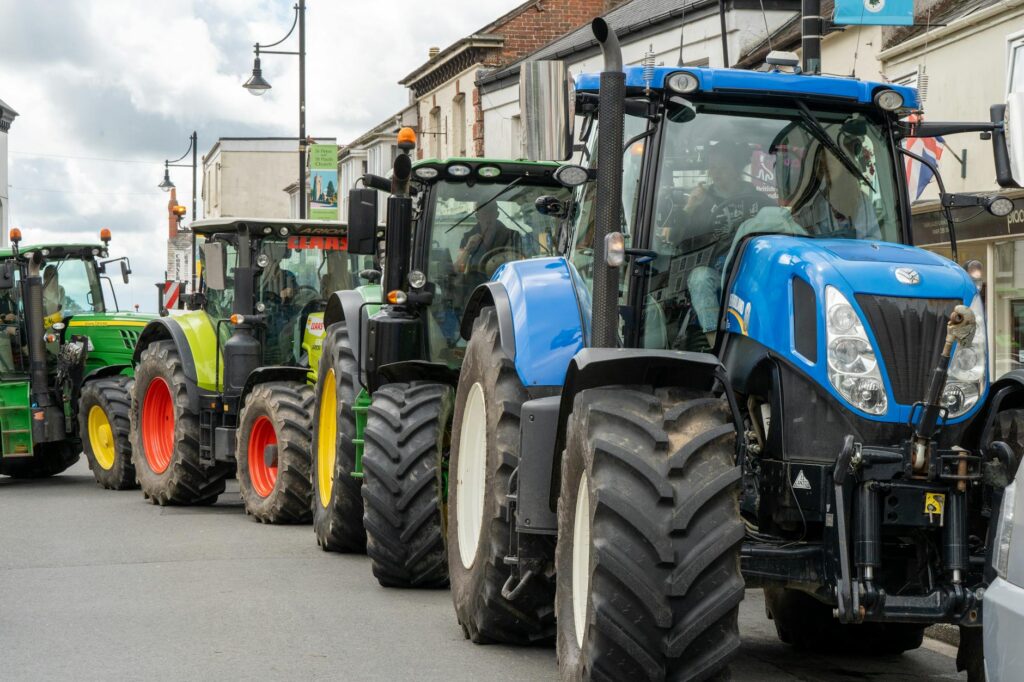
The 2011 and 2012 mandates covered cars, vans, lorries and buses. Agricultural tractors are approved under separate rules. Since 20 May 2018 the RVLR list a daytime running lamp as obligatory on motor vehicles first registered on or after 1 March 2018, an amendment made to bring DRLs into roadworthiness testing; how that applies to a tractor type approved without DRLs is not spelled out, so check with your dealer for a tractor registered since March 2018. Many newer tractors have LED DRLs as a factory feature, and where they are fitted they must work as designed and follow the same colour and switching rules.
- Older tractors: there is no legal need to fit DRLs. Operators who want extra visibility on the road at silage and harvest can fit an approved RL-marked pair, wired to switch off with the headlamps.
- Height: a DRL must sit between 250 mm and 1,500 mm above the ground. On most full-size tractors that rules out the cab roof, so DRLs go on the bonnet or front weights frame, not the roof.
- Not a substitute for beacons: a DRL is not a warning lamp. Slow or wide farm vehicles still need amber beacons where the law requires them.
- Trailers and implements: DRLs are not fitted to trailers. Trailers carry position lamps, brake lamps, indicators and, where required, rear fog lamps.
Common DRL Faults
Most DRL faults are electrical rather than the LEDs themselves wearing out.
- One DRL out: a failed LED driver inside the lamp, or a broken wire or plug. Check for voltage at the lamp connector; if it is there, the lamp unit has usually failed. Factory LED DRLs are often not repairable separately from the headlamp.
- Both DRLs out: a blown fuse, a failed relay or module, or a wiring fault upstream. Check the fuse first.
- DRLs stay bright with headlamps on: on an aftermarket kit, the headlamp input is missing or disconnected. On factory lamps, a dimming fault in the lamp or a switch signal fault.
- DRLs flicker: a poor earth, low voltage at idle, or an incompatible LED module. Clean the earths and check the charging voltage.
For the full list of lamps checked at the MOT, including DRLs, reverse lights and fog lamps, see which lights fail an MOT.
Frequently asked questions
What is the DRL law in the UK?
DRLs are compulsory on new types of car and small van since 7 February 2011, and on new types of lorry and bus since 7 August 2012. Where fitted, they must be white, approved (marked RL), fitted as a pair, and switch off or dim when the headlights are on.
Are yellow DRLs legal in the UK?
No. DRLs must be white. Amber or yellow running lights are not approved as DRLs, and amber at the front is reserved for indicators and side markers.
Can I fit aftermarket daytime running lights?
Yes, if the lamps are E-marked with RL, white, mounted 250 mm to 1,500 mm high with the correct spacing, and wired to come on with the engine and go off or dim with the headlamps.
Are DRLs checked in the MOT?
Only on cars first used on or after 1 March 2018 that had DRLs fitted as original equipment. On those cars, a DRL that does not work is a major defect.
Do I need headlights on if I have DRLs?
Yes, at night and when visibility is seriously reduced. DRLs do not light the road and many cars do not light their rear lamps with the DRLs, so in poor light you must switch on dipped headlights, which also lights the tail lights.