Tractor Road Legal Lights: The Minimum Lighting Kit for UK Roads
In this guide
- Why Road Legal Lighting Matters
- The Law Behind Tractor Road Legal Lights
- Baseline Requirements: Every Tractor on the Road
- Over 15mph: What a Post-1986 Tractor Needs
- Over 25mph: Adding Brake Lights
- Fast Tractors at 40mph: The Full Specification
- Amber Beacon Rules for Tractors
- Work Lights on the Road
- Trailer and Implement Lighting
- Tractor Road Legal Lights: The Checklist by Speed Tier
- Summary
Tractor road legal lights are the minimum set of lamps a tractor must carry to drive legally on a UK public road. The exact kit depends on two things: the tractor’s maximum road speed and when it was first used. A vintage tractor that never exceeds 15mph needs far fewer lights than a modern fast tractor rated at 40mph. The Road Vehicles Lighting Regulations 1989 (RVLR 1989) sets out the requirements in full, and the thresholds break down into four tiers: baseline, over 15mph, over 25mph, and fast tractor. This article organises those tiers into a single reference, with a printable checklist table at the end, so you can confirm your tractor has every light it needs before pulling onto the road.
Why Road Legal Lighting Matters
A tractor without the correct road legal lights is committing an offence and creating a serious hazard. Tractors travel at speeds between 6 and 25mph on roads where other vehicles approach at 50 or 60mph. That speed difference gives a car driver very little time to react, and in poor visibility or at night, a tractor without working lights is practically invisible.
Incorrect or missing tractor road legal lights can result in a fixed penalty notice, and in the event of a collision, inadequate lighting shifts liability. A following driver who sees a red rear lamp at 200 metres has roughly 7 seconds of reaction time at 60mph. Without that lamp, the reaction window drops to the point where avoidance may not be possible.
The Law Behind Tractor Road Legal Lights
The Road Vehicles Lighting Regulations 1989 (RVLR 1989) is the primary legislation governing tractor road legal lights in the UK. It sets out which lamps, reflectors, and warning devices every vehicle class must carry when used on a public road, and it applies to tractors as agricultural motor vehicles.
The Road Vehicles (Construction and Use) Regulations 1986 also applies, particularly around braking systems and the associated stop lamp requirements. For the purposes of lighting, the RVLR 1989 is the reference point.
The requirements scale with two variables. The first is the tractor’s maximum road speed. The second is the date of first use. Tractors first used on or after 1 April 1986 face additional requirements at each speed threshold. Tractors first used before that date need only meet the baseline standard, although any lights that are fitted must be in working order. This is a point many farmers miss: if a pre-1986 tractor has indicators fitted, those indicators must function correctly, even though they were not required at the time of manufacture.
For the full scope of UK agricultural vehicle lighting law, including trailers, self-propelled machinery, and implements, see the pillar guide.
Baseline Requirements: Every Tractor on the Road
Every tractor driven on a public road must have at least 4 lamps: 2 white front position lamps and 2 red rear position lamps. This is the absolute baseline for tractor road legal lights, and it applies regardless of the tractor’s age, speed rating, or intended use.
The 2 white front lamps must be visible from a reasonable distance ahead. The 2 red rear lamps must be visible from behind. These lamps serve a single purpose: making the tractor visible to other road users. They do not illuminate the road ahead (that is the job of headlights) and they do not signal braking or turning.
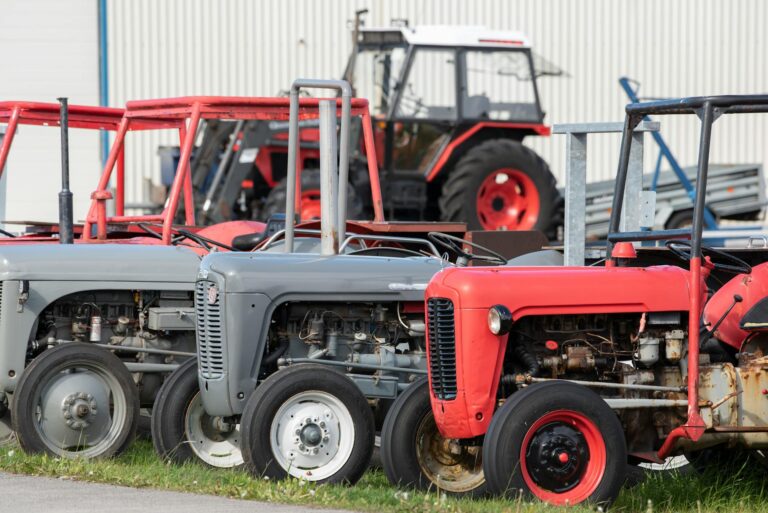
For tractors that never exceed 15mph and were first used before 1 April 1986, this baseline is the legal minimum. Many older tractors, such as the Massey Ferguson 135, David Brown 990, or a Ford 3000, fall into this category. They need 2 white at the front, 2 red at the back, and nothing else by law, provided they stay below 15mph.
Even at this baseline level, all 4 lamps must work. A blown bulb or cracked lens that stops the lamp functioning makes the tractor illegal on the road.
Over 15mph: What a Post-1986 Tractor Needs
A tractor first used on or after 1 April 1986 that exceeds 15mph on a public road must carry additional tractor road legal lights beyond the baseline. The additions at this tier are dipped beam headlights, direction indicators, and hazard warning lights.
Dipped beam headlights illuminate the road ahead without dazzling oncoming traffic. The RVLR 1989 requires them on post-1986 tractors used above 15mph.
Direction indicators (front and rear, amber) signal the tractor’s intention to turn. On roads where a tractor’s slow speed forces overtaking traffic to pass frequently, indicators give following drivers critical information.
Hazard warning lights activate all indicators simultaneously to warn other road users when the tractor is stationary or moving very slowly.
Most modern tractors manufactured from the late 1980s onwards, such as the John Deere 6000 series, Case IH Maxxum range, or New Holland T5 series, leave the factory with all of these lights fitted. The obligation falls on the driver to confirm they work before every road journey.
Over 25mph: Adding Brake Lights
A post-1986 tractor that travels above 25mph must add 2 red stop lamps to its tractor road legal lights. Stop lamps (brake lights) illuminate when the driver applies the brakes, warning following traffic that the tractor is slowing or stopping.
At 25mph and above, the closing speed between a tractor and a car travelling at 60mph is 35mph. A driver behind needs clear, immediate warning of braking. Without stop lamps, the only clue is the tractor appearing to grow larger in the windscreen, which leaves far less reaction time.
The 2 stop lamps must be red and rear-facing. They must activate in direct response to the braking system. Tractors in this speed range, such as the John Deere 6R, Massey Ferguson 5S, or Fendt 300 Vario, ship with stop lamps as standard, but after years of field work, vibration, and corrosion, the lamps need regular checking.
Browse the full range of tractor rear lamps at Agri Lighting for direct replacements and universal options.
Fast Tractors at 40mph: The Full Specification
A fast tractor rated at 40mph requires the most extensive set of tractor road legal lights. The law treats fast tractors more like conventional road vehicles, and the lighting specification reflects that.
A fast tractor must carry every light from the baseline, 15mph, and 25mph tiers, plus the following additions:
- Main beam headlights (full beam) for illuminating the road at distance, in addition to dipped beam.
- Rear fog lights to make the tractor visible to following traffic in fog, heavy rain, or snow. At least one rear fog lamp is required, fitted to the centre or offside.
The full lighting requirement for a fast tractor at 40mph is therefore:
- 2 white front position lamps
- 2 red rear position lamps
- Dipped beam headlights
- Main beam headlights
- Direction indicators (front and rear, amber)
- Hazard warning lights
- 2 red stop lamps (brake lights)
- At least 1 rear fog lamp
Fast tractors, such as the JCB Fastrac, Fendt 900 Vario, or John Deere 7R/8R series, are designed for regular road use at higher speeds. Their lighting systems typically meet or exceed these requirements from the factory. The driver’s responsibility is to keep every lamp operational.
Amber Beacon Rules for Tractors
A tractor travelling under 25mph on a dual carriageway must display an amber beacon. This is a specific requirement under the RVLR 1989 for slow-moving vehicles on roads where other traffic moves at significantly higher speeds.
The amber beacon must meet three physical requirements:
- 360-degree visibility. The beacon must emit light visible from every direction around the vehicle. A forward-facing-only or rear-facing-only light does not qualify.
- Flashing operation. The beacon must flash rather than emit a steady light. The flash pattern alerts other drivers that the vehicle ahead is slow-moving.
- Minimum height. The centre of the beacon must sit at least 1.2 metres above the ground. On most tractors, this means mounting the beacon on the cab roof or on a dedicated beacon pole.
On single carriageways, an amber beacon is not a legal requirement for tractors. It is, however, strongly recommended, particularly on fast A-roads and B-roads where the speed differential between a tractor and following traffic is large.
Amber beacons are not a substitute for the tractor road legal lights described in the tiers above. The beacon supplements those lights by providing an additional, highly visible warning to other road users.
Browse the range of tractor beacons at Agri Lighting for magnetic, bolt-on, and pole-mount options.
Work Lights on the Road
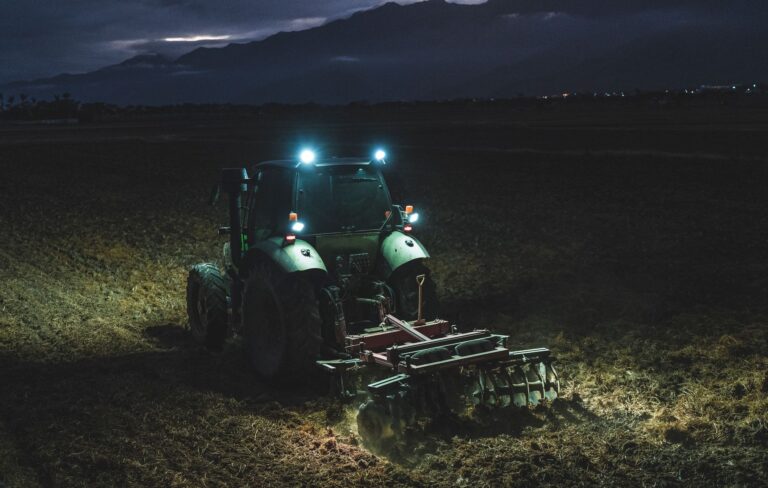
Work lights must not face forward or show white light to the rear when a tractor is on a public road. This is a common point of confusion, because work lights are fitted to almost every modern tractor and are used daily in the field.
A forward-facing work light on a public road can dazzle oncoming drivers with the same blinding effect as full beam headlights. A rear-facing work light that shows white to the rear can mislead following drivers into thinking the tractor is facing them (and therefore travelling in the opposite direction), which can cause a head-on collision attempt on a narrow road.
Before joining the road, switch off all work lights. If the tractor has manually adjustable work lights, fold them down or turn them away from the direction of travel. Some tractors have a road mode that automatically disables work lights when the road lights are activated. If yours does not, make it part of your pre-road check.
The tractor road legal lights described in this article are the lights that replace work lights on the road: position lamps for visibility, headlights for illumination, indicators for signalling, and stop lamps for braking.
Trailer and Implement Lighting
If a trailer or implement obscures the tractor’s own lights, additional lights must be fitted to the trailer or implement so that the rearmost point of the combination carries the required tractor road legal lights. The law is clear: the lights visible to other road users must meet the same standard as the tractor’s own lamps.
This applies in several common scenarios:
- Towing a trailer. The trailer’s own rear lamps, stop lamps, indicators, and rear fog light (if applicable) take over from the tractor’s. These must work and must be connected through the towing socket.
- Towing a wide implement. A plough, mower, or cultivator that extends beyond the tractor’s own width or obscures the tractor’s rear lights requires a lighting board or additional lamps fitted to the implement itself.
- Carrying a rear-mounted implement. A loader, bale spike, or attachment that blocks the tractor’s rear lamps requires additional lighting fitted to the implement or mounted above it.
The rear of whatever is furthest back must display the correct lights. For a tractor towing a wide mower on a dual carriageway, that means the mower needs red rear lamps, indicators, stop lamps (if applicable), and an amber beacon visible from 360 degrees.
For detailed guidance on tractor lighting regulations UK, including trailer-specific requirements, see the dedicated guide.
Tractor Road Legal Lights: The Checklist by Speed Tier
This table shows every light required for tractor road legal lights at each speed tier, for tractors first used on or after 1 April 1986. Print it, laminate it, and keep it in the cab.
| Light | Baseline (all tractors) | Over 15mph | Over 25mph | Fast tractor (40mph) |
|---|---|---|---|---|
| 2 white front position lamps | Required | Required | Required | Required |
| 2 red rear position lamps | Required | Required | Required | Required |
| Dipped beam headlights | Not required | Required | Required | Required |
| Main beam headlights | Not required | Not required | Not required | Required |
| Direction indicators (amber) | Not required | Required | Required | Required |
| Hazard warning lights | Not required | Required | Required | Required |
| 2 red stop lamps (brake lights) | Not required | Not required | Required | Required |
| Rear fog lamp(s) | Not required | Not required | Not required | Required |
| Amber beacon (dual carriageway only) | Required if under 25mph on dual carriageway | Required if under 25mph on dual carriageway | Not required (over 25mph) | Not required (over 25mph) |
Notes on the table:
- Pre-1986 tractors. Tractors first used before 1 April 1986 need only meet the baseline column. However, any lights that are fitted to a pre-1986 tractor must work correctly.
- Daylight exemption. Tractor road legal lights are not required during daylight hours in good visibility conditions. If visibility is good and it is daylight, the tractor can travel without lights. The moment visibility drops, or the sun sets, every light listed in the relevant speed tier must be on and working.
- Work lights. Not listed because they must be off on the road. They are not tractor road legal lights.
- Rear reflectors. Not covered in this table. Rear reflectors (red, triangular on trailers, non-triangular on tractors) are a separate requirement under the RVLR 1989.
Summary
Tractor road legal lights start simple (2 white front, 2 red rear) and build with each speed tier up to the full specification required of a fast tractor at 40mph. The RVLR 1989 sets the requirements, and the key date is 1 April 1986 for when the additional tiers apply. Amber beacons are required on dual carriageways for tractors under 25mph. Work lights must be off on the road. If a trailer or implement obscures the tractor’s lights, additional lighting must be fitted.
Use the checklist table above as your pre-road reference. Check every lamp before every journey. A blown bulb takes 5 minutes to replace. A collision caused by invisible tractor takes a lifetime to recover from.
Browse tractor rear lamps and tractor beacons at Agri Lighting for replacements, upgrades, and universal fitment options.