Compact Tractor Work Lights: Lighting for Kubota, Iseki, John Deere Compact and Smaller Machines
In this guide
- What Counts as a Compact Tractor
- Why Lighting Differs on a Compact Tractor
- LED Versus Halogen for Compact Tractors
- 12V or 24V: What Compact Tractors Use
- Compact Tractor Work Lights by Brand
- Mounting Positions on a Compact Tractor
- Lumen Targets for Common Compact Tractor Tasks
- Wiring and Amperage Limits
- Best Compact Tractor Work Light Picks
- Related Articles
A compact tractor work light is a small to medium output LED or halogen lamp sized to suit a tractor under 60 horsepower, with lumen output between 800 and 3,500 per unit and current draw matched to a 30 to 60 amp alternator. The light differs from a full-size tractor lamp in physical size, lumen target, mounting space and electrical headroom. This guide picks compact tractor work lights by task, brand and budget, and covers Kubota, Iseki, John Deere compact, New Holland Boomer and Massey Ferguson GC machines.
What Counts as a Compact Tractor
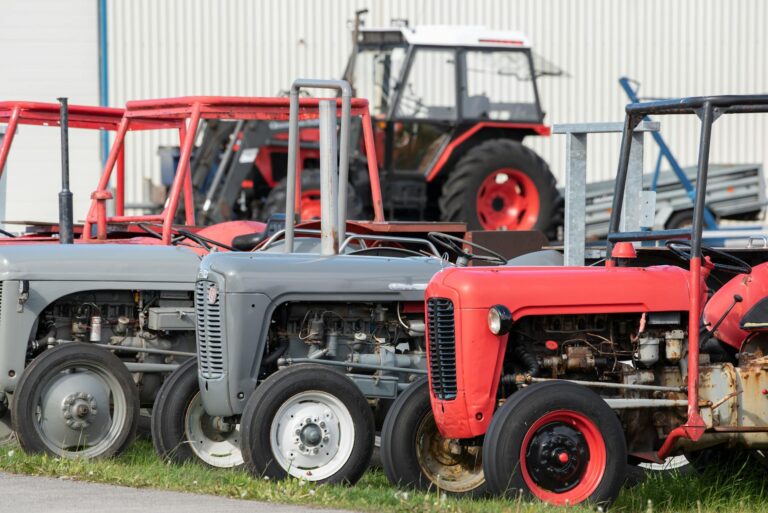
A compact tractor is a tractor of 15 to 60 horsepower, designed for smallholdings, equestrian properties, grounds maintenance, market gardens and light agricultural work. Sub-compacts sit at the lower end (15 to 25 hp), compacts cover 26 to 45 hp, and utility compacts run from 46 to 60 hp.
Common compact tractor models in the UK include the Kubota L1 and L2 series, the Iseki TM and TG series, the John Deere 1 and 2 Family, the New Holland Boomer 25 to 55, the Massey Ferguson GC1700 and 1700E series, and the Yanmar SA and YT series. Some hobby and grey-import machines (Mitsubishi, Hinomoto, Shibaura) also fall in this band.
A compact tractor differs from a full-size tractor in four ways that change the lighting decision. The mounting space is smaller, with narrower bonnets, lower cab rails and tighter ROPS frames. The alternator output is lower, often 30 to 60 amps against 90 to 200 amps on a larger tractor. The standard tasks (mowing, loader work, hedge cutting, paddock harrowing) need less raw light than ploughing or harvesting. The voltage system is almost always 12V, where larger tractors split between 12V and 24V.
Why Lighting Differs on a Compact Tractor
Lighting on a compact tractor must work inside three limits: mounting space, electrical headroom and physical scale. Ignoring any one of the three leads to a lamp that fails inspection, blows fuses, or simply does not fit.
Mounting space sets the maximum lamp size. A compact tractor ROPS frame is typically 38 to 50 mm wide on the upright section. A standard tractor work light bracket designed for a 60 mm post does not fit. Lamps for compacts need either smaller M6 or M8 bracket holes, ball-mount bases that bolt to flat panels, or ROPS clamps sized for narrow uprights.
Electrical headroom comes from the alternator. A 40 amp alternator on a Kubota L3200 powers the tractor itself (15 to 20 amps for fuel pump, glow plugs, gauges, fan and accessories), then leaves 20 to 25 amps for added work lights. A pair of 35W halogen lamps draws 5.8 amps. A pair of 35W LED lamps draws the same. The fact that LED puts out 5 times the lumens for the same current is exactly why compact tractor owners switch to LED first.
Physical scale changes the beam target. A compact tractor with a front-end loader works at distances of 2 to 8 metres around the bucket. A compact tractor on paddock harrows works at 4 to 10 metres ahead and across the implement. A spot beam designed to throw light 80 metres ahead overshoots the working area and washes out close detail.
LED Versus Halogen for Compact Tractors
LED beats halogen on compact tractors more decisively than on any other class of machine, because the small alternator makes current draw the limiting factor.
A 27W LED work lamp produces around 2,700 lumens at a current draw of 2.25 amps on 12V. A halogen lamp producing the same 2,700 lumens needs 100W of input and draws 8.3 amps. The LED upgrade lets a Kubota or Iseki carry four work lamps where halogen allowed only one.
Halogen still appears on some compact tractors for two reasons. Factory parts on machines built before 2010 still ship with halogen sealed beams, and direct replacement on a working machine costs less than a full LED upgrade kit. A few low-budget aftermarket halogen kits sell at GBP 15 to GBP 25 a pair, against GBP 30 to GBP 80 a pair for entry LED. Where the work is occasional (a few hours per year on a private smallholding), the halogen saving may justify itself.
The case for LED otherwise covers every working metric. LED runs cool, so the lens does not melt resin mounts on plastic bonnets. LED resists vibration from the rotary cutter, the flail and the front-end loader bucket. LED carries IP67 or IP69K rating that handles paddock mud, pressure washing and winter salt. LED puts out 5,000 to 6,500 Kelvin daylight white, which shows grass, livestock and stock fence wire more clearly than halogen yellow.
12V or 24V: What Compact Tractors Use
Compact tractors use 12V electrical systems. Every major brand selling compact tractors in the UK (Kubota, Iseki, John Deere, New Holland, Massey Ferguson, Yanmar, Kioti) builds on 12V architecture for compact and sub-compact models.
A 24V system appears on full-size tractors from the higher horsepower bands of John Deere, Case IH and Fendt, but never on compact machines. The reason is cost and supply. Compact tractor owners buy at lower price points, and 12V batteries, alternators and accessories cost less than 24V equivalents. The compact market also overlaps with garden tractor, ATV and quad components, which run universally on 12V.
The 12V system shapes the work light buying decision. Almost all 12V LED work lamps in the agricultural range carry 9 to 32V multi-voltage drivers, so they fit any compact tractor without conversion. A few cheap eBay lamps run 12V only, which suits compacts but excludes use on a 24V combine or telehandler. Buying a multi-voltage lamp adds GBP 5 to GBP 15 and keeps the option open.
Compact Tractor Work Lights by Brand
Compact tractor work light fitment varies by brand. Each manufacturer ships standard mounting points and accessory positions that shape the upgrade route.
Kubota L and B Series
The Kubota L series (L1, L2, L3 and L4 sub-models, 22 to 60 hp) carries factory work light positions on the ROPS upright and on the bonnet front. The factory lamps are 35W halogen or factory LED on newer models. Upgrade kits from Kubota dealers fit OEM LED replacements. Aftermarket fitment uses M8 bracket holes already drilled in the ROPS, or bullbar-style clamps for 40 to 50 mm uprights. The Kubota B series (B1, B2, B3, 18 to 32 hp) carries similar fitment with slightly smaller ROPS dimensions.
Iseki TM and TG Series
The Iseki TM (15 to 33 hp) and TG (40 to 65 hp) compact ranges carry mounting holes on the ROPS upright and pre-drilled bonnet positions for front work lamps. Standard fitment uses M6 bolts on the bonnet and M8 on the ROPS. The grey market Iseki imports (TX, TU, TF series) sometimes lack the front bonnet positions and need clamp-style bracket mounts.
John Deere 1 and 2 Family Compacts
The John Deere 1023E, 1025R, 1026R (1 Family, 23 to 25 hp), 2032R, 2038R (2 Family, 32 to 38 hp), 2R and 3R compact series carry OEM LED work light kits available through Deere dealers. The fitment uses pre-tapped M8 holes on the ROPS and a standard hood mount on the bonnet. Aftermarket LED lamps fit using the same hole pattern, and Deere-branded LED upgrade kits ship for older 1Series machines.
New Holland Boomer
The New Holland Boomer 25, 35, 45, 55 and 3045 series carry factory work light positions on the ROPS and front grille. Mounting uses M8 bolts. Boomer compacts share several components with Case IH Farmall compact models, so Case-fit lamps often work on Boomer machines and vice versa.
Massey Ferguson GC and 1700 Series
The Massey Ferguson GC1700 (sub-compact, 22 hp), 1700E and 1700M (compact, 22 to 39 hp) carry ROPS mounting points and a front bonnet mount that takes M6 bolts. The 1700 series uses the same compact tractor LED kits sold for Iseki TM models, because Iseki manufactures these machines for Massey under contract.
Mounting Positions on a Compact Tractor
A compact tractor carries work lights in four mounting positions: front bonnet, ROPS upright, ROPS top rail and rear fender.
Front bonnet positions illuminate the front-end loader bucket, the working area immediately ahead of the tractor and the headland on paddock work. Bonnet lamps mount on the radiator grille bar, the headlight pod brackets or a custom front bullbar.
ROPS upright positions illuminate the side of the tractor for loader work, hedge cutting and mid-mount mower visibility. The upright carries clamp mounts or bolt-on brackets at 1.5 to 2 metres from the ground.
ROPS top rail positions throw light across the working area from above. The top rail sits 2 to 2.5 metres from the ground on most compacts and accepts ball-mount or bolt-on brackets.
Rear fender positions illuminate the rear linkage area for night PTO work, hitching trailers and checking implements. Rear lamps mount on the rear fender top, the linkage cross bar or a dedicated rear light bracket.
Lumen Targets for Common Compact Tractor Tasks
Lumen targets for a compact tractor work light depend on the task and the working distance. Specifying for the task avoids over-lighting and wasted alternator capacity.
| Task | Lumen target per lamp | Beam pattern | Lamps required |
|---|---|---|---|
| Loader bucket work | 1,500 to 2,500 lm | Flood | 2 (one each side of bonnet) |
| Mowing (mid or rear) | 2,000 to 3,000 lm | Flood | 2 (ROPS upright) |
| Paddock harrowing | 2,500 to 3,500 lm | Flood or combo | 2 to 4 |
| Hedge cutting | 1,500 to 2,500 lm | Spot | 2 (one front, one rear) |
| Yard manoeuvring | 800 to 1,500 lm | Wide flood | 2 (front and rear) |
| Livestock checks | 800 to 1,500 lm | Flood | 1 rear, 1 spot front |
Total work-lamp output on a typical compact tractor sits between 5,000 and 15,000 lumens across 4 to 6 lamps. A sub-compact at the lower end carries 2 lamps and 3,000 to 5,000 lumens total.
Wiring and Amperage Limits
Wiring a compact tractor for added work lights demands attention to total amperage draw, cable size and relay placement.
Total amperage from added lamps should not exceed half the spare alternator capacity. On a 40 amp alternator with 18 amps used by the tractor itself, the spare capacity is 22 amps. Half of that, 11 amps, is the safe limit for added work lights. At 12V, 11 amps equals roughly 130W of LED lighting or 4 lamps of 30W each.
Cable size for 12V work light circuits runs 1.5 mm squared for single lamps under 5 amps, 2.5 mm squared for pairs up to 10 amps and 4 mm squared for full loom runs above 10 amps. Smaller cable on longer runs causes voltage drop, which dims the lamps and overheats the wire.
Relays should sit on every work light circuit. A relay isolates the lamp current from the cab switch, which protects the switch contacts and keeps the wiring tidy. A 30 amp automotive relay (Bosch type 5-pin or 4-pin) handles up to 4 LED work lamps on a single circuit. A 40 amp relay handles 6 lamps.
Fuses sit between the battery and the relay, sized at 1.5 to 2 times the expected load. A circuit carrying 8 amps takes a 15 amp blade fuse. The fuse protects the wire from a short-circuit fire, not the lamp from over-current.
Best Compact Tractor Work Light Picks
The right compact tractor work light depends on budget, task and machine. Three categories cover most compact tractor needs.
Budget pick: LED Autolamps 6624 series, 27W, 2,500 lumens, IP67, flood beam, GBP 25 to GBP 35 each. Fits Kubota, Iseki, John Deere compact with M8 bolt or universal bracket. Suits hobby and smallholding use up to 200 hours per year.
Mid pick: Hella ValueFit S700, 36W, 2,400 lumens, IP69K, flood pattern, ECE R10 EMC approval, GBP 60 to GBP 90 each. Carries a 5-year warranty and survives daily commercial use on a contractor compact.
Premium pick: Nordic Lights Scorpius N2401 or N3401, 35W to 45W, 3,000 to 4,500 lumens, IP69K, flood or combo beam, ECE R10 with full EMC documentation, GBP 180 to GBP 280 each. Suits heavy commercial use, hire fleet compacts and machines under residual-value finance.
A pair of mid-tier lamps on the ROPS upright and a pair on the front bonnet, fitted with a 4-pin relay and 2.5 mm cable, covers most compact tractor tasks for under GBP 350 in parts.
Related Articles
- The full tractor work lights guide covers selection across every tractor size class.
- LED work lights explains LED lamp technology, lifespan and ratings.
- 12V LED work lights covers 12V-specific selection in detail.
- How to mount work lights walks through mounting brackets, bolts and clamps for every position.
- Kubota tractor lights covers compatibility for compact and utility Kubota machines.
- Shop the full range of universal LED work lamps suitable for compact tractor fitment.