Daytime Running Lights: UK Rules for Cars, Vans, and Farm Vehicles
In this guide
A daytime running light (DRL) is a forward-facing white lamp that switches on automatically when the engine starts and operates whenever the vehicle is in motion in daylight, fitted to make the vehicle more visible to other road users. UK law makes DRLs mandatory on all new passenger cars and small commercial vehicles type-approved after 7 February 2011 and on new heavy commercial vehicles type-approved after 7 August 2012. The lamp must be type-approved to ECE Regulation 87, marked with the letters RL, and switched off (or dimmed to position lamp output) when the main headlamps are turned on. This article covers what a DRL does, the UK mandatory date, the colour, position, and switching rules, the ECE Regulation 87 approval mark, the rules around aftermarket retrofit DRLs, the fitment on tractors and agricultural vehicles, and the common faults that take a DRL out of action.
What a Daytime Running Light Does
A daytime running light increases the visibility of a moving vehicle in daylight by emitting a steady white forward beam that switches on automatically with the engine. The lamp is not designed to light the road for the driver; it is designed to make the vehicle visible to other drivers, motorcyclists, cyclists, and pedestrians at distance.
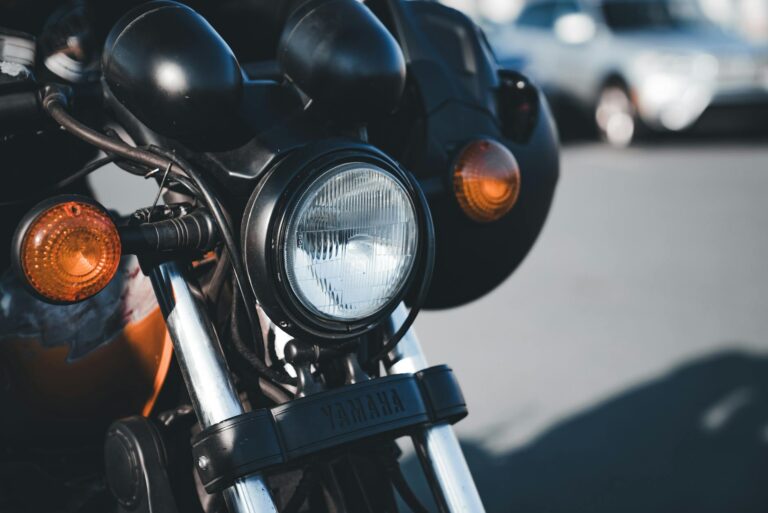
The DRL is bright enough to be noticed in full daylight but dim enough not to dazzle, with typical output between 400 and 1,200 candela per lamp. The light source is almost always a row of LEDs on modern vehicles, with the lamp moulded into the front bumper, into the headlamp housing, or as a thin strip beneath the headlamp on each side.
Four reasons explain why DRLs reduce daylight collisions.
- Higher contrast. A lit lamp on the front of a vehicle stands out against most backgrounds (road, hedgerow, sky) far better than the unlit grille.
- Earlier detection. Pedestrians and other drivers see a lit vehicle 1 to 3 seconds earlier than an unlit vehicle, which gives more time to react.
- Reduced closing-speed misjudgement. Two lit lamps at a known spacing give a clearer cue to approaching distance and speed than an unlit vehicle profile.
- Consistent behaviour. The DRL switches on with the ignition, so the driver cannot forget to use it.
European Commission analysis estimated daylight road deaths fell by 5 to 15 per cent in countries that introduced DRL legislation before the UK followed in 2011.
UK Law on Daytime Running Lights
UK law requires every new passenger car and light commercial vehicle (M1 and N1 category) type-approved on or after 7 February 2011 to be fitted with daytime running lights. The same rule applies to heavy commercial vehicles (M2, M3, N2, N3) and buses type-approved on or after 7 August 2012. The mandate sits in the Road Vehicles Lighting Regulations 1989 as amended by Regulation 87 of the United Nations Economic Commission for Europe.
Three points clarify how the law applies in practice.
- The mandate applies to new vehicle type approvals, not to existing vehicles on the road. A car first registered in 2008 has no legal obligation to fit DRLs.
- Where DRLs are factory-fitted, they must work. A failed DRL on a vehicle that left the factory with DRLs is an MOT failure.
- The driver cannot legally disable factory-fitted DRLs. The lamp must operate as designed whenever the engine is running.
Brexit left the rule in place. The Road Vehicles Lighting Regulations 1989 still reference ECE Regulation 87 for DRL type approval, and the UK continues to align with European Commission Directive 2008/89/EC on this point.
The Construction and Use rule applies to every motor vehicle on a public road, including tractors and agricultural vehicles, but with one practical exception: agricultural tractors that pre-date the type approval mandate do not need to retrofit DRLs to remain road-legal. New tractors brought into service from 1 January 2018 fall within the European Whole Vehicle Type Approval scheme and DRL compliance is checked at first registration.
For the full statutory framework, see Road Vehicles Lighting Regulations 1989: What Farmers Need to Know.
Colour, Position, and Switching Rules
UK law fixes the colour, position, and switching behaviour of DRLs through ECE Regulation 87, with specific limits on light output, switch-off behaviour, and lamp pairing. The rules apply to factory-fitted DRLs and to aftermarket retrofits intended for road use.
Six rules govern the operation of UK DRLs.
- Colour. White light only at the front. Amber and yellow are not legal for forward-facing DRLs on a UK road vehicle, though they remain legal in some non-European markets.
- Output. Between 400 and 1,200 candela per lamp. Below 400 the lamp is too dim to satisfy the visibility purpose; above 1,200 the lamp risks dazzling oncoming drivers.
- Pairing. Two DRLs in a symmetrical pair, one on each side of the vehicle centreline. A single central DRL is not legal.
- Mounting position. Between 250 and 1,500 mm above the ground, no more than 400 mm inboard of the widest point of the vehicle, and a minimum of 600 mm apart from each other.
- Switching with engine. The DRL must switch on automatically when the engine starts and switch off when the engine stops.
- Switching with headlamps. The DRL must switch off, or dim to position lamp output, when the main headlamps are switched on. The lamp cannot remain at full DRL intensity once the headlamps light the road.
Rear DRLs are not mandatory. Where fitted, they emit red light at lower intensity than a brake lamp, and switch with the front DRLs. Most UK passenger cars do not have rear DRLs; the feature appears mainly on higher-end models from Audi, Mercedes, and BMW.
For the broader rules on front and rear running lights, see Position Lamps: Front and Rear Sidelights Explained.
ECE Regulation 87 and the RL Marking
ECE Regulation 87 is the European type approval standard for daytime running lights, and every DRL fitted to a UK road vehicle must carry the regulation marking on the lens or the housing. The mark proves the lamp meets the geometric, photometric, and electrical specifications set by the regulation.
The mark contains three elements.
- A circle enclosing the letter E and a country code number. The number identifies the country that approved the lamp. E1 is Germany, E11 is the United Kingdom, E13 is Luxembourg, E20 is Poland. The country code indicates where the approval was granted, not where the lamp must be sold.
- The letters RL on the lamp lens. RL is the abbreviation for daytime running light under the UNECE coding system. A lamp without RL marking is not type-approved as a DRL even if the manufacturer labels it as one.
- An approval number printed near the E-mark. The number traces the lamp to its homologation certificate held by the type approval authority.
A DRL that lacks the RL mark fails an MOT and a roadside check, and cannot legally be fitted to a UK road vehicle as a daytime running light. The mark is the simplest visual check before purchase or installation.
For wider context on lamp approval marks, see ECE and E-Mark Approval: What the Numbers on Your Lights Mean.
Retrofit Daytime Running Lights: Legal Requirements
Aftermarket DRLs are legal in the UK provided the kit carries ECE Regulation 87 type approval, the RL mark is visible, the installation meets the mounting position rules, and the switching circuit dims or extinguishes the DRL with the main headlamps. Kits that meet all four conditions are legal to fit to any UK road vehicle, including those without factory DRLs.
Three categories of aftermarket DRL kit appear on the UK market.
- Type-approved RL-marked kits. Carry the full ECE R87 approval and meet all the mounting and switching rules out of the box. Legal to fit. Price range GBP 30 to GBP 150.
- LED strip kits sold as “DRL look” upgrades. Often lack the RL mark, lack the mandatory headlamp-off switching, and are sold as styling parts. Not legal as DRLs on a UK road, even where the LEDs themselves are bright enough to perform the visibility function.
- Combined DRL and position lamp units. Carry both RL and A markings (A is the position lamp code), and switch automatically between full DRL output and dim position lamp output when the headlamps come on. Legal and convenient because they replace existing position lamp wiring.
The installation must place the lamps at the correct height (250 to 1,500 mm above ground), with the correct spacing (600 mm minimum between centres, 400 mm maximum from the widest point of the vehicle), and wire the DRL feed to switch off when the headlamp circuit energises. A relay or a dedicated DRL controller handles the switching on most kits.
For agricultural fitment options, see Tractor Road Legal Lights: The Minimum Lighting Kit for UK Roads.
DRLs on Tractors and Agricultural Vehicles
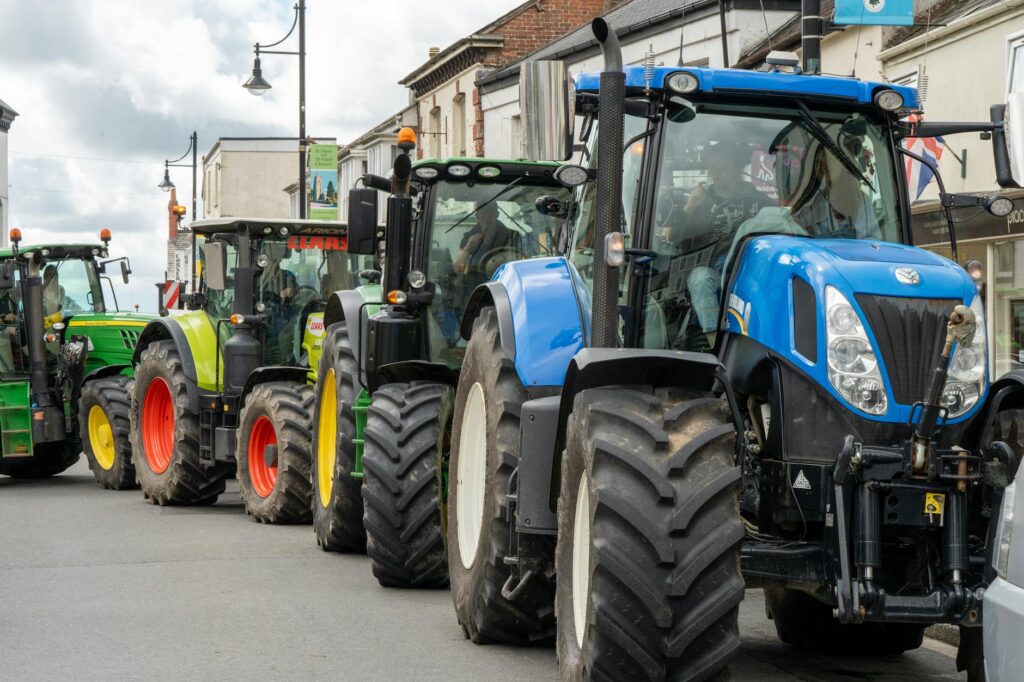
Agricultural tractor DRL fitment depends on the date of first registration and the Whole Vehicle Type Approval status of the model. Tractors first registered in the UK from 1 January 2018 onwards generally carry factory-fitted DRLs as part of their EU type approval. Tractors registered before that date have no obligation to fit or retrofit DRLs.
Three practical implications follow for UK farms.
- Pre-2018 tractors. No legal need to fit DRLs, but operators may choose to retrofit a type-approved kit for visibility on public roads at harvest and silage time. The retrofit must use an RL-marked kit and must switch correctly with the headlamps.
- Post-2018 tractors. Factory DRLs must work as designed. A failed DRL is an MOT failure on tractors that fall within MOT scope (currently limited to fast tractors registered as T5 category).
- Agricultural trailers and implements. DRLs are not required and not normally fitted. The trailer carries position lamps, brake lamps, indicators, and rear fog lamps as standard.
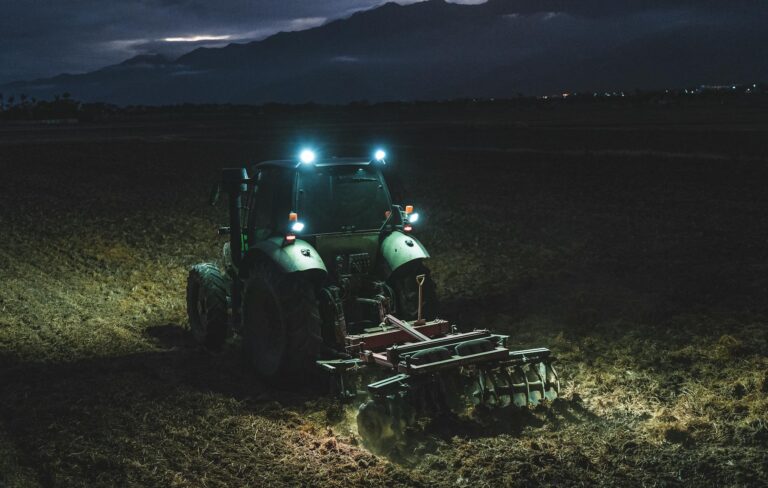
For visibility during road transport, many UK tractor operators fit a roof-mounted lightbar that combines DRL function with marker lighting. A roof bar marked RL is legal as a DRL on the same rules as front-mounted units, provided the mounting height stays within the 250 to 1,500 mm range (which the cab roof exceeds on most full-size tractors). Where the roof bar sits above 1,500 mm, it operates as a marker light or beacon, not as a DRL.
For roof-mounted warning systems, see Roof-Mounted Warning Systems: RTK, OWS, and Lightbar Options.
Common DRL Faults and Replacement
DRL faults fall into four common patterns, and most stem from LED driver failure rather than the LEDs themselves. The starting point is the dashboard warning lamp, because the body control module on modern vehicles flags DRL faults as a separate code from headlamp faults.
- DRL out on one side only. Cause: failed LED driver inside the lamp unit, or open circuit in the lamp loom. Fix: test the supply voltage at the lamp connector, then replace the lamp unit if voltage is present.
- Both DRLs out. Cause: blown fuse in the DRL circuit, failed body control module relay, or wiring fault upstream. Fix: check the fuse, then test the relay, then trace the loom.
- DRL stays on at full intensity with headlamps. Cause: failed dimming circuit in the lamp, failed headlamp switch signal to the DRL controller, or aftermarket DRL kit wired without the headlamp switch input. Fix: re-wire the DRL switch input, or replace the lamp on factory units.
- DRL flickers at idle. Cause: low alternator output at idle voltage, poor earth at the lamp, or thermal LED driver shutdown. Fix: clean earth points, test alternator output, replace lamp if persistent.
A DRL lamp unit costs GBP 25 to GBP 250 depending on the vehicle, with luxury car units at the higher end and aftermarket retrofit kits at the lower end. The replacement job is usually straightforward (lamp unit unbolts from the front bumper or grille, plug and play connector) but on some models the bumper must come off to access the bolts.
For wider electrical fault diagnosis on agricultural vehicles, see How to Troubleshoot Tractor Lighting Problems.
Frequently Asked Questions
Are daytime running lights mandatory in the UK?
Yes, on new passenger cars and light commercial vehicles type-approved after 7 February 2011, and on heavy commercial vehicles type-approved after 7 August 2012. Older vehicles have no obligation to retrofit DRLs.
Can I retrofit daytime running lights legally?
Yes, provided the kit carries ECE R87 type approval, the RL mark on the lens, the correct mounting position (250 to 1,500 mm above ground), and a switching circuit that dims or switches off the DRLs when the main headlamps are turned on.
What colour are daytime running lights?
Front DRLs are white. Rear DRLs (where fitted) are red. Amber and yellow are not legal for front DRLs on a UK road vehicle.
Do daytime running lights turn off automatically?
Yes, when the main headlamps switch on or when the engine stops. The DRL cannot remain at full output once the headlamps come on.
Do tractors need daytime running lights?
Tractors first registered from 1 January 2018 onwards generally carry factory-fitted DRLs under European Whole Vehicle Type Approval. Earlier tractors do not need to retrofit DRLs but may do so for visibility during road transport.
Internal links to articles not yet published: ECE and E-Mark Approval (8.4) is not yet published; will need adding when 8.4 goes live.