LED Fog Lamps: Upgrading from Halogen for Better Cut-Off

In this guide
An LED fog lamp is a vehicle fog light that uses light-emitting diodes as the bulb source instead of a halogen filament. The lamp serves the same job as the halogen version. It throws a wide low-mounted beam beneath the fog layer in front-fog form, or it makes the back of the vehicle visible through fog and heavy spray in rear-fog form. The LED version adds three benefits over halogen: a sharper beam cut-off above the horizontal line, a 30,000 to 50,000 hour rated life and a 60 to 80 percent reduction in current draw. Done right, an LED fog lamp upgrade delivers better visibility in genuine fog without dazzling oncoming traffic and without breaking UK road law.
This guide explains what an LED fog lamp is, where it fits on a vehicle, the cut-off optics that separate a road-legal fog lamp from a generic LED bolt-on, and how to choose the right upgrade for a car, van, tractor or trailer.
What an LED fog lamp is
An LED fog lamp consists of an LED light source, a precision reflector or lens optic shaped to deliver a flat-topped beam, a sealed housing rated to IP67 or higher, and an electronic driver that runs the LED at the correct current. The lamp produces 800 to 2,500 lumens at the lens, draws 15W to 35W on a 12V system and outputs at a colour temperature between 4,500K and 6,500K depending on the model.
The defining feature of a fog lamp, LED or halogen, is the beam shape. A fog lamp throws a wide, flat, low-mounted beam that sits beneath typical fog layers without scattering light back into the driver’s eyes. A driving lamp or a generic spot lamp does the opposite. Mount a 4-inch round LED driving lamp where a fog lamp belongs and the dispersed beam reflects from every water droplet and blinds the driver. LED fog lamps use a horizontal cut-off optic specifically to avoid this.
LED fog lamps come in two physical formats. A complete sealed unit replaces an existing fog lamp wholesale and brings its own optic, driver and connector. A retrofit LED bulb fits into an existing halogen fog lamp housing, replacing the H8, H11, H16 or PSX24W bulb the housing was designed for. The first format gives consistent results because the optic is matched to the LED. The second format is hit-and-miss because the halogen reflector was designed for a filament that sits in a different position from the LED chip.
Front fog vs rear fog
Front fog lamps and rear fog lamps look similar but solve opposite problems. Front fog lamps light the road in front of the driver beneath the fog layer. Rear fog lamps make the vehicle visible to the driver behind in dense fog or heavy spray.
Front fog lamps mount low on the vehicle, typically 250mm to 800mm above the road surface, and aim slightly downward. The low mounting matters because light that travels close to the road, below the driver’s line of sight, sends less glare back off the fog droplets into the driver’s eyes. Under the UN R48 installation rules, front fog lamps can only be switched on with the position lamps on, and it must be possible to switch them on and off independently of the headlamps.
Rear fog lamps mount on the back of the vehicle at a regulated height of 250mm to 1,000mm above the ground, sit a minimum of 100mm from the brake lamp to prevent confusion, and emit a high-intensity red beam at 150 to 300 candela. A motor vehicle first used on or after 1 April 1980 must carry at least one rear fog lamp (exemptions below). It should only be possible to switch it on with the dipped beam, main beam or front fog lamps on, and the driver must have an amber tell-tale. Read more on the UK regulations for rear fog lights for the full legal detail.
Front fog lamps are optional on every vehicle, tractors included, but if fitted they must comply and work. Rear fog lamps are not required on vehicles with a maximum speed of 25 mph or less (most tractors), on agricultural vehicles first used before 1 April 1986, or on agricultural trailers. Most LED retrofits sit on the rear of an ag vehicle because the front lamp on a tractor is often a hybrid driving lamp rather than a true fog lamp.
Why beam cut-off matters
Beam cut-off is the sharp horizontal line at the top of a fog lamp’s beam. Above the line, no light is emitted. Below the line, the full output spreads across the road. A correct cut-off keeps light beneath the fog layer and out of oncoming drivers’ eyes. An incorrect cut-off turns the fog lamp into a fog-amplifier, scattering output across the fog layer and reducing visibility for everyone.
LED fog lamps achieve cut-off in two ways. The premium method uses a projector lens with an internal shield that blocks light above a designed angle. The cheaper method uses a parabolic reflector with the LED placed at the focal point and an external shield casting the cut-off line. Projector optics give a sharper, more consistent cut-off and they handle vehicle vibration better.
The pitfall with LED retrofit bulbs in halogen housings is broken cut-off. A halogen H11 filament sits in a specific spot in the housing focal plane. An LED chip sits on a flat board that is offset from where the filament would have been. The result is a beam that fires upward and sideways instead of forward and downward, throwing light into the fog and into oncoming traffic. Some retrofit bulbs come with adjustable chip positions to address this, but consistent results need a properly designed complete LED fog lamp.
The visible test on a parked vehicle: shine the fog lamp at a wall 5 metres away with the vehicle on level ground. The top of the beam should form a flat horizontal line. Any curve, scatter, hotspot above the line or beam that spreads upward indicates a broken cut-off, and the lamp should not be used on UK roads.
UK road legality and E-marking
LED fog lamps used on UK roads must carry an E-mark indicating European type approval. The mark consists of the letter E followed by a country number inside a circle, followed by an approval number and a function code. UK-approved lamps carry E11. France approves to E2, Germany to E1, the Netherlands to E4. Any of these marks is accepted on UK roads.
Function codes that apply to fog lamps:
- B: front fog lamp
- F: rear fog lamp
A front LED fog lamp on a UK road needs an E-mark with function code B (or F3 for lamps approved to the newer class F3 in ECE R19). A rear LED fog lamp needs an E-mark with function code F. A retrofit LED bulb fitted into an existing fog lamp invalidates the original E-mark unless the bulb itself is type-approved as a replacement for that housing, and currently almost no LED retrofit bulbs hold such approval.
A complete LED fog lamp unit sold by a UK retailer for road use typically carries the relevant E-mark on the lens face. Check for the mark before you buy and before you fit.
On cars and vans, the MOT checks fog lamps for presence, condition, security, switching, colour and position (front fog lamps only on vehicles first used from 1 March 2018), plus a working tell-tale where a rear fog lamp is required. A rear fog lamp that does not work, or a damaged lens that cuts the light output, is a major defect. Farm tractors in the agricultural tax class do not take an MOT, but the same checks are a good guide. Read the full E-mark approval guide for the underlying type-approval scheme.
LED vs halogen direct comparison
LED fog lamps beat halogen fog lamps on most measures that matter in 2026. The numbers tell the story:
- Lifespan: LED 30,000 to 50,000 hours, halogen 500 to 1,500 hours
- Current draw on 12V: LED 1.2A to 3A, halogen 4.2A to 5A
- Vibration tolerance: LED very high (no filament), halogen moderate
- Warm-up time: LED instant, halogen 0.3 to 0.5 seconds to full output
- Colour temperature: LED 4,500K to 6,500K, halogen 3,000K to 3,500K
- Upfront cost: LED £30 to £150 per pair, halogen £10 to £40 per pair
Halogen keeps two advantages. It costs less at point of sale, and the warmer 3,000K to 3,500K beam cuts through dense fog slightly better than a 6,000K LED. Cool white LED beams scatter off fog droplets more than warm yellow halogen beams, which is why some LED fog lamps now ship with a 4,500K or amber 3,000K colour temperature specifically to handle fog.
For agricultural applications, the vibration tolerance, sealed housing and long lifespan of LED win. A halogen rear fog lamp on a trailer that works across rough stubble can fail early from filament shock. The LED equivalent usually lasts far longer.
Compare the broader LED vs halogen picture in the agricultural lighting technology comparison.
Bulb upgrades vs complete unit replacement
LED bulb upgrades and complete LED fog lamp units are two different products. The choice between them is the most important decision in a fog lamp upgrade.
A complete LED fog lamp unit replaces the existing fog lamp housing entirely. It comes with a matched LED chip, a designed optic, a sealed body and a connector to suit the vehicle. Fitting takes 20 to 60 minutes per lamp and gives consistent road-legal performance.
An LED bulb upgrade swaps the existing H8, H11, H16 or PSX24W halogen bulb for an LED retrofit that fits the same socket. Fitting takes 10 minutes per side. The result depends entirely on whether the LED chip position matches the original filament position. Match it well and the beam looks similar to the halogen original with a whiter tint. Miss the focal plane and the beam scatters upward, dazzling oncoming drivers and failing both MOT and self-test.
LED retrofit bulbs are not road legal in lamps type-approved for halogen bulbs, because changing the light source type invalidates the original approval. Enforcement varies. In halogen headlamps the MOT treats an LED or HID conversion as a failure (light source and lamp not compatible), but the MOT fog lamp checks do not list that defect, so fog lamp retrofits are judged on whether the lamp works and shows the right colour.
For agricultural use on private land, an LED retrofit bulb is a reasonable cheap upgrade. For road use on cars, vans and lorries, a complete LED fog lamp unit is the correct route to a road-legal install.
Choosing LED fog lamps for tractors and farm vehicles
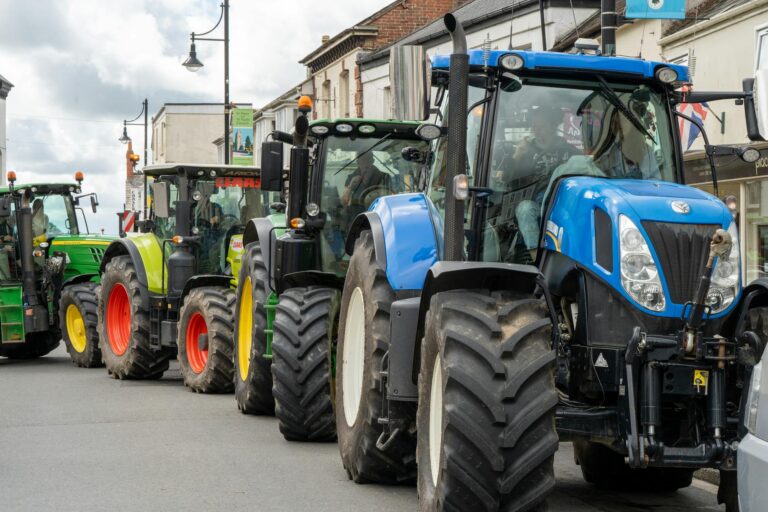
Tractors, telehandlers, sprayers and combines benefit from LED fog lamps because the working environment punishes halogen filaments. The right LED fog lamp for an ag vehicle differs from a car LED fog lamp in three ways.
The first difference is voltage. A 12V LED fog lamp suits compact tractors and most modern utility tractors. Heavy-duty self-propelled machinery often runs at 24V and needs 24V LED lamps or a step-down converter feeding 12V units. Read the 12V vs 24V tractor systems guide before buying.
The second difference is ingress protection. A car fog lamp at IP67 sits behind a bumper that protects it. A tractor fog lamp on a rear pillar or trailer hitch faces direct pressure-washing, mud, slurry and chemical contact. Buy IP69K rated LED fog lamps for ag-vehicle use.
The third difference is mounting. Car LED fog lamps come with vehicle-specific brackets that fit one bumper aperture. Ag LED fog lamps come as universal round or square sealed lamps from 4 inches to 7 inches across, with bracket options to fit roll bars, mudguards, hitch points or cab roof pillars.
A working specification for an LED fog lamp upgrade on a UK farm tractor used 30 percent on roads:
- 2 front LED fog lamps, 4-inch round, 1,500 lumens each, E-marked with code B
- 1 rear LED fog lamp, square, 150 to 300 candela (the ECE R38 range), E-marked with code F
- Stainless mounting brackets and Deutsch connectors
- Inline 7.5A blade fuse on each circuit
- Switch panel with tell-tale lamp in cab
Budget runs from £80 to £250 for the lamp set, plus £30 to £80 in brackets and wiring. The same setup in halogen costs less upfront but pays back its difference in 18 to 36 months on bulb replacements and field-side breakdowns.
For full LED fog lamp ranges and bracket options, browse the auxiliary lamps category and the fog lamps section.