Slow Moving Vehicle Signs and Lighting Requirements in the UK
In this guide
A slow-moving vehicle is a UK road vehicle whose maximum design speed sits at 25 mph or below, including agricultural tractors, road rollers, ride-on grass cutters, tracked vehicles and certain works trucks. A slow-moving vehicle with four or more wheels must show an amber beacon when used on an unrestricted dual carriageway, and must show the required road lamps and reflectors at night. This guide covers the slow-moving vehicle definition, the beacon rules, rear marking boards, the side and rear lighting requirements, and the penalties for non-compliance.
What Counts as a Slow-Moving Vehicle in UK Law
For beacon purposes, the key test is a maximum design speed not exceeding 25 mph. A 40 km/h tractor (24.85 mph) is caught. The beacon rule sits in Regulation 17 of the Road Vehicles Lighting Regulations 1989, and many of the lamp exemptions in Schedule 1 of the same regulations also turn on the 25 mph figure.
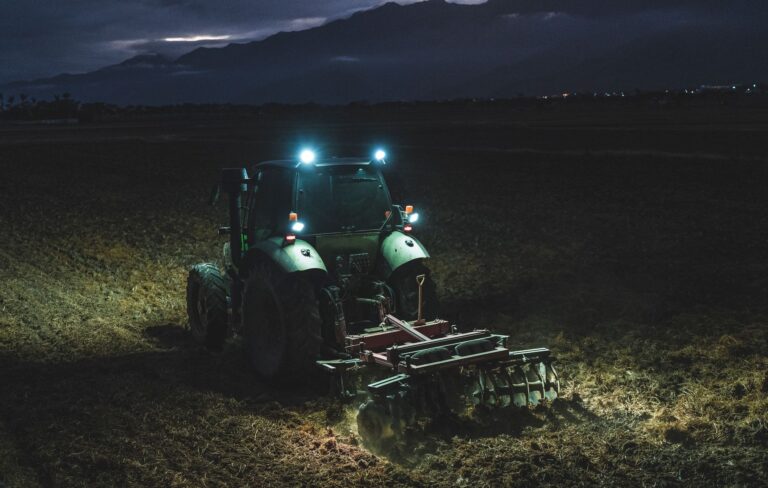
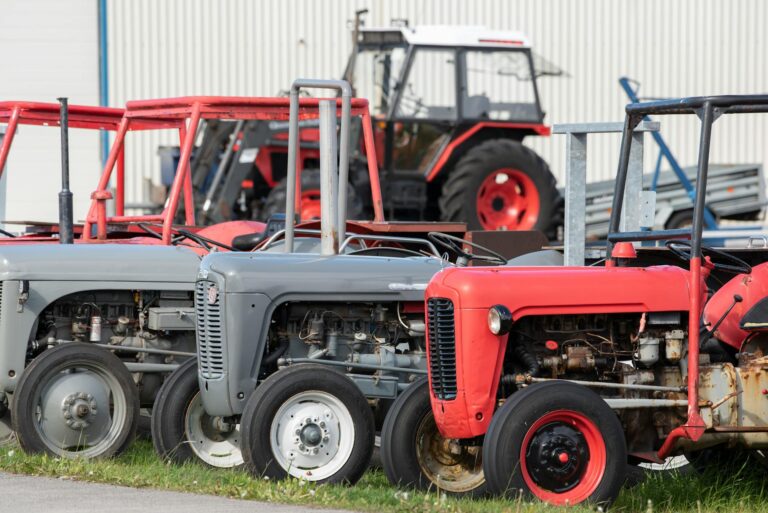
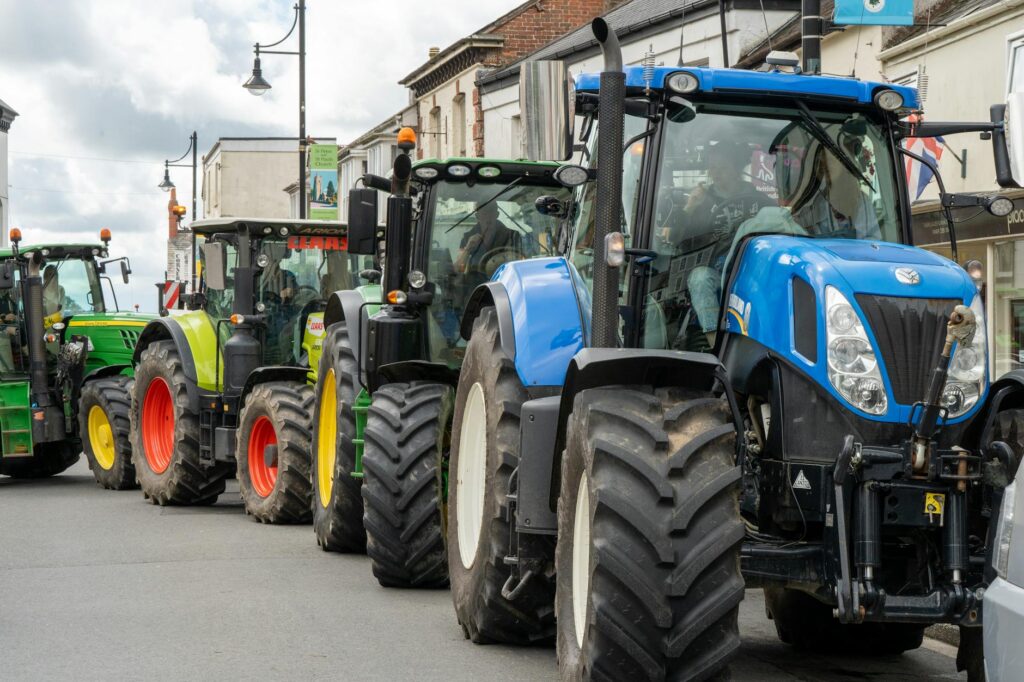
Agricultural tractors form the largest category of slow-moving vehicles on UK roads. A standard agricultural tractor with a maximum design speed of 25 mph or below sits firmly within the definition. A fast tractor with a design speed above 25 mph (for example 50 km/h versions of the Fendt 700 Vario, John Deere 6R, Massey Ferguson 8S or Case IH Maxxum) is not caught by the regulation 17 beacon rule, although such tractors often still fit beacons for visibility.
Other slow-moving vehicles include:
- Road rollers (typically 5 to 12 mph)
- Tracked vehicles such as crawler tractors and tracked excavators on road movement
- Mowers and ride-on grass cutters used on the road for transit
- Some works trucks (industrial trucks used briefly on the road between sites)
Vehicles with a design speed above 25 mph are not required to carry a beacon by regulation 17. They may still use one whenever it is necessary or desirable to warn other road users of the vehicle (regulation 27).
The 25 mph threshold is the design speed, not the actual travel speed. A tractor designed for 40 mph operation that happens to be travelling at 12 mph because it is towing a heavy implement is not a slow-moving vehicle in law. A 25 mph tractor travelling at its top speed is.
The Amber Beacon Requirement
The amber beacon requirement for slow-moving vehicles sits in Regulation 17 of the Road Vehicles Lighting Regulations 1989. The requirement is targeted: a beacon is required only on specific road types and only when the vehicle is moving.
The legal trigger is a vehicle with four or more wheels and a maximum design speed of 25 mph or below used on an unrestricted dual carriageway, meaning a dual carriageway with a speed limit over 50 mph. A vehicle that is only crossing the dual carriageway in the quickest practicable manner, and vehicles first used before 1 January 1947, are exempt. There is no legal requirement to show a beacon on single carriageway roads, whatever the speed limit, although using one on a slow tractor is allowed and usually wise.
The beacon must:
- Show an amber light
- Flash between 60 and 240 times per minute
- Be visible from any point at a reasonable distance around the vehicle (from at least one beacon)
- Be mounted with the centre of the lamp at least 1,200 mm above the ground, typically on the cab roof or a dedicated beacon pole
The beacon must be lit while the vehicle is on an unrestricted dual carriageway, and must flash throughout that part of the journey.
Multiple beacons satisfy the requirement equally. A roof-mounted lightbar with integrated beacons, a single beacon on a pole, or a pair of beacons on the cab all meet the law if the light from at least one beacon is visible from every side.
UK law does not require a beacon to carry an ECE R65 approval mark, but R65 is the recognised international standard and an R65 marked beacon is the safe choice. Class 1 R65 beacons have one intensity level. Class 2 R65 beacons have two: a brighter day level and a dimmed night level, switched manually or automatically. A Class 2 beacon on a tractor is a good choice, particularly in bright sunlight.
The beacon does not need to be on when the tractor is on private land, on a farm track, or in a field. The trigger is road use on the qualifying road types.
Rear Marker Boards and Chevron Plates
Rear marking boards (the red and yellow boards seen on lorries) are required by Schedule 19 of the Road Vehicles Lighting Regulations on heavier goods vehicles and trailers, with long vehicle versions for vehicles over 13 metres. They are not required on a motor vehicle with a maximum speed of 25 mph or less, or on agricultural trailers and trailed appliances.
For a typical tractor (25 mph or less) and agricultural trailer, rear marking boards are not a legal requirement, whatever the combination length. A faster tractor over 7,500 kg gross can fall within the rules, so check Schedule 1 of the RVLR for the vehicle concerned.
Where rear markings are fitted to meet Schedule 19, the lower edge must sit between 400 mm and 1,700 mm above the ground.
Chevron plates (the red-and-yellow striped boards seen on the rear of slow-moving works vehicles and some agricultural plant) are not legally required on most agricultural vehicles but are recommended as best practice. The chevron pattern is more visually distinctive than the standard marker board and improves driver recognition at distance.
Side and Rear Lighting on Slow-Moving Vehicles
A slow-moving vehicle on the road at night must show the lamps and reflectors required by the Road Vehicles Lighting Regulations 1989: front position lamps, dipped beam headlamps (unless the maximum speed is 15 mph or less), rear position lamps, rear registration plate lamp, rear reflectors, and direction indicators (unless exempt by age or speed). Stop lamps, main beam headlamps, side marker lamps and end-outline marker lamps are not obligatory on a motor vehicle with a maximum speed of 25 mph or less, but any that are fitted must work.
The front position lamps must show white light, mounted no higher than 1,500 mm from the ground (or 2,100 mm where the body shape requires).
The headlamps must produce a dipped beam and a main beam, both aimed to the legal alignment, switchable from the cab, with the dipped beam used in all night and adverse-weather conditions.
The rear position lamps must show red light, mounted no higher than 1,500 mm above the ground (or 2,100 mm by exception).
Stop lamps activate with the brake pedal and show red light through the same rear lamp unit or a separate dedicated stop lamp. They are not obligatory on a motor vehicle with a maximum speed of 25 mph or less, or on agricultural trailers, but if fitted they must work.
Direction indicators show amber light, fitted in pairs at the front and the rear, with a flash rate of 60 to 120 per minute, controlled from a single switch in the cab.
The rear registration plate lamp illuminates the rear number plate with white light, visible from the rear when the rear position lamps are on.
Side marker lamps are not obligatory on a motor vehicle with a maximum speed of 25 mph or less, or on agricultural trailers. Long combinations are the exception: regulation 22 requires side marker lamps on a vehicle or combination over 18.3 metres long including its load, and on some combinations over 12.2 metres carrying a load supported by two vehicles.
End-outline marker lamps (white to the front, red to the rear) are required on faster motor vehicles over 2.1 metres wide first used from 1 April 1991, but not on vehicles with a maximum speed of 25 mph or less, or on agricultural trailers.
Wide and Long Implement Lighting
Wide and long implements carry additional lighting requirements on the road, designed to mark the full extent of the implement for other road users.
Where an implement or load projects sideways more than 400 mm beyond the tractor’s front or rear position lamps, the lamp must be moved onto it, or an extra position lamp and reflector fitted, so the outer edge is marked. This applies between sunset and sunrise and in seriously reduced visibility (RVLR regulation 21).
Agricultural vehicles wider than 2.55 metres run under the Special Types Order 2003, with speed limits of 20 mph above 2.55 metres and 12 mph above 3.5 metres. Over 3 metres, the police must be notified in advance if the journey uses a road with a limit of 40 mph or less or is over 5 miles, and over 3.5 metres attendants are needed. Plan the route to avoid narrow bridges and roundabouts. The lighting requirements still apply, with the marker lamps positioned to mark the outermost width.
Where an implement or load extends more than 1 metre behind the rear of the vehicle, an extra red rear lamp and red reflector must be fitted on it, no more than 2 metres from its rear end on an agricultural vehicle (RVLR regulation 21).
Agricultural trailers (grain trailers, bale trailers, slurry tankers) must have red rear position lamps and red triangular rear reflectors, plus a registration plate lamp where a rear plate is required. Direction indicators are required on agricultural trailers made from 1 October 1990, and side reflectors on trailers over 5 metres long (excluding the drawbar). Stop lamps, rear fog lamps, side marker lamps and rear marking boards are not obligatory on agricultural trailers, but any that are fitted must work, and in practice most trailers have stop lamps.
The connection from the tractor’s lighting circuit to the trailer or implement uses the standard 7-pin (12N or 12S) or 13-pin agricultural plug and socket. The wiring colour code follows ISO 1185 (12N) or ISO 3732 (12S) standards, with the 13-pin ISO 11446 plug increasingly common on new tractors. Each pin carries a specific function (tail, stop, indicators, reverse, fog) and the trailer connector must match the tractor socket for the lights to work.
A trailer that fails to show the required rear lights on the road is the responsibility of the towing driver, regardless of who fitted or maintains the trailer. A pre-departure check of every lamp before each road journey is the only reliable way to avoid an enforcement stop.
When the Beacon and Marker Rules Apply
The beacon and marker requirements apply when the vehicle is on a qualifying road, not when the vehicle is on private land or in a field. The trigger is the road journey, with the specific rules depending on the road type and the time of day.
The amber beacon must be on whenever a slow-moving vehicle with four or more wheels (design speed 25 mph or below) is on:
- An unrestricted dual carriageway (speed limit above 50 mph), unless it is only crossing it
On all other roads a beacon is not required by law, but it may be used whenever it is necessary or desirable to warn other road users of the vehicle, and on a slow tractor it usually is.
Side marker lamps and end-outline marker lamps must be on at night (defined as the period between sunset and sunrise) and during the day in conditions of seriously reduced visibility (fog, heavy rain, snow).
Standard road lighting (headlamps, position lamps, rear lamps) must be on at night and in conditions of seriously reduced visibility. The dipped beam is the default. Main beam is used only on open road with no oncoming vehicles.
Hazard warning lights may be used when the vehicle is stationary and causing a temporary obstruction, or briefly on a motorway or unrestricted dual carriageway to warn drivers behind of a hazard ahead. They are not for general slow running.
The rules apply throughout a road journey, not just at the start or end. A slow tractor that switches the beacon off while travelling on an unrestricted dual carriageway commits an offence under Regulation 17 of the Road Vehicles Lighting Regulations.
Penalties and Enforcement
Non-compliance with lighting requirements is an offence, which can lead to a fixed penalty or prosecution. It can also cause insurance problems after a collision, and a vehicle in an unsafe state can bring the more serious offence of using a vehicle in a dangerous condition. Farm tractors in the agricultural tax class used solely for agriculture do not take an MOT, so roadside checks are where lighting faults are usually picked up.
A fixed penalty notice can be issued for an unlit or defective lamp, or a missing beacon where one is required, with the option to challenge the notice in court. Multiple offences on the same vehicle can attract multiple notices.
More serious cases (no working headlamps, no rear lamps, deliberately disabled lighting) can be prosecuted, with the fine set by the court. Where the lighting fault makes the vehicle dangerous, the charge can be using a vehicle in a dangerous condition under the Road Traffic Act 1988, which carries 3 penalty points.
Insurance implications can follow a collision. A slow tractor involved in a rear-end collision on an unrestricted dual carriageway without a lit beacon could face a finding of contributory negligence, and the insurer may reduce the payout depending on policy terms.
Roadside enforcement comes through police checks, particularly during harvest, silage and ploughing seasons when tractor numbers on rural roads peak.
The defence is preparation: fit the right lamps, check them before every road journey, replace bulbs and damaged lenses promptly, and carry a spare bulb kit on the tractor for roadside repairs. The cost of an LED beacon and a spare bulb kit is small next to a fixed penalty and the disruption of a roadside stop.
Related Articles
- The UK agricultural vehicle lighting law guide covers the wider legal framework.
- Amber beacon meaning explains what flashing amber lights signal.
- When are beacons required on tractors UK covers the beacon trigger rules in detail.
- Tractor road legal lights covers the minimum lighting kit for road use.
- Agricultural trailer lighting requirements covers trailer-specific rules.
- ECE R65 beacons explains the beacon approval standard.
- Shop the full range of beacons including R65 Class 2 units for slow-moving vehicles.