Power Draw Comparison: LED, Halogen, and Xenon on 12V and 24V Systems
In this guide
- How Power Draw Works on a Tractor Lighting Circuit
- Halogen Work Light Power Draw on 12V and 24V
- LED Work Light Power Draw on 12V and 24V
- Xenon (HID) Work Light Power Draw on 12V and 24V
- Side-by-Side Power Draw Comparison
- Alternator Headroom and Battery Load
- Wiring, Fuse and Relay Sizing for Each Technology
- The Real-World Cost of Higher Power Draw
- Internal links to add when target articles publish
Vehicle work-light power draw is the current in amperes that a lamp pulls from the tractor electrical system at its rated voltage, and the figure differs by a factor of 3 to 5 between halogen, LED and xenon technologies. A 55W halogen work light pulls 4.6 amps on 12V. An equivalent-output 30W LED pulls 2.5 amps. A 35W xenon HID pulls 3 amps in steady state but 6 to 9 amps during the 30-second warm-up. These numbers determine how many lamps an alternator can carry, what cable size the wiring needs, what fuse rating to fit, and how much fuel the lighting load adds over a season. This guide covers the electrical fundamentals, the per-technology amp figures on 12V and 24V, the alternator headroom rules, the wiring and fuse sizing, and the real cost of carrying that load.
How Power Draw Works on a Tractor Lighting Circuit
Power draw on a tractor lighting circuit is the current flowing through the lamp, calculated from the lamp wattage divided by the system voltage. The formula is P = IV, where P is watts, I is amperes, and V is volts. Rearranged for current draw, I = P / V.
A 55W lamp on a 12V system draws 55 / 12 = 4.58 amps. The same 55W lamp on a 24V system draws 55 / 24 = 2.29 amps. Voltage halves the current draw at the same wattage. That is the reason 24V trucks and large tractors run smaller cables and lower-rated fuses than 12V machines for the same lighting output.
Three rules govern lighting current on a vehicle.
- Total current at any switch or fuse is the sum of every lamp on that circuit.
- Cable size must carry the steady current plus a 25% safety margin.
- Fuse rating must protect the smallest cable on the circuit, not the lamp.
LED and xenon work lights complicate the simple formula. LED draw is what the driver pulls from the supply, not what the LED chips consume, and the driver runs at 80 to 95% efficiency. A 30W LED lamp with a 90% driver pulls 33W from the supply (30W output, 3W driver loss), which is 2.75 amps on 12V. Xenon draw varies between cold start and steady state because the ballast forces high current through the bulb to strike the arc.
For a wider view of lighting electrical systems, see 12V vs 24V Tractor Systems and How to Wire Work Lights to a 12V System with a Relay.
Halogen Work Light Power Draw on 12V and 24V
A halogen work light draws current equal to its rated wattage divided by the system voltage, with no driver overhead and a steady amp figure for the life of the bulb. Halogen is the only technology of the three where the printed wattage equals the actual electrical load.
Halogen work-light current draw at 12V.
- 35W H3 lamp. 2.92 amps at 12V.
- 55W H3 or H7 lamp. 4.58 amps at 12V.
- 60/55W H4 dual-filament lamp (high beam). 5.0 amps at 12V.
- 70W H9 lamp. 5.83 amps at 12V.
- 100W heavy-duty work lamp. 8.33 amps at 12V.
Halogen work-light current draw at 24V.
- 35W H3 lamp. 1.46 amps at 24V.
- 55W H7 lamp. 2.29 amps at 24V.
- 70W H9 lamp. 2.92 amps at 24V.
- 100W heavy-duty lamp. 4.17 amps at 24V.
A bank of 6 by 55W halogen work lamps on a 12V tractor pulls 27.5 amps. The same 6 lamps on a 24V telehandler pull 13.7 amps. Cable and fuse sizing follows. A 12V cable for that bank needs 4mm sq conductor and a 30A fuse. The 24V version needs only 1.5mm sq conductor and a 15A fuse.
Halogen current draw is constant from cold to hot, which makes sizing simple. Inrush current at switch-on is about 8 to 12 times the steady draw for the first 50 milliseconds, so the fuse must be a slow-blow type to avoid nuisance tripping. For wider context on the technology, see LED vs Halogen Tractor Lights.
LED Work Light Power Draw on 12V and 24V
LED work light power draw is set by the driver electronics, not the LED chips alone, and a quality driver delivers the rated output for 25 to 40% less supply current than a halogen of equivalent brightness. The driver converts the supply voltage to the constant current needed by the LED string.
LED work-light current draw at 12V (representative agricultural mid-tier and premium lamps).
- 18W LED work lamp (1,500 lumens). 1.5 amps at 12V.
- 27W LED work lamp (2,500 lumens). 2.25 amps at 12V.
- 30W LED work lamp (2,800 lumens). 2.5 amps at 12V.
- 48W LED work lamp (4,500 lumens). 4.0 amps at 12V.
- 60W LED work lamp (6,000 lumens). 5.0 amps at 12V.
- 100W LED light bar (9,000 lumens). 8.3 amps at 12V.
LED work-light current draw at 24V.
- 27W LED lamp. 1.13 amps at 24V.
- 48W LED lamp. 2.0 amps at 24V.
- 100W LED light bar. 4.17 amps at 24V.
The output gap is what makes LED look so favourable on the alternator. A 55W halogen work lamp delivers about 1,200 to 1,500 lumens for 4.6 amps at 12V. A 27W LED work lamp delivers 2,500 lumens for 2.25 amps at 12V. The LED produces 67% more light for half the current draw. A bank of 6 LED lamps replaces 6 halogen lamps at 13.5 amps instead of 27.5 amps, freeing 14 amps of alternator capacity.
Driver efficiency varies by lamp tier. Budget unbranded lamps run drivers at 75 to 80% efficiency. Mid-tier branded lamps (LED Autolamps, Britax) sit at 85 to 90%. Premium agricultural lamps (Hella, Nordic Lights) reach 92 to 95%. Higher driver efficiency means less heat in the driver and a slight reduction in supply current for the same light output. For more on tier comparison, see Cheap vs Premium LED Work Lights.
Xenon (HID) Work Light Power Draw on 12V and 24V
A xenon work light draws a high warm-up current for 15 to 30 seconds, then settles to a steady draw set by the ballast. The ballast strikes the arc inside the bulb at 20,000 to 30,000 volts, then maintains it at 80 to 90 volts AC, all driven from the 12V or 24V supply.
Xenon (HID) work-light current draw at 12V.
- 35W HID lamp, warm-up phase. 6 to 9 amps for the first 15 to 30 seconds.
- 35W HID lamp, steady state. 3.0 to 3.5 amps at 12V.
- 55W HID lamp, warm-up phase. 8 to 12 amps for the first 15 to 30 seconds.
- 55W HID lamp, steady state. 4.6 to 5.2 amps at 12V.
- 70W HID lamp, warm-up phase. 10 to 14 amps for the first 15 to 30 seconds.
- 70W HID lamp, steady state. 5.8 to 6.5 amps at 12V.
Xenon (HID) work-light current draw at 24V.
- 35W HID lamp, steady state. 1.5 to 1.75 amps at 24V.
- 55W HID lamp, steady state. 2.3 to 2.6 amps at 24V.
- 70W HID lamp, steady state. 2.9 to 3.25 amps at 24V.
The warm-up surge is the design constraint for xenon wiring and switching. A relay rated for the steady current burns out at switch-on if the warm-up surge exceeds the contact rating. Xenon installations need relays rated 30A or higher for a single 35W lamp on 12V, even though the steady draw is only 3 amps.
Xenon ballast efficiency runs 80 to 88%. The light output per watt at the lamp is 60 to 90 lumens per watt, which sits between halogen and LED. A 35W xenon work lamp produces 3,000 to 3,200 lumens, similar to a 35W to 40W LED work lamp. For the wider xenon technology view, see Xenon Work Lights.
Side-by-Side Power Draw Comparison
The 3 lighting technologies compared at matched lumen output show the practical electrical-load difference for a typical farm work-light position.
| Technology | Lamp wattage | Lumen output | 12V steady draw | 24V steady draw |
|---|---|---|---|---|
| Halogen | 55W | 1,200 to 1,500 | 4.58 amps | 2.29 amps |
| Halogen | 70W | 1,500 to 2,100 | 5.83 amps | 2.92 amps |
| LED | 18W | 1,500 lumens | 1.50 amps | 0.75 amps |
| LED | 30W | 2,800 lumens | 2.50 amps | 1.25 amps |
| LED | 48W | 4,500 lumens | 4.00 amps | 2.00 amps |
| Xenon HID | 35W | 3,000 to 3,200 | 3.00 amps | 1.50 amps |
| Xenon HID | 55W | 4,500 lumens | 4.60 amps | 2.30 amps |
For equal light on the work area (around 3,000 lumens), the choice is a 70W halogen at 5.83 amps, a 30W LED at 2.5 amps, or a 35W xenon at 3.0 amps. LED is the lowest-draw option in every comparable output band. Halogen is the worst per-lumen option in every band.
A bank of 6 lamps at 3,000 lumens each, on a 12V tractor.
- Six 70W halogen lamps. 35 amps total steady draw.
- Six 30W LED lamps. 15 amps total steady draw.
- Six 35W xenon lamps. 18 amps steady, 36 to 54 amps during the 15 to 30 second warm-up.
The same six positions filled with LED instead of halogen frees 20 amps on the alternator. That headroom matters on older tractors with 60 to 90 amp alternators that are already loaded by cab heating, ECU, GPS and beacon circuits.
Alternator Headroom and Battery Load
Alternator headroom is the difference between alternator output capacity at engine working speed and the total electrical load on the system. Lighting, especially work lighting on banks of 4 to 8 lamps, often pushes a tractor close to or past its alternator capacity.
Tractor alternator output by era and class.
- Pre-1995 utility tractor (Ford 4000, MF 165, JD 2040). 35 to 65 amps at idle, 50 to 85 amps at PTO speed.
- 1995 to 2010 mid-range tractor (Case MX, NH TS, JD 6000). 80 to 120 amps at PTO speed.
- 2010 to 2026 modern tractor (Fendt 700, JD 6R, NH T7). 150 to 200 amps at PTO speed.
- Telehandlers and self-propelled sprayers. 90 to 160 amps depending on model.
A typical modern tractor base load (ECU, ISOBUS, GPS, climate fan, lights on at low setting) sits at 25 to 50 amps. That leaves 100 to 150 amps for added work lights on a modern machine, but only 25 to 50 amps on a 1995-era tractor. A bank of 6 by 70W halogen lamps (35 amps) on a 90-amp alternator with a 30-amp base load leaves 25 amps of headroom, which is tight. The same bank in LED (15 amps) leaves 45 amps of headroom, which is comfortable.
Battery load matters when the engine is off. A bank of 6 LED work lights run for 30 minutes during a hitching task with the engine off pulls 7.5 amp-hours from the battery. The same job in halogen pulls 17.5 amp-hours. A typical tractor battery holds 100 to 130 amp-hours. The halogen bank with the engine off can flatten the battery in 6 to 7 hours of standby use.
For the wider topic of adding extra lights, see Adding Extra Lights to Your Tractor Without Overloading the Circuit.
Wiring, Fuse and Relay Sizing for Each Technology
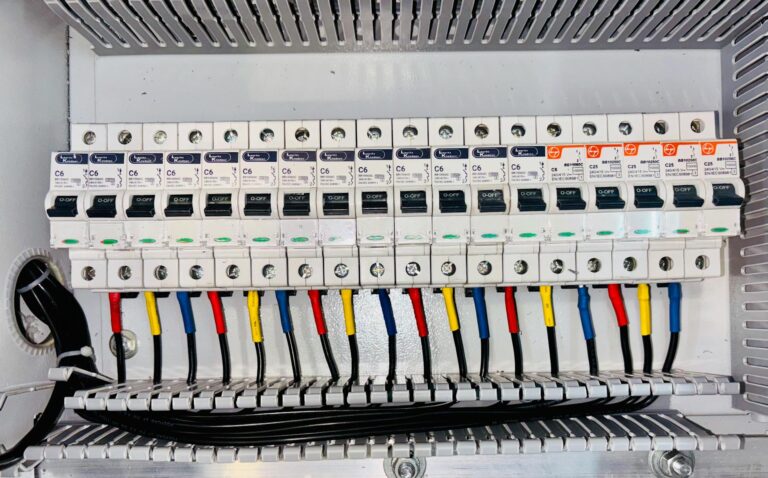
Wiring, fuse and relay sizing follows the steady current draw of the lamp bank, with extra margin for inrush current on halogen and warm-up surge on xenon. The cable carries the current, the fuse protects the cable, and the relay switches the load on a low-current trigger.
Cable size by current draw (12V automotive cable, single run under 5 metres).
- Up to 5 amps. 1.0mm sq cable, 10A fuse.
- 5 to 10 amps. 1.5mm sq cable, 15A fuse.
- 10 to 15 amps. 2.5mm sq cable, 20A fuse.
- 15 to 20 amps. 4.0mm sq cable, 25A fuse.
- 20 to 30 amps. 6.0mm sq cable, 30A fuse.
- 30 to 50 amps. 10.0mm sq cable, 50A fuse.
Fuse rating rules.
- Halogen circuits use a slow-blow fuse to absorb the 50ms inrush surge.
- LED circuits use a standard automotive blade fuse, sized at the steady draw plus 25%.
- Xenon circuits need a fuse rated for the warm-up surge, which is 2 to 3 times the steady draw.
Relay sizing.
- Halogen banks under 20 amps. Standard 30A relay.
- LED banks under 30 amps. Standard 40A relay.
- Xenon banks. Use a 40A relay for a single 35W lamp, 50A or solid-state for multi-lamp banks.
A common mistake is fitting a 30A relay to a xenon bank that draws 6 amps steady. The 30A relay handles steady use but the warm-up surge of 14 amps per lamp burns the contacts after 50 to 200 cycles. Solid-state relays handle inrush better than mechanical relays and last 10 to 50 times longer in xenon installations.
For the full wiring walkthrough, see How to Wire Tractor Lights with a Relay and How to Wire Work Lights to a 12V System with a Relay.
The Real-World Cost of Higher Power Draw
Higher work-light power draw costs money in three ways: extra fuel burn, faster battery wear, and earlier alternator failure. The cost gap between an LED and a halogen banking is small per hour but adds up over a season.
Fuel cost of carrying lighting load. Every 100 watts of constant electrical load adds about 0.13 litres per hour to a working tractor’s fuel burn (alternator efficiency 50 to 60%, diesel calorific value 35 MJ/litre). A bank of 6 by 70W halogen lamps adds 420 watts of load, which is 0.55 litres per hour. The same bank in LED at 180 watts adds 0.23 litres per hour. Across 600 working hours a year, the halogen bank costs 192 extra litres of diesel over LED. At GBP 0.85 per litre red diesel in 2026, that is GBP 163 a year per tractor.
Battery wear from heavy intermittent draw. Lead-acid batteries lose capacity faster when discharged below 50% repeatedly. A halogen lighting load with the engine off discharges a 100Ah battery in 6 to 7 hours. The same job in LED takes 14 to 16 hours. Tractors that often sit at idle with lights on (loading, hitching, livestock work) wear batteries 30 to 50% faster on halogen than on LED. A typical tractor battery costs GBP 80 to GBP 200, replaced every 4 years on LED or every 2 to 3 years on heavy halogen.
Alternator wear. A heavily loaded alternator runs hotter, and bearing wear accelerates above 80% of rated capacity. Tractors with halogen lighting banks pushing the alternator to 85 to 95% of capacity see alternator failures at 4,000 to 7,000 hours. The same machine with LED lighting and a 50 to 65% load sees alternator failures at 8,000 to 12,000 hours. Replacement alternator cost is GBP 250 to GBP 600 fitted on a typical farm tractor.
The total annual saving of running LED rather than halogen on a 6-lamp bank, on a tractor doing 600 working hours, is roughly GBP 200 to GBP 350 in fuel, plus pro-rated battery and alternator life. Across a 5-year LED service life, the cumulative saving is GBP 1,000 to GBP 1,750 per tractor, which is why the LED upgrade pays back inside 2 years on most working farms. For the buying-side view, see Cost to Fit LED Lights to a Tractor.
For the universal LED work lamps range and the universal halogen work lamps range, browse the shop.
Internal links to add when target articles publish
- /technical/add-extra-lights-tractor/ (article 10.7, P2 not yet published)
- /technical/xenon-work-lights/ (article 2.3, published)
End of article.