Amber Beacon Meaning: What a Flashing Amber Beacon Means
Amber beacon meaning: a flashing amber beacon warns of a slow, stopped or wide vehicle such as a tractor or gritter. What to do and when tractors need one.
In this guide
- What does a flashing amber beacon mean?
- What should you do when you see a flashing amber beacon?
- Which vehicles use flashing amber beacons?
- When must a tractor use an amber beacon?
- How does amber compare with other beacon colours?
- What makes an amber beacon road legal?
- Is it illegal to use an amber beacon?
- Frequently asked questions
A flashing amber beacon warns other road users that the vehicle showing it is slow-moving, stopped, or an obstruction or hazard on the road, such as a tractor, gritter, recovery truck or road works vehicle. It gives the vehicle no priority and no right of way: you do not have to pull over, but you should slow down, keep well back and pass only when it is safe.
That is the Highway Code meaning (rule 225) and the answer the driving theory test expects. The rest of this guide explains which vehicles may use amber beacons, when the law makes one compulsory on a tractor, how amber compares with the other beacon colours, and what to look for in a road-legal amber beacon.
What does a flashing amber beacon mean?
A flashing amber beacon means “slow-moving or stationary vehicle, approach with caution”. Highway Code rule 225 says amber beacons warn of a slow-moving or stationary vehicle (it gives traffic officer vehicles, salt spreaders, snow ploughs and recovery vehicles as examples) or an abnormal load.
The beacon is a warning, not an instruction. It does not mean the vehicle is on an emergency call, and it does not ask you to stop or give way. It tells you three things:
- The vehicle ahead may be travelling far below the speed of other traffic, often 25 mph or less.
- The vehicle may be wider or longer than normal, or partly blocking your lane.
- The vehicle may be stopped, working or about to pull out, turn or stop without much warning.
The theory test version of the question is “What does a flashing amber beacon mean when it’s on a moving vehicle?” The correct answer is that the vehicle is slow-moving. The usual wrong answers (a doctor’s car, a broken-down vehicle, a school crossing patrol) all belong to other lights or signs.
What a flashing amber beacon on a stationary vehicle means
On a stationary vehicle, an amber beacon marks a hazard: a recovery truck at a breakdown, a highways vehicle closing a lane, a utility van working at the kerb, or a bin lorry collecting. Expect people on foot around the vehicle, open doors, cones, and equipment in the road.
What should you do when you see a flashing amber beacon?
When you see a flashing amber beacon, slow down early and plan to be behind a much slower vehicle. Practical steps:
- Ease off early. Closing speed is the danger. A car at 60 mph closes on a tractor at 20 mph at 40 mph, roughly 18 metres every second.
- Drop back. Highway Code rule 164 advises dropping back from large vehicles, including tractors with trailers, so you can see past and the driver can see you in their mirrors.
- Watch for turning and stopping. Tractors turn into field gateways, gritters change lanes, recovery trucks pull onto verges.
- Overtake only with a clear view. A tractor with a trailer or mounted implement is longer than it looks from behind, so allow for the extra length before you commit.
- Do not pull over or stop as you would for a blue light. That can cause a collision behind you.
Which vehicles use flashing amber beacons?
The vehicles allowed to show an amber beacon are listed in regulation 11 of the Road Vehicles Lighting Regulations 1989 (RVLR). The list covers vehicles that are slow, wide, working on the road or dealing with breakdowns:
| Vehicle type (RVLR reg 11) | Everyday examples |
|---|---|
| Vehicle with a maximum speed not exceeding 25 mph, or a trailer it tows | Tractors with a 40 km/h maximum speed, self-propelled sprayers, forklifts and plant on the road, mobility scooters |
| Vehicle over 2.9 m overall width (including load) | Combine harvesters, wide implements, wide loads |
| Road clearance vehicle | Gritters, snow ploughs |
| Vehicle testing, maintaining, cleansing or watering roads | Road sweepers, line markers, highways inspection vans |
| Vehicle working on apparatus in, on, under or over a road | Utility, telecoms and street lighting vans |
| Breakdown vehicle | Recovery trucks and patrol vans |
| Refuse collection vehicle | Bin lorries |
| Vehicle used for escort purposes | Abnormal load escorts |
| Vehicle authorised by a special types order (section 44) | Abnormal indivisible load vehicles |
| Other listed uses | Customs fuel testing, surveying, vehicle removal and clamping |
National Highways traffic officer vehicles also use flashing amber lights, which is why Highway Code rule 219 tells you to look out for them alongside the emergency services.
Amber beacons on farm vehicles
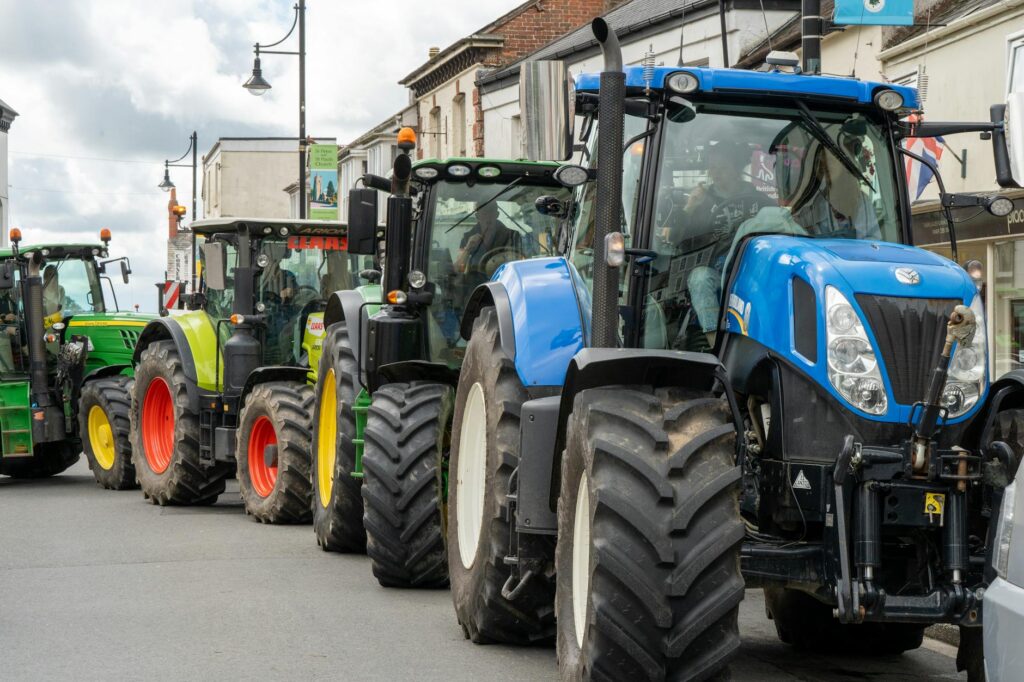
Farm machinery fits the amber list in two ways. A tractor whose maximum speed by construction is 40 km/h (24.85 mph) falls into the “not exceeding 25 mph” group, as long as it genuinely cannot go faster than 25 mph. Combines, wide sprayers and tractors carrying wide implements are often over 2.9 m wide. A combine on the road at transport width, behind a hedge on a single-track lane, is exactly the hazard the beacon exists to warn about.
When must a tractor use an amber beacon?
A tractor must use a lit amber beacon on an unrestricted dual carriageway if it has 4 or more wheels and a maximum speed not exceeding 25 mph. This comes from RVLR regulation 17, and regulation 26 adds that the beacon must be kept lit while the vehicle is on that road.
The details matter:
- “Unrestricted dual carriageway” means a dual carriageway where vehicles may lawfully be driven at more than 50 mph (RVLR regulation 3). A dual carriageway with a 50 mph or lower limit is not covered by the obligation, though using the beacon there is still sensible.
- “Maximum speed” is the speed the vehicle cannot exceed by its construction, on the level, fully laden (Construction and Use Regulations). It is the design speed, not the speed you happen to be driving at. A tractor built for 50 km/h does not become a 25 mph vehicle by driving slowly.
- The beacon can be on the tractor or on the trailer it is towing, as long as the light from at least one beacon is visible from any point at a reasonable distance (RVLR Schedule 16).
- Two exemptions apply: vehicles first used before 1 January 1947, and a vehicle that is only crossing the dual carriageway in the quickest manner practicable.
The full rule, with the theory test wording, is covered in our guide to the amber flashing beacon on a dual carriageway. For every situation where farm vehicles need beacons, see when amber beacons are legally required on tractors.
Do tractors need a beacon on single carriageways?
No law requires a beacon on a single carriageway, but regulation 27 allows an amber beacon to be lit whenever it is “necessary or desirable to warn persons of the presence of the vehicle”. On a fast A-road, a winding lane at dusk, or a long climb with a loaded trailer, that test is easy to meet. Running the beacon on every public road journey is the safe habit.
What about tractors faster than 25 mph?
A tractor with a maximum speed above 25 mph (for example a 50 km/h or 60 km/h model) is not caught by regulation 17. It is also outside the “not exceeding 25 mph” group in the regulation 11 amber list, so it may only be fitted with an amber beacon if it fits another listed category, for example when the tractor or its load is over 2.9 m wide. The same goes for a trailer it tows. If you are unsure, ask your dealer or the DVSA.
How does amber compare with other beacon colours?
Amber is the only beacon colour for slow, wide and working vehicles. The other colours belong to specific users, and fitting the wrong one is an offence. In Great Britain:
| Beacon colour | Who may use it | What it means to you |
|---|---|---|
| Amber | Slow, wide, breakdown, road works and the other vehicles listed above | Hazard or slow vehicle, approach with caution |
| Blue | Emergency vehicles only (police, fire, ambulance and others listed in RVLR, including bomb disposal and blood service vehicles) | Emergency, let it pass safely |
| Green | Doctors registered with the General Medical Council, on emergency calls | Doctor attending an emergency, give way if you safely can |
| Yellow | Vehicles at airports, must not be lit on a road | Not used on public roads |
Red is not a general beacon colour: RVLR bans red light to the front apart from a few exceptions, such as the red and white mast beacon on a fire service control vehicle. Purple, white and other colours are not permitted as warning beacons. The full list, with the legal basis for each, is in our guide to beacon colours explained.
What makes an amber beacon road legal?
An amber beacon is road legal in Great Britain when it meets RVLR Schedule 16 and is fitted to a vehicle allowed to show amber. Schedule 16 sets four practical requirements:
- Height: the centre of the beacon at least 1,200 mm above the ground.
- Visibility: light from at least one beacon visible from any point at a reasonable distance around the vehicle and any trailer. If a high trailer or load hides the cab beacon from behind, fit another beacon further back.
- Flash rate: between 60 and 240 flashes per minute, at equal intervals.
- Colour: amber, for the vehicles listed in regulation 11.
RVLR itself sets no intensity requirement for beacons, which is why the approval marks matter when you buy.
ECE R65 approval
ECE R65 is the UN regulation for special warning lamps. An R65 mark shows the beacon has been tested for colour, intensity at set angles and flash behaviour. It comes in 2 classes: Class 1 beacons have one level of intensity, and Class 2 beacons have two levels, a brighter day setting and a dimmer night setting. The Department for Transport’s Traffic Signs Manual Chapter 8, which governs road works, says roof-mounted amber beacons should comply with R65. Look also for an R10 mark, which covers electromagnetic compatibility and matters on tractors with GPS and ISOBUS. Our ECE R65 beacons guide explains how to read the marks.
LED or halogen
Rotating halogen beacons use an H1 bulb (55 W at 12 V, 70 W at 24 V) and a motor-driven reflector. LED beacons have no moving parts, draw a fraction of the current, and usually offer several flash patterns, which is why most new tractors and replacements now use them. Browse our amber tractor beacons or go straight to LED tractor beacons.
Mounting and voltage
Tractor beacons fit on a DIN pole, a flexi DIN pole that bends on contact with branches and door frames, a magnetic base or a fixed bolt-on base. Most tractors run 12 V, while many trucks and some larger machines run 24 V. Many LED beacons are multi-volt and run on either, but halogen beacons are voltage-specific. The wider range of road and site beacons is in our universal beacons category.
Is it illegal to use an amber beacon?
It is illegal to fit or use an amber beacon on a vehicle that is not in the regulation 11 list, and illegal to light it except as regulation 27 allows. Regulation 27 permits an amber beacon to be lit at the scene of an emergency, when it is necessary or desirable to warn of the vehicle’s presence, and for breakdown and escort vehicles while they are doing that work. An amber beacon gives the driver no exemption from speed limits, red lights or any other traffic law. A private car with an amber beacon used for show is breaking the rules.
Frequently asked questions
What is a flashing amber beacon?
A flashing amber beacon is a lamp that sends a flashing or rotating amber light all the way round the vehicle (RVLR defines a warning beacon as emitting light throughout 360 degrees). It marks a slow-moving, wide, stopped or working vehicle and tells other drivers to approach with caution.
Do I have to pull over for a flashing amber beacon?
No. You only need to give way to emergency vehicles showing blue lights, and to doctors with green beacons where you safely can. For an amber beacon, slow down, keep your distance and overtake only when it is safe.
What does a flashing amber beacon on a vehicle mean in the theory test?
The theory test answer is that the vehicle is slow-moving. Related questions ask which vehicle must show one on a dual carriageway: the answers are vehicles with a maximum speed of 25 mph or less, such as tractors and mobility scooters.
What does an amber light mean on a dashboard?
An amber warning light on a vehicle dashboard is a different thing: it flags a fault or reminder that needs checking soon, while red means stop safely. An amber beacon is the roof-mounted warning light covered in this guide.
Can I fit an amber beacon to my car or van?
Only if the vehicle is used for one of the purposes listed in RVLR regulation 11, such as breakdown recovery, road works, utility work, refuse collection or escorting. A beacon on an ordinary private car is not permitted.