Rear Fog Lights: When to Use Them, UK Law, Bulbs and MOT
Rear fog lights: use them when visibility drops below about 100 metres and switch off when it improves. UK law, fitting rules, P21W bulbs and the MOT.
In this guide
- What Are Rear Fog Lights
- Why Are Vehicles Fitted With Rear Fog Lights
- When to Use Rear Fog Lights
- Why Rear Fog Lights Must Not Be Left On
- The Rear Fog Light Symbol
- UK Law: Which Vehicles Need Rear Fog Lights
- How Rear Fog Lights Must Be Fitted
- Rear Fog Light Bulbs
- Rear Fog Lights and the MOT
- How to Replace a Rear Fog Light Bulb
- Rear Fog Lights on Tractors and Trailers
- Frequently asked questions
Rear fog lights are bright red lamps at the back of a vehicle that you should switch on only when visibility is seriously reduced, generally when you cannot see more than 100 metres ahead, and switch off as soon as it improves. They exist so drivers behind can see you in thick fog, falling snow or heavy spray, when ordinary tail lights disappear.
That is the short answer, and it comes straight from the Highway Code (rules 226 and 236). The rest of this guide explains why vehicles are fitted with rear fog lights, how they differ from tail and brake lights, the dashboard symbol, the fitting rules under the Road Vehicles Lighting Regulations 1989 (RVLR), the bulbs they use, what the MOT checks, and what applies to tractors and trailers.
What Are Rear Fog Lights
A rear fog light is a red, rear-facing lamp designed to make a vehicle more readily visible from behind in conditions of seriously reduced visibility. That is close to the legal definition in RVLR regulation 3. It is far brighter than a tail light and is switched on and off by the driver with its own switch, separately from the other rear lamps.
Every car has several red lamps at the back, and they are easy to confuse:
- Rear position lamp (tail light): a dim, steady red light that comes on with the sidelights and headlights. Usually a 5W filament or a low-power LED.
- Stop lamp (brake light): a brighter red light that comes on only when the brake pedal is pressed. Usually 21W.
- Rear fog lamp: a bright red light that stays on until you switch it off. Usually 21W, in a lamp designed to throw that light out to the rear with high intensity.
Most cars and vans have the rear fog lamp built into one of the rear lamp clusters or into the rear bumper. Older vehicles, trailers and farm machinery often carry a separate, standalone rear fog lamp bolted under the bumper or on a lighting board.
Why Are Vehicles Fitted With Rear Fog Lights
Vehicles are fitted with rear fog lights so that following drivers can see them in fog early enough to slow down. Fog scatters light, and a 5W tail light that is easy to see on a clear night fades to nothing within a short distance in thick fog. A rear fog lamp is many times brighter, so it punches through far enough to give the driver behind a warning.
Rear-end collisions in fog follow a familiar pattern: a driver closes on a slower vehicle faster than they realise because they cannot see it until the last moment. A bright rear fog lamp gives that driver an earlier cue. At 50 mph a car covers roughly 22 metres every second, so every extra metre of warning matters.
That is also why they became compulsory. Since 1 April 1980, most motor vehicles in the UK must have at least 1 rear fog lamp (the details are in the legal section below).
When to Use Rear Fog Lights
Use rear fog lights when visibility is seriously reduced, which the Highway Code describes as generally when you cannot see for more than 100 metres (328 feet). That is about the length of a football pitch. Switch them off as soon as visibility improves.
What the Highway Code Says
- Rule 226: you MUST use headlights when visibility is seriously reduced, generally when you cannot see for more than 100 metres. You may also use front or rear fog lights, but you MUST switch them off when visibility improves.
- Rule 236: you MUST NOT use front or rear fog lights unless visibility is seriously reduced, because they dazzle other road users and can obscure your brake lights. You MUST switch them off when visibility improves.
- Rule 114: repeats that fog lights must not be used unless visibility is seriously reduced, and that you must not use any lights in a way that dazzles other road users.
The legal basis for these rules is RVLR regulations 25 and 27. Using fog lamps when visibility is not seriously reduced is an offence, not just bad manners.
Fog, Snow, Rain and Spray
The 100 metre test applies whatever is causing the poor visibility. Thick fog is the obvious case, but heavy falling snow and dense motorway spray can also cut visibility below 100 metres. Ordinary rain, drizzle and light mist usually do not, and in those conditions rear fog lights cause more problems than they solve.
When to Switch Them Off
Switch rear fog lights off the moment you can see further than about 100 metres. If a car is following closely behind you in fog, its driver can already see your normal tail lights, so the fog lamp may only be dazzling them. Many drivers forget they are on because the dashboard light is small. Make a habit of checking the amber fog symbol whenever the fog thins out.
A Practical Rule
If you can clearly see the tail lights of the vehicle in front, the driver behind you can probably see yours. If those tail lights keep fading out or vanish altogether, your rear fog lights are doing a useful job.
Front fog lamps follow the same Highway Code rules but do a different job. For the full picture on both sets, read our guide on when to use fog lights in the UK.
Why Rear Fog Lights Must Not Be Left On
Rear fog lights left on in clear conditions cause 2 problems: dazzle and brake-light masking.
- Dazzle: at normal following distances on a clear or wet night, a rear fog lamp is uncomfortably bright. It glares off a wet road and makes it harder for the driver behind to judge distance.
- Brake-light masking: a rear fog lamp is roughly as bright as a brake light, and on many cars it sits close to one. With the fog lamp on, the change in brightness when you brake is much smaller, so the driver behind is slower to notice you slowing down. This is exactly what rule 236 means by “can obscure your brake lights”.
Rear fog lamps should also never be used as parking lights. If you stop at the roadside in fog, use your sidelights, and your hazard warning lights if you are causing an obstruction.
The Rear Fog Light Symbol
The rear fog light symbol is an amber (orange or yellow) warning light on the dashboard. It shows a lamp shape facing to the right with 3 straight horizontal lines coming out of it, crossed by a single wavy vertical line that represents fog. It lights whenever the rear fog lamp is on.
The front fog light symbol is green, faces the opposite way, and has lines angled downwards. The switch or stalk position for the rear fog lamp usually carries the same amber-style symbol. For a full side-by-side description of both symbols, how the switches work and what the colours mean, see our guide to the rear fog light symbol.
The dashboard symbol is not just helpful, it is required: RVLR requires a circuit-closed tell-tale for an obligatory rear fog lamp, and the MOT fails a missing or inoperative rear fog tell-tale as a major defect.
UK Law: Which Vehicles Need Rear Fog Lights
Under RVLR Schedule 1, a motor vehicle with 3 or more wheels must have at least 1 rear fog lamp if it was first used on or after 1 April 1980. A trailer must have one if it was manufactured on or after 1 April 1980. Several exemptions apply.
| Vehicle | Rear fog lamp required? |
|---|---|
| Car, van, lorry or bus first used on or after 1 April 1980 | Yes, at least 1 |
| Motor vehicle first used before 1 April 1980 | No (optional lamps may be fitted) |
| Motor vehicle with a maximum speed of 25 mph or less | No |
| Agricultural vehicle or works truck first used before 1 April 1986 | No |
| Vehicle with an overall width of 1,300 mm or less | No |
| Trailer manufactured on or after 1 April 1980 (wider than 1,300 mm) | Yes, at least 1 |
| Agricultural trailer or works trailer | No (exempt from the obligatory lamp) |
Exempt vehicles may still have rear fog lamps fitted, and where they are fitted they must meet the colour and wiring rules below.
How Rear Fog Lights Must Be Fitted
RVLR Schedule 11 sets the fitting rules for rear fog lamps. The key points are:
| Requirement | Rule |
|---|---|
| Number | 1 obligatory. No more than 2 on vehicles first used from 1 April 1980 (or manufactured from 1 October 1979) |
| Position if only 1 fitted | On the centre line or the offside (the driver’s side in the UK) |
| Position if 2 fitted | No lateral requirement; they must form a matched pair on motor vehicles first used from 1 April 1986 and trailers made from 1 October 1985 |
| Height above ground | 250 mm minimum; 1,000 mm maximum (2,100 mm for agricultural vehicles, engineering plant and motor tractors) |
| Distance from stop lamp | At least 100 mm between the light-emitting surfaces |
| Colour | Red |
| Approval | Must carry an approval mark (E-mark) |
| Wiring | Must not light up when the brakes are applied |
| Tell-tale | A circuit-closed tell-tale (dashboard warning light) must be fitted |
The offside rule is why so many UK cars have a single rear fog lamp on the right. On a UK road the offside is nearest the centre of the road, so the lamp is easiest to see for traffic behind and is kept well away from the nearside brake light. Imported cars built for right-hand traffic sometimes have the single fog lamp on the left, which is worth checking on a grey import.
The 100 mm separation from the stop lamp is there for the brake-masking reason described above: if the 2 bright lamps were side by side, a driver could not tell braking from fog lamp.
On most cars the rear fog switch only works once dipped headlights (or front fog lamps) are on, which is how the European lighting installation rules are written. Some older vehicles and aftermarket installations do not do this.
Rear Fog Light Bulbs
Most rear fog lights with a replaceable bulb use a P21W (trade code 382), a 21W single-filament bulb on a BA15s bayonet base. Some modern clusters use a wedge bulb, and many newer cars use LEDs built into the lamp that cannot be changed separately.
| Bulb | Trade code | Base | Wattage | Where you find it |
|---|---|---|---|---|
| P21W | 382 | BA15s bayonet (pins level) | 21W | Most cars, vans, older tractors, standalone fog lamps |
| PR21W | None common | BAW15s bayonet (angled pins) | 21W | Some clusters that use a red-glass bulb behind a clear lens |
| W21W | 582 | W3x16d wedge | 21W | Some modern European clusters |
| P21W 24V | 241 | BA15s bayonet | 21W | Lorries, buses and 24V plant |
| Integrated LED | None | Built into the lamp | Typically a few watts | Many cars from the 2010s onwards, LED trailer lamps |
Always check the handbook or the old bulb before buying, because a bulb with the wrong pin layout will not lock into the holder. Our guide to P21W 382 bulbs covers the base, codes and replacement in more detail, and you can find replacement bulbs in our standard miniature bulbs range.
12V or 24V
Cars, vans and most tractors run on 12V. Lorries, many buses and some plant run on 24V. A 12V bulb in a 24V system blows almost immediately, and a 24V bulb in a 12V system glows weakly. Match the bulb or lamp to the vehicle voltage.
LED Rear Fog Lights
Complete LED rear fog lamps draw a small fraction of the current of a 21W bulb, last far longer, and cope with vibration better because there is no filament. They are a sensible choice for trailers, plant and tractors. Choose a complete lamp that carries an E-mark for the rear fog function (usually marked F on the lens). Browse our LED rear lamps for combination and standalone units.
Rear Fog Lights and the MOT
The MOT checks 1 rear fog lamp: the obligatory one, which must be fitted to the centre or offside of vehicles first used on or after 1 April 1980. If your car has 2, the nearside one is not inspected.
| Defect | MOT category |
|---|---|
| Obligatory rear fog lamp missing or not working | Major (fail) |
| LED lamp with more than half of its light sources out | Major (fail) |
| LED lamp with up to half of its light sources out | Minor |
| Lens damaged so that the light is affected | Major (fail) |
| Lens damaged without affecting the light | Minor |
| Lamp insecure / likely to fall off | Minor / Major |
| Fog lamp switch not working as required | Major (fail) |
| Wrong colour (not red) or wrong position | Major (fail) |
| Rear fog tell-tale missing or not working | Major (fail) |
A blown bulb is the usual cause of a rear fog fail and the easiest to fix. A failed tell-tale is often a blown dashboard bulb or, on some cars, a symptom of a fog lamp circuit fault.
How to Replace a Rear Fog Light Bulb
On most cars and vans, replacing a rear fog light bulb takes 5 to 10 minutes with a screwdriver or trim tool.
- Switch on dipped headlights and the rear fog lamp, and confirm which lamp is out.
- Open the boot or tailgate and remove the trim panel or access cover behind the lamp. Bumper-mounted fog lamps are usually reached from underneath.
- Twist the bulb holder anticlockwise and pull it out.
- Push the P21W in slightly, twist anticlockwise and pull it out of the holder.
- Fit the new bulb (push in, twist clockwise until it locks) and refit the holder.
- Test the lamp and check the amber tell-tale lights before refitting the trim.
If the new bulb does not light, check the fuse, look for green corrosion in the holder, and check the earth. Where the fog lamp works but the tell-tale does not, the fault is on the dashboard side.
Rear Fog Lights on Tractors and Trailers
The rules for farm vehicles are not the same as for cars, and they catch people out.
Tractors
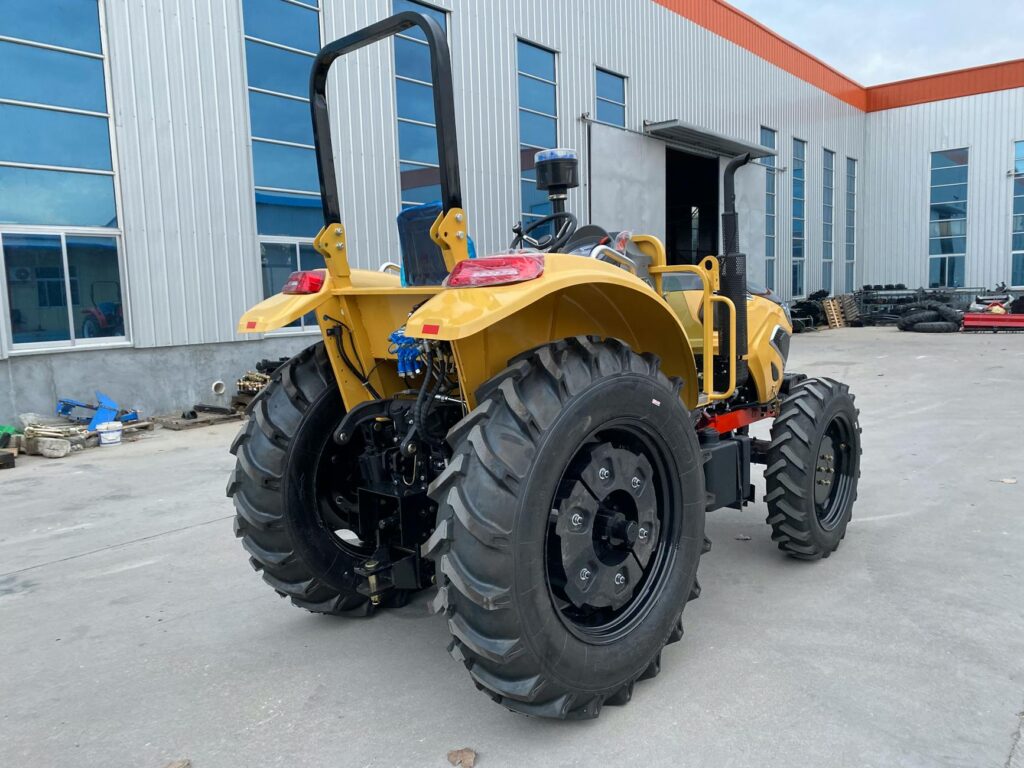
An agricultural tractor first used on or after 1 April 1986 needs an obligatory rear fog lamp, unless its maximum speed is 25 mph or less. A tractor first used before 1 April 1986 is exempt. Where fitted, the lamp may be mounted as high as 2,100 mm on an agricultural vehicle, which suits a lamp on the cab or a rear mudguard bracket. For more on tractors specifically, see our guide to tractor fog lights.
Agricultural Trailers
Agricultural trailers are exempt from the obligatory rear fog lamp under RVLR Schedule 1, although road trailers and most general-purpose trailers manufactured since 1 April 1980 and wider than 1,300 mm do need one. Many farm trailers have one anyway, and it is good practice on a trailer that travels lanes in winter. If one is fitted, it must be red, approved and wired so it does not light with the brakes.
Trailer Wiring
On a 7-pin 12N socket and on a 13-pin socket, the rear fog lamp feed is pin 2. A trailer fog lamp that does not work is usually a corroded pin, a broken earth, or a towing vehicle whose fog circuit is not connected through to the socket.
Wide Implements
When a mounted implement or load hides the tractor’s rear lamps, those lamps must be repeated on the implement or on a lighting board. A board with a rear fog lamp should place it on the offside or centre, like a permanently fitted lamp.
Frequently asked questions
When should you use rear fog lights in the UK?
Only when visibility is seriously reduced, generally when you cannot see more than 100 metres ahead, in fog, heavy falling snow or dense spray. Switch them off as soon as visibility improves (Highway Code rules 226 and 236).
Why does my car only have one rear fog light?
UK law requires only 1 rear fog lamp, fitted on the centre line or the offside. A single lamp on the driver’s side keeps it away from the nearside brake light and makes it easiest to see for following traffic. Some cars fit 2 as a matched pair.
Is a rear fog light an MOT failure?
Yes. On vehicles first used from 1 April 1980, a missing or inoperative obligatory rear fog lamp, a faulty fog switch or a missing or inoperative tell-tale are all major defects. Only the centre or offside lamp is inspected.
Can you get fined for using rear fog lights?
Yes. Using fog lamps when visibility is not seriously reduced breaks RVLR, and the Highway Code says you MUST NOT do it. Police can deal with it as a lighting offence.
Can I use rear fog lights in heavy rain?
Only if the rain or spray cuts visibility to around 100 metres or less. In normal rain they dazzle drivers behind, reflect off the wet road and hide your brake lights, so leave them off.